Health care would be financed primarily by employers, through a 6 percent payroll tax
With just weeks until the national election, U.S. Rep. James Langevin has unveiled
a plan for universal health coverage that would put all Americans in a single
insurance pool administered by the government, which would negotiate plans and
rates.
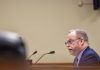
“America is facing a health care crisis,” Langevin said at a news conference last Tuesday at Hasbro Children’s Hospital. “It’s time to make the system work for all Americans. We cannot continue on this path.”
A modernized health plan: Supporting cost management and the employee experience.
The Surest health plan came from a group of innovators wondering: What if health care…
Learn More
Under Langevin’s plan, everyone who is not in a federal health plan already would be required to enroll in a new system, the American Health Benefits Program, which would offer a range of private plans with different insurers.
Health care would no longer be an employment benefit, but it would still be financed primarily by employers, through a new 6 percent payroll tax. Employees, for their part, would pay up to 28 percent of the premiums, with subsidies for the poor.
A Democrat seeking a third term in Congress, Langevin said health care has been his top priority all along, and this plan is the product of years of research and discussions by a work group he established – a point confirmed by Edward J. Quinlan, president of the Hospital Association of Rhode Island.
Arthur Barton, a Republican, and Edward Morabito, an Independent, are running against Langevin.
Langevin said he has introduced a bill to implement his plan, H.R. 4964, though he is still seeking co-sponsors and acknowledged it was unlikely the measure would see any action before the new Congress comes in.
“It will take some time, but it’s beginning the dialogue,” Langevin said. Asked about the timing, so close to the election, he strongly denied any suggestion that politics was at play. “It’s certainly not a campaign pitch,” he said of his proposal.
Langevin’s plan, by his own admission, is one of “a couple dozen” floating about Congress – not to mention the high-profile, and starkly different, plans by the Bush and Kerry presidential campaigns. President Bush’s plan would use tax credits to encourage people to pay for their own health care out of health savings accounts, with high-deductible insurance plans as a backup.
Sen. John F. Kerry’s plan would expand Medicaid eligibility to a segment of the working poor (as Rhode Island has already done), create a government reinsurance program for catastrophic costs, and allow small businesses to buy into the Federal Employee Health Benefits Program.
As Langevin noted in unveiling his single-payer plan, about 45 million Americans are currently uninsured, up from 31 million in 1987. The Bush plan would extend coverage to 2 million to 10 million of those people, depending on whose figures one accepts; Kerry would cover 27 million people, but at six to 10 times the cost.
Asked about Kerry’s plan, Langevin said he would “take that over doing nothing,” but it doesn’t cover all Americans. However, Langevin said, “I would be pleased to work with a President Kerry on the issue of universal health insurance.”
While Kerry’s plan would bring new members into the Federal Employee Health Benefits Program, which covers about 8 million federal employees, retirees and their dependents, as well as members of Congress, Langevin’s plan would create an entirely new entity, modeled on the federal benefits program, to cover the entire population. That agency would not only negotiate plans with insurers, but would also collect co-pays and pay the insurers.
The plan has many advantages, Langevin said: It would make insurance totally portable and independent of a person’s employment status; it would cost employers less than they typically pay now (at least 7 percent of payroll, Langevin said); and by requiring all Americans to participate, it would greatly expand the risk pool, cutting costs.
Quinlan, of the hospital association, introduced Langevin at his press conference, and though he didn’t explicitly endorse the details of Langevin’s plan, he did praise the congressman for putting forward a “bold” proposal at a time when health care is viewed as “radioactive” in some political circles.
“I think the congressman has looked at that mindset and decided, ‘I’m going
to change that,’” Quinlan said.