
PROVIDENCE – University of Rhode Island economist Leonard Lardaro says the state’s economic health depends less on what it does than on how well the COVID-19 pandemic is managed, changes in national fiscal policy and the ability of the Federal Reserve to maintain stability in financial markets.
“In other words, it is largely out of our hands,” wrote Lardaro in June’s Current Conditions Index report, which was released early Monday morning.
ISO 9001:2026: A Practical Opportunity to Build for What’s Next
For Rhode Island manufacturers, ISO 9001 has been much more than a certificate on the…
Learn More
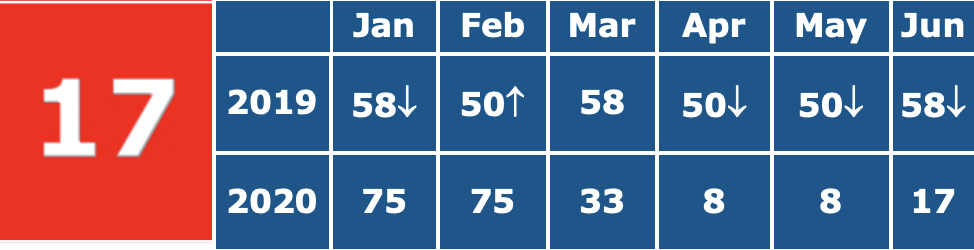
As previously reported, Lardaro wrote that the pandemic is resulting in an exogenous shock to the economy, one that no one could have predicted and could take Rhode Island three to five years to recover from. The state in June had a CCI value of 17, marking a 41-point decrease from last June, but an increase from May and April’s Index of just 8.
Only two of the 12 CCI indicators improved in June, compared to this same time last year, which included single-unit permits rising at double-digit rates, which reflect new home construction. Lardaro said this improvement is likely due to lower interest rates, which he called “an ironic by-product” of the coronavirus crisis.
The second improving indicator included manufacturing wages, which also improved in May’s CCI report. However, Lardaro said it’s nothing to be excited over.
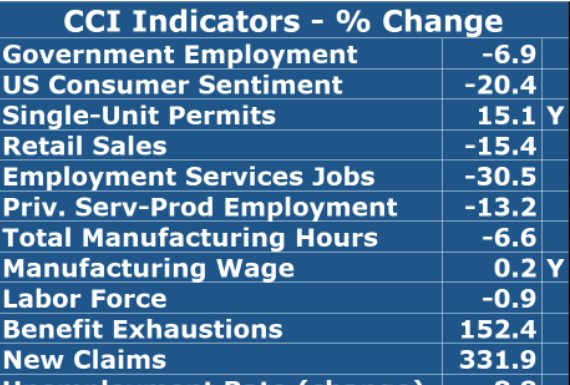
“While this might sound encouraging, it is not,” wrote Lardaro, who explained that he chose not to discuss this as an issue in May’s CCI report because he didn’t want to continue to “pile on the bad news. The manufacturing wage, which is an average, rose because many of the jobs lost [in May and June] were lower-paying, service-sector jobs. When you eliminate large numbers of below-average values, the average necessarily rises, hardly a cause for celebration in this context.”
Lardaro said that Rhode Island has never meaningfully defined itself as a post-manufacturing economy, even though it has been since the tail end of 1987. He wrote that the state’s ability to make the transition is hindered not only by what he called the “ineffectiveness of the state government,” but that the economic status of the state now largely depends on managing the pandemic and national factors.
Retail sales, which was once the CCI’s best indicator, fell by an additional 15.4% in June, which also follows a 22.3% decrease in May and 17% decrease in April.
Much like Lardaro wrote last month, to examine the full scope of the slight improvements during the current health crisis, Lardaro examined the CCI indicators by monthly changes. When examining how the indicators changed from May to June, six indicators improved.
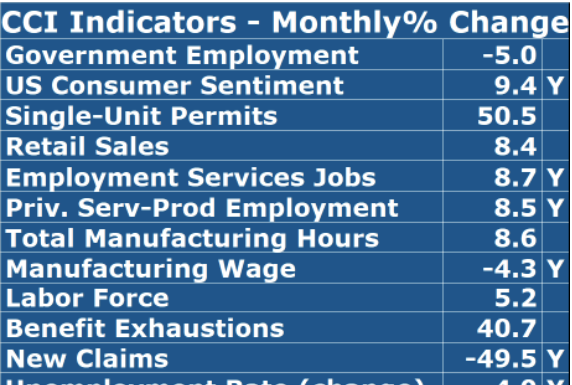
“We are comparing here to an economy close to a dead stop, which tends to make monthly changes large,” wrote Lardaro. “Let’s hope the monthly progress, while sadly spectacular, is sustained in spite of the host of obstacles we face.”
These improved indicators from May to June included U.S. consumer sentiment, employment service jobs, private service-production employment, manufacturing wage, new claims and the unemployment rate.
“While still saddled with highly depressed levels of economic activity, [Rhode Island’s economy] continued to make further progress as more and more segments moved beyond recent shutdown levels,” wrote Lardaro.
Year-over-year changes in Rhode Island’s CCI indicators:
- Government employment declined 6.9%
- U.S. consumer sentiment declined 20.4%
- Single-unit permits increased 15.1%
- Retail sales declined 15.4%
- Employment services jobs declined 30.5%
- Private service-production employment declined 13.2%
- Total manufacturing hours declined 6.6%
- The manufacturing wage increased 0.2%
- The labor force declined 0.9%
- Benefit exhaustions increased 152.4%
- New claims increased 331.9%
- The unemployment rate increased 8.8 percentage points.
Alexa Gagosz is a PBN staff writer. Contact her by emailing Gagosz@PBN.com.