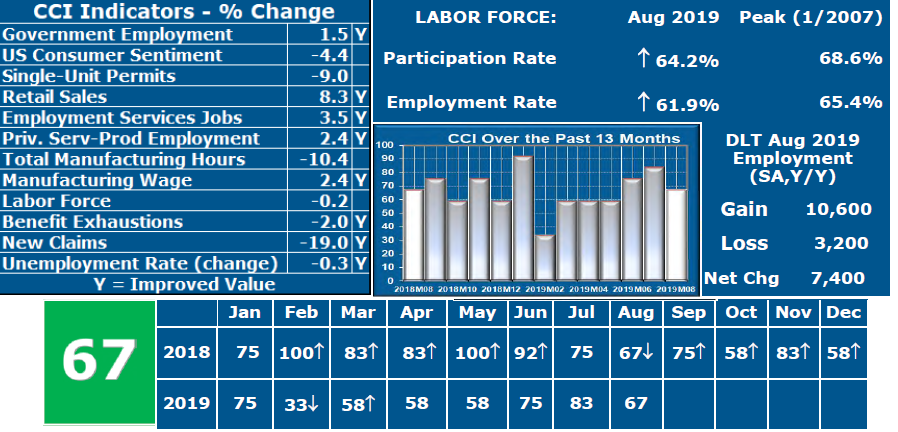
PROVIDENCE – The state’s current conditions index for August matched its value from one year ago at 67, a decline from 83 one month prior.
Despite a slowdown in August, Rhode Island’s economy didn’t weaken as much as the numbers indicate, University of Rhode Island economist Leonard Lardaro said Monday.
A modernized health plan: Supporting cost management and the employee experience.
The Surest health plan came from a group of innovators wondering: What if health care…
Learn More
A CCI value below 50 signals contraction while a value above 50 reflects expansion. July has been the only month this year to post a value exceeding its year-over-year mark.
August’s performance included sustained momentum in economic indicators that only recently began to show improvement, although just two of the five leading indicators improved, Lardaro said.
Of the 12 indicators, eight improved. Notable performances include surges in monthly employment and labor force participation rates, and improvements in benefit exhaustions and new claims for unemployment insurance.
Retail sales, which Lardaro calls the “star indicator,” pushed past 8% in August, while employment service jobs also posted its fifth consecutive increase.
“At this point, Rhode Island’s economy might well find itself at an inflection point. Will we sustain the uptick in momentum of the last three months or will we revert back to diminished momentum of the past several years?” Lardaro wrote. “The answer for Rhode Island lies almost entirely with how well the national and Massachusetts economies perform in the upcoming months.”
Still, a drop in manufacturing hours, which fell more than 10% from last year, is cause for concern, Lardaro said.
“Particularly disturbing is the fact that the manufacturing workweek has now fallen on a yearly basis for all but one month since last October,” he wrote.
The report also noted that single-unit permits, which are a measure of new home construction, fell by 9 percent from last year after climbing for the last several months.
August CCI indicator changes year over year:
- Government employment increased 1.5%
- U.S. consumer sentiment dropped by 4.4%
- Single-unit permits fell by 9%
- Retail sales climbed by 8.3%
- Employment service jobs increased 3.5%
- Private service-producing employment increased 2.4%
- Total manufacturing hours fell 10.4%
- The manufacturing wage increased 2.4%
- The labor force dropped by 0.2%
- Benefit exhaustions decreased by 2%
- New claims fell by 19%
- The unemployment rate dropped by 0.3%
Elizabeth Graham is a PBN staff writer. Email her at Graham@PBN.com.