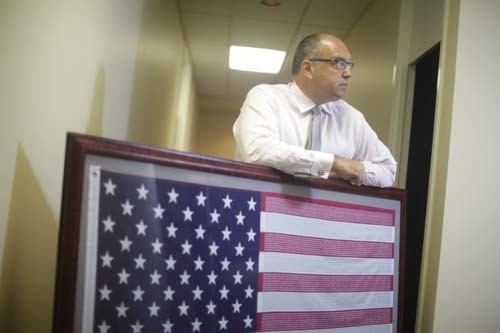
During the last nine years, lawyer Donald Migliori and his team have interviewed hundreds of people and assembled millions of pages of documents. The partner at Motley Rice’s Providence office has missed his children’s birthday parties and karate belt promotions and spent hours traveling between Rhode Island and New York and Washington. Now the finish line may be in sight.
In November, Migliori has a date at the U.S. District Court for Southern New York. There he will represent the last family still suing over the terrorist attacks of Sept. 11 in a closely watched case.
“It’s a lawsuit that’s got the whole world looking at it,” Migliori said recently.
Migliori represents the family of Mark Bavis, who died when United Airlines Flight 175 slammed into the World Trade Center a decade ago. The family filed suit in 2002, alleging that United Airlines failed in its duty to protect Bavis, a 31-year-old scout for the National Hockey League’s Los Angeles Kings and a former assistant hockey coach at Brown University. The family has little interest in settling, saying that a settlement will not publicly explain how the airline security system failed Bavis on Sept. 11, 2011.
In choosing to pursue the trial – rather than settle through a compensation fund established by Congress – the family is banking on jurors to find United Airlines and its then-security contractor, Huntleigh USA, liable for Bavis’ death. And they are relying on Motley Rice to win the right to unveil troves of information about Sept. 11 now secret by court order.
Migliori says the ramifications are sweeping. About half the people his law firm interviewed were never quizzed by law enforcement, meaning their conversations never found their way into official government reports. Migliori says no report offers as detailed a picture of airline security checkpoints on Sept. 11 as the account Motley Rice has assembled. And no investigation had such sweeping subpoena powers as the ones Congress granted the relatives of victims of the terrorist attacks.
Some argue that the family’s pursuit will never achieve meaningful public disclosure. Last year, Kenneth Feinberg, who served as special master of the compensation fund, told The New York Times it was “unrealistic” to expect that the Bavis case will compel disclosure.
Even if the family does win the case, the response by the public, Congress and airlines is a wild card, said John Goldberg, a law professor at Harvard Law School.
“Just getting the information out doesn’t mean anybody has to do anything about it,” he told Providence Business News.
Still, Goldberg said he views the Bavis case as a legitimate use of the civil justice system built upon the tenet of holding others responsible for their actions.
And it appears the family is genuine in its quest to seek answers. Rebuffing settlement talks for a decade and pursuing a case for nine years requires great persistence and brings a rollercoaster of emotions, Goldberg said.
Make no mistake though; the case is also about money. Migliori said a major financial payout by the defendants is a necessity. United Airlines, he said, should not be able to “just write a check and make it go away.” The lawyer declined to say what the Bavis family seeks but said the money awarded to families who settled through the taxpayer-supported Victim Compensation Fund failed to represent a fair settlement. The fund awarded an average $2.1 million per death.
“There has to be compensation that says we made a mistake here and we’re acknowledging the cost of that mistake,” Migliori said.
It is a route taken by few others. The compensation fund handled 2,880 claims from family members of victims and 2,680 from those injured in the attacks or related rescue operations. In the end, the fund paid out $7 billion.
Shortly after Congress set up the fund, a federal judge appointed Migliori to serve as the liaison to the 96 families choosing not to partake in settlements. He formally went on to represent 56 directly in cases.
The families, he said, turned to South Carolina-based Motley Rice because of the firm’s expertise in handling large cases against big corporations. The firm played a key role in winning a lawsuit in 1998 against American tobacco firms brought by the attorneys general of 46 states, including Rhode Island. That case forced the companies to pay $246 billion and generated a windfall for Motley Rice.
The firm also initially won a case against lead-paint companies, charging that their selling of lead-based paint constituted a public nuisance. The R.I. Supreme Court later vacated the decision but nonetheless the case further catapulted Motley Rice’s reputation for taking on big cases.
For Sept. 11 cases, Motley Rice assigned dozens of lawyers and about 50 staff to support them. Migliori, who lives in South Kingstown, has found himself immersed in paperwork and the details of laws created in a response to a unique event.
The uniqueness of the terrorist attacks and the laws surrounding it mean there’s never likely to be another case quite like it, Migliori and Goldberg say. Hence, it’s unlikely to set precedent in legal circles or christen Rhode Island the epicenter of mass civil lawsuits. Nonetheless, the Bavis family’s long and winding case will be remembered for a long time to come, especially by those looking to unearth answers by suing.
“If anything, this is sort of a cautionary message about just how much it takes to reach some sort of resolution,” Goldberg said. •