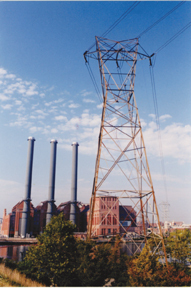
Narragansett Electric in Providence.
A new pricing system for wholesale electricity in New England could present cost-cutting opportunities for big energy users in Rhode Island next year – and might mean a bit more competition for the state’s wobbly experiment with deregulation.
Next spring, ISO New England, operator of the region’s electricity grid, plans to begin calculating wholesale electricity prices based on location, rather than using a blended, average price for all of New England. The move, which was ordered by the Federal Energy Regulatory Commission, is an effort to have wholesale prices reflect the actual cost of delivering power to different areas.
Those costs vary depending on generation capacity and the strength of transmission lines in different parts of New England. For example, costs are highest in “congestion” areas such as Greater Boston and southwest Connecticut. Although New England generates enough power to supply those high-demand areas, transmission lines have not been upgraded to allow electricity to be moved efficiently.
Selling Luxury Real Estate Requires More Than Exposure
By Emilio DiSpirito IV License Partner | Private Office Advisor Engel & Völkers Oceanside www.DiSpiritoteam.com…
Learn More
The result: Electricity is more expensive to deliver to those areas. But without a location-based pricing system, electricity buyers in those congested spots pay the same price for wholesale power as buyers elsewhere in New England.
“Less-expensive generation often sits idle in New England because of inadequate or congested transmission lines,” said ISO New England President and Chief Executive Officer Gordon van Welie. The grid operator released a study last month estimating that as much as $900 million in transmission upgrades might be needed to maintain the grid’s reliability.
So who’s losing out? Rhode Island and southeastern Massachusetts, which have built a number of new power plants in recent years and now have an abundance of electricity. That glut of power is trapped here, making electricity relatively cheap to deliver, but wholesale buyers are paying the same prices as buyers in congested areas such as Boston.
That should change next spring, though, when ISO New England is expected to change how it calculates wholesale prices under a system called “locational marginal pricing.” The grid operator plans to divide the region into eight zones, determining prices for each zone based on the actual cost of delivering its power.
Each state will represent a zone, except for Massachusetts, which will be split in three sections. (The southeastern Massachusetts zone will include the South Shore, Fall River, New Bedford and Cape Cod).
“As far as Rhode Island’s place in this new market, it’s probably going to be one of the least expensive places to buy electricity,” said James Grasso, principal of SilentSherpa, an energy consulting firm in Lincoln. “Anybody in Rhode Island willing to buy on a competitive basis has an advantage.”
But those buyers include only the state’s largest electricity users: hospitals, universities and large manufacturers such as North Kingstown’s Toray Plastics – customers who use enough power to be able to negotiate contracts with electricity retailers at better rates than those charged by Narragansett Electric.
Meanwhile, nearly all of the state’s businesses and residential customers won’t see changes from the new pricing system anytime soon. That’s because Narragansett Electric’s “standard offer” rate – which more than 99 percent of the state’s electric customers pay – was set long before the locational pricing plan was in the works.
But the new pricing system, which should be phased in starting this March, could help lure more power retailers into the state to compete for contracts with big customers, Grasso said.
“With the Rhode Island market cheaper than Boston, you bet energy marketers will be looking at this state for a lot more business, because it will be easier to beat the utility’s price than it will be up in Mass.,” Grasso said.
Others, however, are less convinced that the plan will spark retail competition.
Robert B. Stoddard, a principal at Charles River Associates in Boston who served as a consultant to the Rhode Island State Legislature on electricity legislation passed in June, said the Rhode Island market is too small for most electricity marketers to go after.
“They more likely would be looking to enter the New England market as a whole, and now the prospect of entering the two biggest markets, Massachusetts and Connecticut, is a little dicey,” Stoddard said.
But he added that a number of power marketers still are actively trolling Rhode Island to sign deals with big electricity customers – including municipalities. Legislation passed this year allows Rhode Island cities and towns to act as power brokers for residents, aggregating the municipality’s electric load in order to secure better deals from retailers.
There also is uncertainty over just how much cheaper wholesale power in Rhode Island and southeastern Massachusetts will be under the new pricing system, relative to other parts of New England.
“I don’t think anybody knows how much difference locational pricing will make between prices in Rhode Island and congested places like Boston,” said Roger Buck, executive director of The Energy Council-Rhode Island, which represents about 75 of the state’s largest energy users.
“If it goes the way it’s supposed to go, there should be a slight (wholesale price) decrease in Rhode Island,” Buck said. “But I don’t see it being that big a difference.”
Indeed, the only way for an electric customer to take advantage of the switch to location-based pricing is to leave Narragansett Electric for a better deal with a private retailer. But the cost of electricity has crept higher in recent months, and Buck says that even the state’s largest energy users are unlikely to find a better deal than Narragansett’s standard offer of 4.67 cents per kilowatt-hour.
“I don’t know of anyone out there who is beating the standard offer at today’s prices,” Buck said, adding that a few TEC-RI members locked into long-term contracts with energy retailers earlier this year for around 4.1 cents, when wholesale prices were lower.
For the complete current issue, visit our subscription Web site, or call (401) 273-2201, ext. 227 or 234.