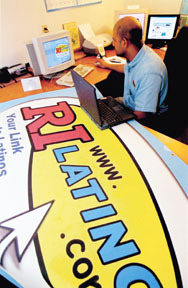
a Web site focusing on the Hispanic
community.
Two Web sites target an untapped market
Two new Providence-based Internet companies that serve Rhode Island’s Spanish-speaking community are changing the media landscape in the state by providing online news and resources in Spanish and selling ads to the many businesses – Hispanic and not – that want to reach Latinos, a growing and untapped demographic.
RILatino.com, a comprehensive news Web site for the estimated 100,000 Latinos in Rhode Island who don’t speak English or prefer to speak Spanish, has experienced explosive growth in the past year, and is already planning to expand into other states. Advertisers on the site include big companies like Cox Cable, Amica Insurance Co. and Shaw’s Supermarket, and small businesses and individuals within the Latino community like the El Brillante, a restaurant, and Delia Rodriguez, an immigration consultant.
A modernized health plan: Supporting cost management and the employee experience.
The Surest health plan came from a group of innovators wondering: What if health care…
Learn More
At the same time, another company with a similar name, Rhode Island Latino.com, is a rival Web site that features a local Latino yellow pages and links to resources for Hispanic immigrants.
Both Web sites are prospering with a traditional two-pronged media strategy: first, focus on the specific needs of a niche community with buying power. Then convince the larger business community to bankroll the operation by advertising to the niche audience.
And businesses are lining up to advertise on both Web sites, aware that the Latino market niche is for real.
The buying power of Latinos in Rhode Island grew from $414 million in 1990 to $1.36 billion in 2002, as Rhode Island’s Hispanic population doubled between 1990 and 2000, growing to 8.7 percent of the state’s population, according to the Selig Center for Economic Growth at the University of Georgia. By 2010, forecasts project that 12 percent of the state’s population will be Latino.
Across the nation, Latino buying power is growing 9.7 percent annually – at nearly twice the rate of non-Hispanics. Today, the buying power of Hispanics in the U.S., $580 billion, eclipses the entire economies of both Spain and Mexico, according to the Selig Center.
At the same time, research consistently shows that Hispanics respond more positively to bicultural marketing and Spanish-speaking advertising, even if they speak English.
“The Census of 2000 was a wake-up call. There’s been an explosive growth really pretty much across the country in the Hispanic consumer market. The buying power of the Hispanic population is growing faster than non-Hispanic buying power virtually everywhere,” said Jeffrey M. Humphreys, director of the Selig Center. “Across the country, (businesses) are rapidly attempting to capitalize on the Hispanic dollar, this under-served and overlooked consumer market. Businesses large and small are trying to establish a presence in the Hispanic community, where brand loyalties are less entrenched and there’s less saturation with competition. If you can develop a relevant product and a relevant advertising method then you can really capitalize on the Hispanic consumer right now.”
Cesar E. Mullix, the founder and chief technology officer of RILatino.com, was an Internet applications programmer for Providence Washington Insurance Company when he built a small Web site to serve local Latinos as a side project in 2000, with the help of the Rhode Island Small Business Development Center.
After a couple of years during which the Web site existed mostly as a resource clearinghouse with links for Spanish speakers, last June Mullix ramped up the venture. Today, RILatino.com covers approximately three events weekly in the state’s Latino community, posting news stories and photo spreads daily.
RILatino.com is linked as a resource for Hispanics on the city of Providence’s Web site, and has strategic alliances with virtually every organization that works in the Hispanic community, including the Rhode Island Small Business Development Center, the Latino Civic Fund and the cultural organization Grupo Duartiano. The Web site has nine content writers, including columnists like Tomas Avila, a well-known business consultant, and Abigail Mesa, a former reporter for the Spanish newspaper Providence En Espanol who writes a social and cultural column.
The Web site had 500 page views in July 2002, the first month that it posted its own content. Fast forward nine months: Last month, the Web site had approximately 330,000 hits and 114,616 page views, up from 76,600 in March.
On May 1, RILatino began selling advertising on its business directory, at prices ranging from $120 a year for a basic listing to $5,000 for its customized corporate package, which can include drop-down banners, a picture gallery and bilingual text. Cox Communications, Providence WaterFire and the Providence Performing Arts Center are among the larger businesses that have already signed on.
“It’s lucrative. We’re talking to investors right now and there’s a lot of interest,” said Mullix, who was born in the Dominican Republic, came to Providence with his family when he was 15 years old and eventually got a master’s degree in information systems from the University of Rhode Island. “Our statistics show that about 75 percent of our viewers are Latinos, and 73 percent prefer to read and speak Spanish. The big number is that 75 percent – that’s the number I point to when I’m selling the site,” said the 28-year-old. “You cannot really say that these people listen to the radio, or read the paper every day, but their income is a little bit higher than you would think. And they’re coming to us to get their information.”
RILatino.com has high penetration into the Latino community, but it already has competition. In 2000, Leo Morales, 40, a computer programmer from Colombia who has lived in Providence for 21 years and once owned a restaurant in Central Falls and a nightclub in Pawtucket, launched Rhode Island Latino.com, which goes by the URL www.rimix.com.
The site features an electronic yellow pages with 450 businesses, four Spanish Internet radio stations, and provides 43 links to such resources as translation services, online US Passport and citizenship applications and a Spanish-English dictionary. Advertisers on the site include Maaco, AAA and the Metropolitan Mortgage Company.
Morales said that the names of the two Web sites are confusingly similar, but said that the Web sites have different aims and are not competitors.
“There’s enough out there for the both of us, and besides our focus is a bit different. My vision is more like, we have a person that arrives to the state, they don’t know where anything is and they don’t understand the language. We provide everything they need in our language,” said Morales.
Morales said his Web site averages 40,000 hits a day. On a daily basis, both Web sites get hits from Internet users in countries throughout Latin America, South America and the Caribbean. That’s good news for both Web sites, said both Mullix and Morales, because the hits from other countries is evidence that Latinos in Rhode Island are still very enmeshed and communicating constantly with friends and family in their home countries. And in other states. Armed with the knowledge that the Latino community in Rhode Island is very contiguous with the Latino community in Massachusetts, Mullix is planning to begin moving into Massachusetts this summer by covering local events, making strategic alliances with organizations and linking with other resources there.
Mullix is planning to rename his Web site USLatino.com, and said that long-term, he hopes to extend the model throughout the nation. “It’s not an experiment anymore. We’ve already proven that this works because of the visits and the feedback,” said Mullix.
For the complete current issue, visit our subscription Web site, or call (401) 273-2201, ext. 227 or 234.