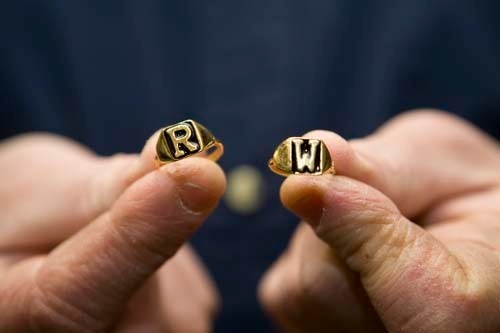
To save their businesses, one maker of children’s jewelry in Rhode Island is reverting to the use of plastic rhinestones and another is seriously considering the same step as they, along with thousands of manufacturers nationwide, await federal decisions to better define the scope of the Feb. 10 ban on certain children’s products containing lead.
Alan R. Green, owner and operator of Argo Products in Johnston, and Keith Barber, partner in Rainbow Sales Inc. in Cranston, are not sure what to do with inventory that may contain more lead than the law allows in the form of rhinestones, glass and crystal stones. As a result their businesses suffer until the U.S. Consumer Product Safety Commission (CPSC) rules on whether these materials can be excluded from the lead ban.
Barber said he has packed up and stored away “thousands of dollars” worth of children’s jewelry pieces, hoping he can salvage and eventually sell them if the federal consumer board grants an exclusion for rhinestones. Meanwhile, he’s started using plastic rhinestones but, without the gleam and glitter of glass, they “don’t have the same appeal,” he said. He is not optimistic about the potential popularity of plastic rhinestones. “What it’s going to cost us in future sales, no one knows,” he said.
The Consumer Product Safety Improvement Act (CPSIA), enacted last summer, restricts to 600 parts per million (ppm) the amount of lead that can be contained in children’s products, with the limit slated to drop to 300 ppm later this year and, if technically feasible, 100 ppm two years after that. Manufacturers must test children’s products and certify the lead content in writing, although the CPSC has yet to issue firm guidelines for testing procedures.
The CPSC last month issued a stay to delay testing requirements for one year, but children’s jewelry products were explicitly excluded from the stay. As of Feb. 10, the law made it illegal to sell jewelry for children less than 13 years old if it contains more than 600 ppm of lead, which is a certainty if the piece includes lead-rich rhinestones.
The law has “definitely hurt our business,” Barber said. “We’ve gotten stuck with inventory we can’t sell because of the lack of a crystal exemption, all because the government did not do its work properly.”
Barber said he has been following this issue for at least five years, since California adopted a strict law banning lead in children’s products. The California law became the model for the federal version, and Barber noted that California included an exclusion for rhinestones and crystals. California, he said, “took the time and did it right.”
Green says that he could live with going out of business if he were a lousy businessman or as a result of the weak economy. “But to lose my business because of an ill-conceived federal regulation that is completely divorced from reality, that’s really going to hurt,” said Green. He, too, is seriously mulling the idea of using plastic rhinestones, but he also has inventory with rhinestones that he cannot sell, worth thousands of dollars. Sales, he said, “are dangerously low.”
Barber and Green, as well as representatives of the fashion jewelry industry, maintain that a rhinestone poses no threat to a youngster because, even if it is swallowed, the lead it contains is inert and will pass through without harm. The only way damage can result, they say, is through repeated exposure, so “we’re talking about a child who has a regular diet of jewelry,” Green said in exasperation. “Is there anyone left in Washington with any common sense?”
Barber’s company also imports adult jewelry, but the majority of Green’s business is selling hundreds of thousands of children’s jewelry pieces to wholesalers nationwide every year. Green said he is stepping up his line of rhinestone-laden pieces for teens, and in the last few months he has started product lines for adults, including rhinestone bra straps for women. “It’s very difficult to introduce a new line, never mind in a weak economy,” he observed.
Green has said he may be forced to close his business, an option that he said last week remains possible if no exclusion for rhinestones is granted soon.
Michael Gale, president of the Fashion Jewelry Trade Association (FJTA) based in North Kingstown, said his organization several weeks ago submitted a 37-page petition to the CPSC, formally requesting an exclusion for crystal, rhinestone and glass, complete with scientific evidence and a risk-assessment study in what he called a “very elaborate presentation.” The FJTA represents about 2,500 costume jewelry makers worldwide. No response has been received yet, Gale said.
At the Manufacturing Jewelers & Suppliers of America (MJSA), a national trade association based in Providence whose 1,800 members deal mostly in fine jewelry, spokesman Gerry Davies said his organization has not yet received the exclusion it requested for precious metals and gems, such as silver and diamonds. The CPSC staff has issued a recommendation in favor of the exclusion, but the commission itself has yet to vote, Davies said.
The CPSIA will be a topic of discussion at MJSA’s major annual exhibition in New York City March 8-10, the MJSA Expo New York, according to Davies, along with discussions about what the organization on its Web site calls “the biggest topic of all,” the overall state of the economy.
The House Small Business Committee, subcommittee on regulations, had scheduled a hearing on the CPSIA at the Capitol for Feb. 26.
Meanwhile, the one-year delay that the CPSC granted for the testing of lead products has proven to be a reprieve for the sale of children’s books, especially those printed before 1985, may contain lead in ink, covers or glue. The American Library Association (ALA) has petitioned for an exclusion.
“The fear was that children’s rooms would have to be closed and materials would have to be tested. Who could afford to test all those books?” he said. •