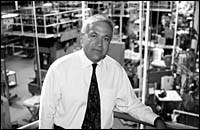
Name: Zia Eftekhar
Position: President of Lightolier
Background: Eftekhar has been president of Lightolier since 1992 and has spent his entire 34-year career with the company. He is a member of the board of directors of the Genlyte Group Inc., the publicly traded parent of Lightolier.
Selling Luxury Real Estate Requires More Than Exposure
By Emilio DiSpirito IV License Partner | Private Office Advisor Engel & Völkers Oceanside www.DiSpiritoteam.com…
Learn More
Education: Masters of science degree in industrial design from the University of Southern California. Bachelor of science degree in aeronautical engineering from Northrop Institute of Technology.
Age: 57
Residence: Portsmouth
Founded in 1904, Lightolier is one of the world’s oldest and largest lighting fixture companies. Fall River-based Lightolier offers a full line of lighting fixtures, including track, fluorescent, downlights, decorative and advanced dimming control systems for both commercial and residential customers. Lightolier has manufacturing and distribution facilities in California, Connecticut, Georgia, Illinois, New Jersey, Texas, Canada and Mexico.
PBN: What is Lightolier’s largest market, commercial, residential, industrial?
EFTEKHAR: The industry gets measured in four segments: residential, commercial, industrial and outdoor lighting. The largest component is commercial, and our company is a commercially oriented company. Only about 10 percent of our business is residential, while 90 percent is commercial.
Lightolier is owned by a public company?
Lightolier is a division of U.S.-based Genlyte Group Inc., a publicly traded
company (NASDAQ symbol GLYT), which is about $1 billion in size. Lightolier
is the largest operating division of that company. The Genlyte Group Inc.
is the largest independent lighting company worldwide.
Lightolier has pioneered several product advances in the lighting industry, including track lighting in the 1960s and fluorescent lighting in the 1970s. What have been the company’s more-recent product innovations?
If you ask what is our company’s distinctive competency, I would say that it’s really our commitment to delivering product innovation and product leadership. We really strive to do it first or do it better. You can’t always be the first, although Lightolier has done a lot of things for the first time. But we always try to make sure that our contribution has improved the product better than the competition. We aim to deliver about 30 percent of our annual volume from new products. Some of our innovation changed the whole way of looking at lighting, like the track lighting for example. In the last 10 years, we’ve been putting a lot of emphasis on bringing more intelligence into the fixture.
What’s an example of that, ‘bringing intelligence into the fixture?’
By intelligence I’m talking about electronic controls. For example, last year we released a product line in which each individual fixture is capable of receiving signals without any wiring from the control, so it can behave as if it’s wired by itself, even though there are a number of fixtures on the same circuit. We have another system we released about a year ago that enables an office to be all wired, but individual users, either through Internet or Intranet, can give specific orders to the fixture that is directly above their desk. So our aim in recent years, in addition to developing products based on new light sources – and by light source I mean light bulbs – a lot of it is bringing more value and control into the product itself.
How much can an office building save through better efficiency by replacing an old lighting system with one of your newer ones?
The savings could be very significant depending on what they were using. Typically office lighting has been fluorescent for the last 30 years. In today’s systems, efficiencies are the result of higher-performance lamps and significantly higher-performance electronic ballasts that drive those lamps, and that improvement is somewhere around 50 percent for the same type of light source (not the same lamps). Now if you go from an office that was using incandescent or older types of lighting designs versus an office that is converted to a higher-efficiency fluorescent, then the efficiency increases can be threefold or fourfold. Then you can get into management of the light, like daylight savings, or lighting that gets dimmer and brighter based on the times of the day. So, combine not only the light sources and the products but the management of them, I think to talk about a 100 percent improvement is not an exaggeration.
Why did Lightolier relocate its corporate headquarters from New Jersey to Fall River in 1994?
This facility, the factory, was already in existence when we moved here. Lightolier was, since its inception, a New York/New Jersey based company. In 1994 we felt that having our corporate headquarters next to one of our facilities would make us more streamlined with respect to product development and marketing. We selected the Fall River location for two reasons. First, it was our largest manufacturing facility. And second, with the educational facilities in this general area and the caliber of work force, we felt this would be conducive to not only this generation but also to the next generation. And frankly, the state of Massachusetts was very cooperative, as was the city of Fall River.
Describe the company’s growth since then.
The overall growth of Lightolier in terms of manpower has been significant, not only here in Fall River but throughout North America. We have approximately 2,000 employees, and of those roughly 700 of them are in the Fall River facility. About 200 or so people that have been added here, but more importantly, most of those have been outside of the manufacturing sector.
What goes on in Lightolier’s research laboratory (a 5,000 square-foot facility housed at its headquarters in Fall River)?
About five years ago we decided to develop a technical center for lighting in this facility. It really has two functions: Its primary function is as part of our educational program for training seminars specifically designed for our own employees. The tech center is really the laboratory for the classroom functions, designed to show lighting performance from an application perspective, how it performs, what the different techniques are, and how do products interface with applications. The second use is for clients who are interested in a specific kind of application. Lightolier to date has brought in well over 15,000 people, outside of our own employees, to this facility. We also have it open to educational institutions, like the Rhode Island School of Design and other architectural schools that have lighting as part of their curriculum.
What are the keys to maintaining healthy profit margins in the lighting business, given the down economy?
The business itself is under two types of pressures. One is that the lighting business is cyclical, directly related to the construction industry. And unfortunately right now, on the commercial end, the construction industry is in a trough. That pressure (from the commercial market) is volume pressure, or a problem with supply and demand, which suddenly erodes margins. Overall our industry is slightly oversupplied to begin with. So the second pressure with respect to profitability has to do with a significant increase in imports, especially in the residential and the lower end of the commercial markets.
What has the company done to deflect those pressures?
Two factors are really being focused on all the time to support our profitability. One is productivity. We have invested a significant amount in not just equipment, but also in training to utilize the latest technologies in manufacturing. The second part is product innovation, because that means our margin structure is always being refurbished. I’m happy to say that we are a profitable company. The public company (Genlyte) has had 30 consecutive quarters of earnings growth, and Lightolier has been a very big part of that.
Have you made any operational changes?
Lightolier had a record year last year, in 2001, even with the economic downturn and the September terrorist attacks. Both of those had an impact on our business, but our momentum carried us through. This year we have felt the slowdown in the economy, and what we have done is focused on some of the market segments that the economy hasn’t really touched. The three major markets for us are the commercial building, or office building; hospitality, which includes hotels and restaurants; and retail. All those segments have been affected significantly. The markets that we are now focusing on in addition to these markets are, for example, schools. Both local and federal governments are providing a lot of money for schools, and that segment is very strong.
You’ve spent your entire 34-year career with Lightolier. Where in the company did you start out?
I was a designer. But my beginning with the company was to get a job so I could pursue further education. But they were flexible enough that I had afternoons off to go to college.
Were you born in the United States?
No, I was born in Iran and I came here in 1965 to go to college and stayed here ever since. I came to Lightolier in 1968 and I just had finished my four years of school when I came here.
It’s unusual for someone to stay with one company in today’s corporate environment.
I’m by far not unique in terms of longevity with the company. In fact we have
employees in this company with over 50 years. Lightolier started as a family
company with immigrant people coming in. The founders came here from Austria.
Seventy or 80 years ago, they came up with a phrase that coined their whole
philosophy about work, which was ‘make a life while you make a living.’ It’s
the whole concept of making your private life become one with what you want
to do in your career with the company. It’s not that easy, but we’ve been able
to maintain as much of that notion and that culture as we possibly can.