When John “J.R.” Richard opened The Avery in April in a residential section of Providence’s West Side, he wanted the bar to be different from the series of other drinking establishments that preceded it in the inconspicuous building at 18 Luongo Square.
“We wanted to open a nice little place that would go under the radar and may not conform to a conventional sensibility of TVs, [alcohol] shot specials, pitchers of beer, etc.,” he said last week.
Richard also chose a decidedly unconventional way to launch the business. There are no outdoor signs, nor did he produce any advertising or create a Web site.
Instead, Richard and his partners relied on a word-of-mouth marketing campaign that’s also been used by a handful of other city nightspots trying to appeal to the hip, in-the-know crowd and those looking for a place off the beaten path.
The Avery’s marketing strategy was based on three things: the location’s background; the owner’s reputation as a staple in the Providence nightlife scene – including stints at Lupo’s Heartbreak Hotel and Jerky’s Bar; and the reputation of Kyla Coburn Designs, which has created the interiors of a few other low-profile spots around Providence.
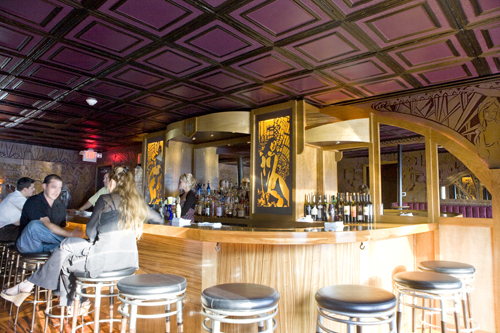
For The Avery, Coburn’s carved wall treatments – she works with designer Andy Trench – replicate the ornate walls of historic theaters around the state. Included in the design are carvings of the Art Deco Bank of America Building and the smokestacks that sit just inside the Fox Point Hurricane Barrier.
“It’s been fun for me, drawing on parts of Providence and the industrial and the classic Art Deco shapes in carving those walls,” said Coburn, a Rhode Island School of Design alumna who started her company as a fashion boutique in New York City in 1996 before returning to Providence to work in commercial design.
The opening of The Avery was preceded by Loie Fuller’s, a Westminster Street restaurant that is in a former hair salon. That restaurant and bar was created by Mike Sears – also a partner in The Avery and the owner of Lili Marlene’s on Atwells Avenue – and designed by Coburn.
At Loie Fuller’s, the restaurant is overflowing with intricate Art Nouveau detailing: an “LF” mosaic embedded in the wooden floor, swirling woodwork and murals of women painted on each wall.
While the design might have hints of the early 1900s, when Art Nouveau design and architecture were in their prime, it’s also very local: all the paintings are of women who have worked or currently work at the bar, Coburn said, adding, “So it’s local, but it’s also kind of a throwback, because that’s who Art Nouveau artists were able to paint when they were painting – it was barmaids and dancers.”
Coburn’s firm also has designed Broadway Bistro, Don Jose Tequila, Atwells Avenue’s new hookah bar Nara and a new mural at East Side Marketplace.
Design is an important draw, because staying below the radar in a marketing sense is often paired with locations that are farther from downtown than some might want to go just for a good meal or drink.
“We’re walking an interesting line in those neighborhoods – with some people wanting them to stay as they were years ago,” Coburn said of the West Side. For that reason, the low-profile restaurants are also an attempt to keep neighbors happy, with “a little more thought into the designs to make some places that are still creative and do still have a little bit of the funkiness of what people who are living in those neighborhoods have in their daily lives.”
But even with creative designs, these establishments could not survive without a burgeoning young community of food-loving locals, said Seth Price, who with Rich Lang recently launched ProvidencePalate.com, a blog-based Web site that’s intended to spur conversations about local restaurants.
His Web site is a product of the conversations that he saw people having around the city, he said.
It’s natural for a culturally aware city to have its secret restaurants, he said. “People seem to, and have always seemed to, thrive on the fact that they’re in the know and are sharing something special.” And, he added, the Providence community seems to have hit a point where it – like New York and Boston – can support those restaurants.
Coburn agreed, saying, “There are so many people – those interested in food and design and atmosphere – who are now buying houses and staying here, that it’s natural for these little places to be popping up.”
And Price’s Web site has been growing. Within six weeks of Providence Palate’s launch, the site was getting about 150 visitors a day. Now, that’s jumped to about 375 visitors daily, Price said last week. About 500 member profiles have been created to blog on the Web site.
And those restaurant bloggers – people “who are in the know” – are exactly the crowd that Richard is hoping to attract: just-out-of-college young men and women. In short, he said, the people who likely go out to a bar every night.
And a lot of them live in Providence’s West Side neighborhoods, Richard said.
“I think that’s part of a trend that’s developing in Providence,” Coburn said. “It may be more that this renaissance that was happening is actually maturing – with all the houses in the West Side that have been cleaned up, there [are] a lot more destination-boutique restaurants and bistros that are springing up outside of downtown.”
And the underground restaurant scene likely hasn’t yet peaked in Providence, said Coburn. She’s now working with Sears on at least one new design and location, but she wouldn’t say where.
“Basically they’re so location driven, with a few spots on the West Side and maybe downtown, [that I couldn’t tell you where without giving too much away.] Mike [Sears] is so private – that’s just how he is. I couldn’t tell anyone the names of some of the places we were working on until after they opened. They’re top secret.”
But when the restaurant is open and the mystique starts to fade, there still needs to be a good product – a restaurant or bar that patrons like, said Richard.
Even though The Avery has been gaining patrons, the busiest night so far has been opening night, Richard admitted. So now comes the hard part: living up to the hype. “But we’ve been around for a while, and we know people,” Richard said. “We tend to know how to design a place that people are looking for.” •