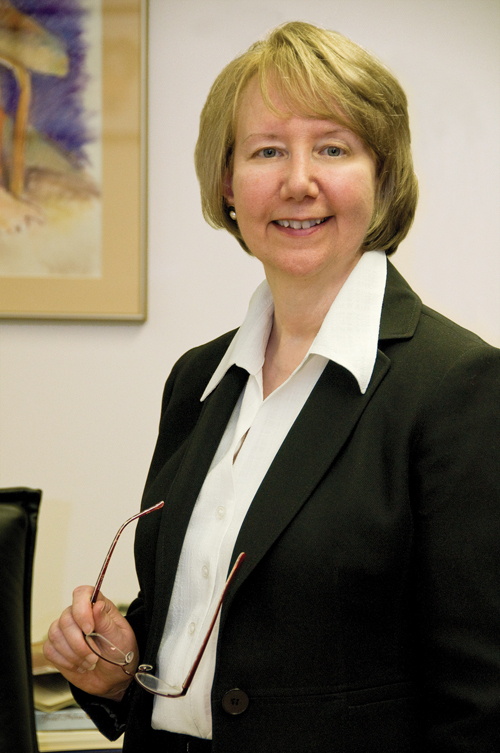
Nancy Carriuolo is the new president of Rhode Island College, taking over the state’s teacher-preparation college during tough economic times. She shared with Providence Business News how the college is coping with budget cuts, her plans for the future of Rhode Island College and why she is opposed to the idea, suggested during budget talks, of merging with another state college.
PBN: The state cut the budgets for all of the institutions of higher learning this year. How much was Rhode Island College cut, and what is the impact of the cuts?
CARRIUOLO: The total reductions from the requested current service-level budget amounted to $7 million. Of those reductions, $3.1 million came after I began my term as president on July 1. As a result, we stopped all hires. … We decided to consider each vacant position and rehire only if the position was needed for daily operation of the college, for the safety and health of our college community, or for maintenance of the quality programs offered to our students. As a result, some positions were left open for an indeterminate time, others were combined or reduced to half time, others were left open for three to six months to effect cost savings. We also cut work-study funds by $100,000, which is very difficult for the students who depend on these jobs and for the departments that depend on the help of the students. Personnel lines have the most available funds.
Beyond Cash Donations: How New Forms of Giving Are Transforming Not-for-Profit Accounting
Evolving Funding Landscape for Not-for-Profits Not-for-profit organizations are being asked to do more with less,…
Learn More
PBN: Where do you see Rhode Island College heading in the future?
CARRIUOLO: The trend has been for the state to reduce its allocations to public higher education. Unless this trend is reversed, or at least halted, public higher education will need to change the way it operates. Our mission is to provide affordable, accessible education to students, so we cannot continue to raise tuition and fees as state support erodes. Over time, the college needs to develop new sources of revenue. RIC needs to become more entrepreneurial. In other words, the public institutions will need to reorganize and become more competitive with tuition-driven, independent institutions in regard to admissions, continuing education, grants and contracts, and major gifts.
PBN: The main mission of Rhode Island College in the eyes of many people is to train teachers. Do you agree with that assessment?
CARRIUOLO: Faculty [members] are offended by the word “training,” which is commonly used in business. The faculty- speak is “preparing” teachers. I have learned not to use those two terms interchangeably. I view teacher preparation as the historic mission of RIC, which began as a normal school devoted to preparing the state’s teachers. That mission continues with RIC arguably the largest provider of teachers in the state.
Diversity and diversity issues are now discussed in all teacher- preparation classes, and student teachers practice in diverse settings. Assessment has become a high priority: Teachers must state outcomes expected by the end of a course and then assess to ensure those outcomes are reached. Tests do not have to be standardized. They must measure what is expected of the students. Alignment between the assessment tool and the skill or knowledge being measured is what matters.
Furthermore, special education students are present in all classrooms, so teachers must understand special education issues and pedagogy. Teachers must also be reflective, cooperative and technology savvy. In addition, they must be knowledgeable about the state high school graduation requirements, such as a portfolio of work. Today’s teachers have very full programs of study in comparison to the teachers RIC prepared early in its history.
PBN: What areas do you believe Rhode Island College is strong in, and which areas need work?
CARRIUOLO: In January 2009, RIC plans to open a STEM (science, technology, engineering and mathematics) Center that is supported by public funds. We hope that center will attract additional math, technology and mathematics majors to the college and provide a hub that will disseminate best practices across the state, as well as provide best practices to RIC faculty to use in the preparation of teachers of mathematics, technology and science.
Nursing has also been a growth area that has attracted external funds, including an exciting new partnership with the Veterans Administration that brings five nurses a year to RIC. RIC, in turn, is helping to prepare more nurses for the returning veterans.
PBN: What do you think of the idea of merging the state’s institutions of higher education?
CARRIUOLO: Merging RIC with another institution with a different mission and different faculty and staff contracts would not be productive. The institution with the better salary structure and work- load would become the standard for all, so savings would not result. The distinctive character and mission and goals of each institution would be lost. Rhode Island has one research institution, one master’s comprehensive and one community college. Each is a distinct model that attracts a particular kind of student and faculty.
During the spring, when I interviewed prospective new faculty, some of the best faculty asked me if RIC might be merged with CCRI. I lost some of those faculty because last spring I had to answer honestly that I did not know. They were equally honest in saying they did not want to work at a merged institution. I suspect some prospective students and families felt the same way. Rhode Island’s periodic speculation about mergers only serves to harm our institutions. •
INTERVIEW
Nancy Carriuolo
POSITION: President of Rhode Island College
BACKGROUND: Originally an English teacher, Carriuolo became president of Rhode Island College on July 1. Since 2000, she had served as deputy commissioner and chief academic officer in the Rhode Island Office of Higher Education, as well as interim vice president for academic affairs at RIC in 2007-2008.
EDUCATION: B.A. in English, Brockport State College/State University of New York (SUNY), 1970; M.S. in education, also from Brockport, 1973; and Ph.D. in research and evaluation from SUNY at Buffalo, 1979.
FIRST JOB: After sour cherries passed down a conveyor belt and through a pitting machine in a canning factory, she checked to be sure the pit was removed. She was 18.
RESIDENCE: North Providence
AGE: 60