Eastern Ice Company started doing business on Newport’s waterfront in 1929, supplying ice and coal to the city’s commercial fishing fleet and other marine businesses along the harbor.
Last week, the company completed its move to a new facility in Fall River, and a developer is moving forward to demolish its brick building on Brown & Howard Wharf and replace it with a three-story commercial building that will house retail shops, restaurants and offices.
As Eastern Ice was leaving Newport, members of Rhode Island’s congressional delegation were in the city trumpeting $500,000 in federal aid to help the International Yacht Restoration School’s (IYRS) $7.5 million project to renovate and occupy a derelict mill building on lower Thames Street. U.S. Sen. Jack Reed and several other speakers all said they hoped the project would help to attract new marine businesses to the district and spark a renaissance of Newport’s working waterfront.
The industry began a slow, steady decline in the mid-1970s, when the U.S. Navy moved its Atlantic fleet out of the city. The decline has accelerated in recent years as stringent fishing regulations and depleted fish stocks have driven Newport’s commercial fishing fleet almost entirely out of business, said Paige Bronk, Newport’s director of planning, zoning and development.
“The fishermen have almost come to nil, we outgrew the facility and they were building high-end condos in front of us,” said Joe Rossi, who owns Eastern Ice Company with his brother, explaining why they chose to move the three-generation family business out of Newport.
Skyrocketing property values on Newport’s waterfront in recent years have caused a booming development of high-end condominiums – many owned by seasonal residents who live in Newport only a few months a year, Bronk said.
Newport Shipyard, the city’s last remaining boat-repair business, has shifted entirely from servicing fishing boats and other commercial ships to private yachts, said Eli Dana, a manager and dock master at the shipyard.
Dana’s family, which owns Newport Shipyard, decided the future of the business lies in doing business with the owners of the very large “super yachts,” from 80 feet to 300 feet in length, that have been based in Newport in increasing numbers in recent years, he said.
Looking to lure the estimated 50,000 transient boaters who use the city’s moorings and anchorage fields annually into downtown Newport’s commercial district and attract more of them, the city of Newport plans to convert a century-old, city-owned armory building on lower Thames Street into a boater facility, information center, commercial office space and open-air market facing the waterfront.
The $1 million transient boating facility, which will be built in about one-third of the 22,000-square-foot building, will provide boaters with showers, lockers and other amenities. The project, which is being funded in part with a $750,000 federal grant, is a smart move for Newport from an economic development perspective, said Bruce Bartlett, director of the Redevelopment Agency of Newport. Newport officials also hope to increase its meager amount of public dock space in coming years to attract more transient boaters, he said.
“The intention is to make their stay in Newport more desirable, and by doing that hopefully people will stay longer and come back,” Bartlett said.
Last fall, at a two-day forum on the future of the city’s waterfront sponsored by the Rhode Island chapter of the American Institute of Architects, more than 100 people who attended expressed broad consensus that Newport should make its waterfront more accessible to the public and restrict commercial uses to water-related businesses, Bronk said.
Creating a pedestrian path that extends the length of Newport’s waterfront was a top priority, he said.
Keith Stokes, executive director of the Newport County Chamber of Commerce, said he would like to see the city adopt planning and zoning policies that encourage the type of mixed-use, pedestrian-friendly waterfront development that other coastal cities have already created.
Cities such as Annapolis, Md., Savannah, Ga., and Charleston, S.C., have created commercial overlay districts and incentive zoning to encourage a “new urban” approach to development that favors dense, mixed-use and open spaces, he said.
“Very dynamic communities have created a whole series of flexible zoning policies and plans that engage the private sector to sit down and work with the government in coming up with the highest and best use,” Stokes said.
Even as Newport works to grow its number of seasonal visitors, there is a growing concern the city’s economy may become too reliant on tourism. Bringing back the marine trades through projects like the IYRS renovation would help ease that concern, say proponents.
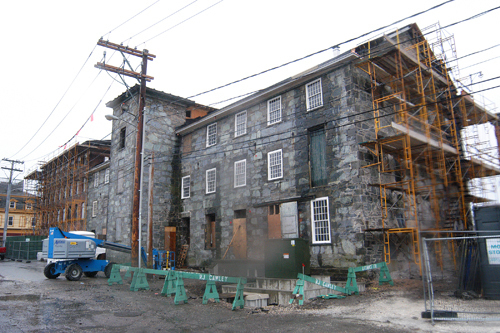
IYRS broke ground nine months ago on the project to restore the building, which is on the National Register of Historic Places. The work is scheduled to be completed in December.
Once restored, the 30,000-square-foot mill will function as a centerpiece of the Lower Thames Street neighborhood, housing the school’s expanded boat-building and marine vocational training, a public library and commercial space.
Next door to the mill project, IYRS operates its nonprofit boat-building trade school.
But Stokes conceded that Newport faces several challenges in growing the city’s marine trades industry – chiefly, that the exceedingly high value of waterfront real estate will severely limit land-use choices.
“These are very difficult land-use planning issues that need to be resolved,” he said. “I would like to see Newport be a true, mixed-use, dynamic working waterfront. I think our economy needs that.” •