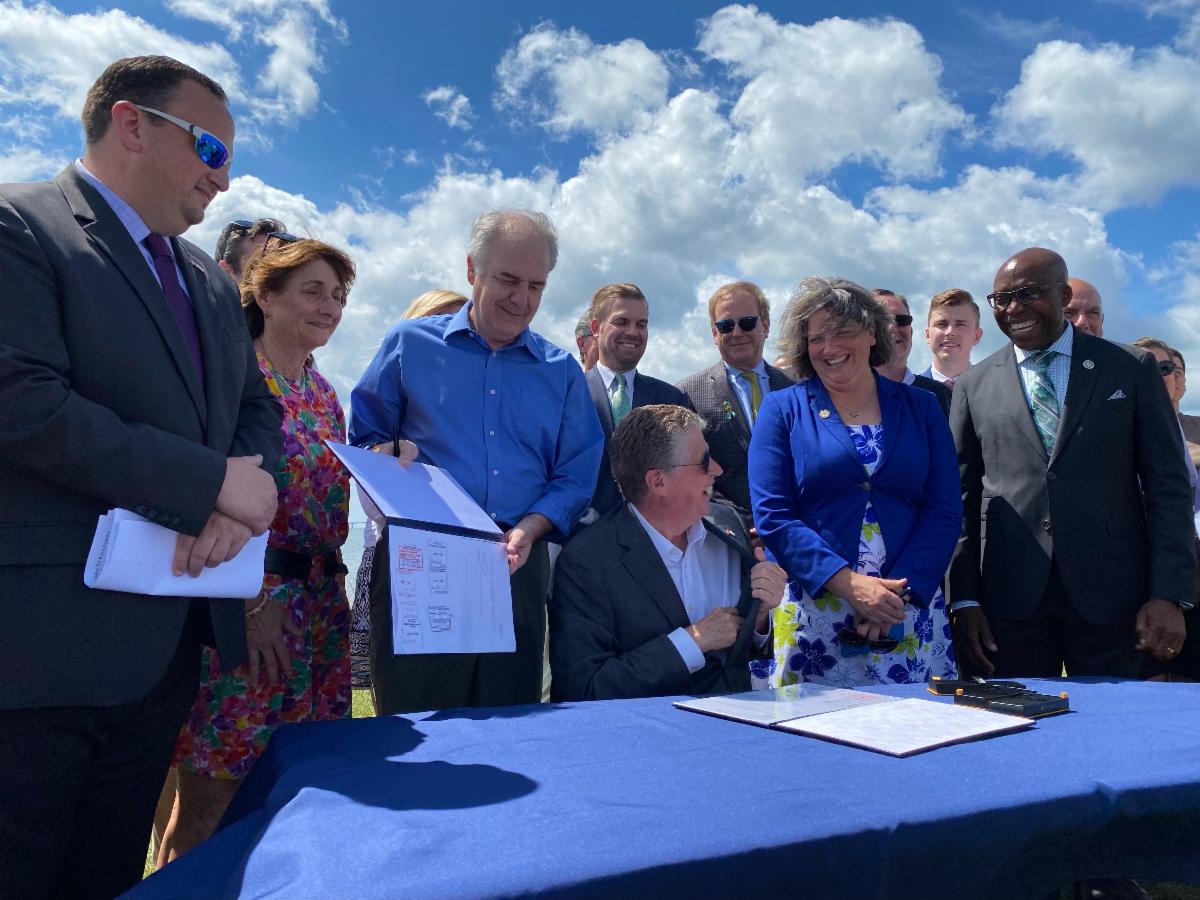
PROVIDENCE – Plans to add enough wind power to supply nearly a third of the state’s electricity needs are moving forward with a new law signed by Gov. Daniel J. McKee on Wednesday.
The law mandates that PPL Corp., which operates the state’s primary oil and gas business now known as Rhode Island Energy, to buy up to 1,000 megawatts of offshore wind power. Based on legislation sponsored by Sen. Dawn Euer, D-Newport, and State Rep. Arthur Handy, D-Cranston, at the request of McKee, the company would have until Oct. 15 to issue the procurement.
Building a Strong Data Foundation in the Age of AI
Artificial intelligence (AI) has become a key priority in the boardroom and across management —…
Learn More
The wind procurement plan aims to help Rhode Island achieve its ambitious renewable energy goals, including achieving 100% of its electricity from renewable sources by 2033 and reaching net-zero carbon emissions by 2050. State lawmakers have also touted the wind bid as a job-creator, although exactly how many more jobs will come from the procurement has never been stated.
“Offshore wind is one of our state’s most abundant natural resources,” McKee said in a statement. “Adding offshore wind clean energy capacity is essential for meeting our new 100% renewable energy by 2033 goal and our Act on Climate emissions reductions target. It will not only be beneficial for the environment, but also create hundreds of jobs as we position Rhode Island as an economic hub of this growing offshore wind industry on the Atlantic Coast.”
The new wind procurement will add to existing wind power from the Block Island Farm as well as the yet-to-be-built Revolution Wind project, which will bring 400 megawatts of wind power once completed. Together, these projects will generate enough power to supply half of Rhode Island’s energy needs, according to the state.
The law also provides a payment of up to 1% of the contract cost for the utility company, with the final decision to be left up to state utility regulators. The legislation was revised several times by state lawmakers to amend the financial incentive, which was originally capped at 2%, then eliminated entirely, before settling on the up-to-1% payment to be determined by the R.I. Public Utilities Commission.
The law also sets standards around labor, and requires environmental and economic impact studies for any new offshore wind projects.
Nancy Lavin is a PBN staff writer. You may reach her at Lavin@PBN.com.