A six-year-old economic development tool designed by the R.I. General Assembly to allow “distressed” municipalities to create special zoning to draw new retailers has remained unused, in part due to the objections of established small businesses.
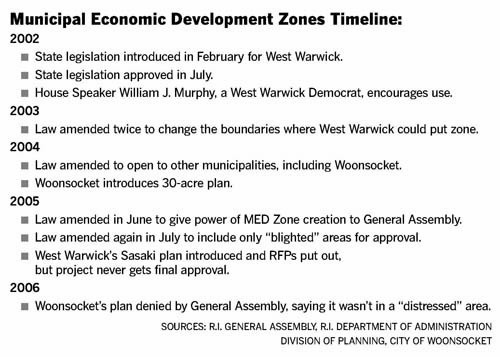
Since its creation in 2002 as a tool for West Warwick’s revitalization, the Municipal Economic Development Zone (MED Zone) program hasn’t once been used, although two cities have undergone extensive planning to make use of it.
The law, which has been amended almost every year since its enactment, allows qualifying municipalities to create zones of 10 to 30 acres where new businesses can build. The municipality would be able to collect half (3.5 percent) of the state sales from the businesses that build in the zone for a decade. That money collected by the state would have to be used for infrastructure development around the MED Zone.
West Warwick and Woonsocket have tried to use the program during the last six years, but both have been held back, officials said.
When it proposed a 30-acre vacant site as a MED Zone, Woonsocket got blowback from legislators and small-business owners who said the plan didn’t fit into the intended use and wording of the law, city Economic Development Director Jeffrey Polucha said.
The zone was planned to sit next to Dowling Village, an under-construction shopping center in North Smithfield on the Woonsocket border. Thirty acres of vacant land on the Woonsocket side would have been used to draw in what would likely have been big-box retailers, Polucha said.
But in 2006, the R.I. General Assembly denied the city the ability to designate it an MED Zone, he said, because it clarified the MED Zone’s regulations to only include “blighted” areas.
“We read the regulations, the law, one way and I guess there was [resistance] from the legislature at the time,” Polucha said. “They felt that the location that we wanted to apply it to was not a distressed area. We read [the law as applying to] a distressed community, not a distressed area.”
A broader view of the disuse of MED Zones might suggest that the program has been a victim of poor legislative wording, said Derwent Riding, a principal planner with the R.I. Department of Administration’s Division of Planning
“I just think the MED Zone maybe was an idea, but wasn’t developed to fit in with other existing laws – maybe another law needed to be updated,” she said last week. “I think everyone can agree that our redevelopment statutes are ancient. They were done for the 1960s.”
She said the wording – specifically the word “blighted” – doesn’t reflect the current trend in establishing areas where redevelopment is necessary. Municipalities, she said, might be hesitant to label themselves as “blighted.”
But in West Warwick, the community for which the original legislation was created, town leaders have had different problems: turnover in government, lack of funding and a lack of agreement among community businesses and planners, said the Community Development Manager Elaine Mansour.
The plan for the town’s MED Zone, created by Sasaki Associates Inc. in 2005, outlines an effort to draw customers from Warwick’s Route 2. That report says that about $1.46 billion is spent in Warwick by Kent County residents, making up 74 percent of all annual purchases made in Kent County. That total was expected to grow to $1.56 billion by 2009, the study says.
But the report raises some concerns about MED Zones, too. One of those is that the law prohibits businesses from moving from one area of Rhode Island to another just to be in a MED Zone, unless “it substantially increases employees.”
And actually implementing the plan in the Arctic section of the town was a problem, Mansour said. “We have gone, in the past, out for [Request for Proposals], but the proposals that we received just didn’t seem to fit everybody’s vision,” she said. “So we are going to address that in the coming months.”
Another issue is the 10-year time limit during which the city can collect its share of the sales tax receipts, she said. Lining up a string of new developments at one time is a difficult task.
“You really want to be in a position where most of the certificates are being issued fairly quickly after one another,” Mansour said. “You don’t want to be in a position for one and then not have the next one going for three years, because then you’re loosing valuable time.”
Although the MED Zone law’s regulations now limit it only to Central Falls, West Warwick and Woonsocket, the program has been talked about for use in Pawtucket. Earlier this month, City Councilor Don Grebien, who is challenging Mayor James E. Doyle, suggested that it be used to spur development in the city’s downtown and the waterfront.
The first problem would be making the law applicable to Pawtucket, he said. And, he added, any new legislation would have to make clear that the MED Zone wouldn’t be an encouragement for knocking down historic buildings in Pawtucket.
“We can bring in new businesses, give incentives, but also maintain the historic value that we have in our existing buildings,” Grebien said. “One of the fears is that we’ll come in and it will be all big-box stores, but we also need to do something with our downtown because nothing’s happening.”
But Pawtucket’s Director of Planning & Redevelopment Michael D. Cassidy said that there are too many concerns about the program for it to be successful or worthwhile.
“We don’t think you should be demolishing buildings to build a new big-box store,” Cassidy said. “And big-boxes come in and destroy small businesses anyway, but you’re giving them an extra incentive.”
He added that the “bread and butter” of Pawtucket is small business.
Grebien agreed, but said it’s necessary to draw new business into the city. He said new legislation could fix problems with the program.
Woonsocket’s MED Zone proposal also got a lot of feedback from established businesses that said they were going to have to compete with new businesses that were, in a way, supported by the city, Polucha said.
“And they had a point,” he added.
When Woonsocket’s MED Zone was proposed, a small-business group called the Valley Alliance for Smart Growth opposed it, saying that it “may be misused to the detriment of established businesses.”
Riding added that the restrictions of retail types that can qualify for MED Zones are very limiting. They can’t include “gambling activities, or the retail sale of motor vehicles, furniture, home furnishings including mattresses and oriental rugs, tobacco products or packaged alcoholic beverages.”
With all those restrictions, along with being limited to the city’s Main Street, Woonsocket’s MED Zone hopes seem to be dead, Polucha said. But in West Warwick, where Town Manager James H. Thomas was hired in June, a MED Zone plan could move forward later this year, Mansour said.
“The town manager will probably form a new subcommittee to revisit the issue of RFPs,” she said. “He’s fairly new with us here … and really was unaware of the MED Zone. It’s been brought to his attention and is something he’s interested in addressing.” •