(Editor’s note: This is the 44th installment in a monthly series highlighting some of the region’s unsung manufacturers that make products essential to the economy and, in many cases, our way of life. See previous installments here.)
Inside a modest 3,000-square-foot workshop in East Greenwich, copper shavings glimmer under the lights like scattered pennies, while the low hum and whir of century-old machinery fills the air.
It’s not loud in the way a larger factory might be. After all, there’s only three full-time employees at Duparquet Copper Cookware. The noise is steady, almost rhythmic. And the work is deliberate and unhurried.
Sheets of copper – warm, pinkish-orange and nearly glowing – line the white-painted brick interior walls, alongside finished pans polished to a rose-gold sheen. Some are brand-new, while others are restorations that date back more than a century.
“We’re making things, but we’re also bringing things back,” said owner Jim Hamann. “As long as there’s somebody who knows how to do this, these pieces aren’t going anywhere.”
The company dates to 1852, when Duparquet, Huot & Moneuse Co. was a leading U.S. manufacturer of commercial ranges and copper cookware in New York City before closing during the Great Depression.
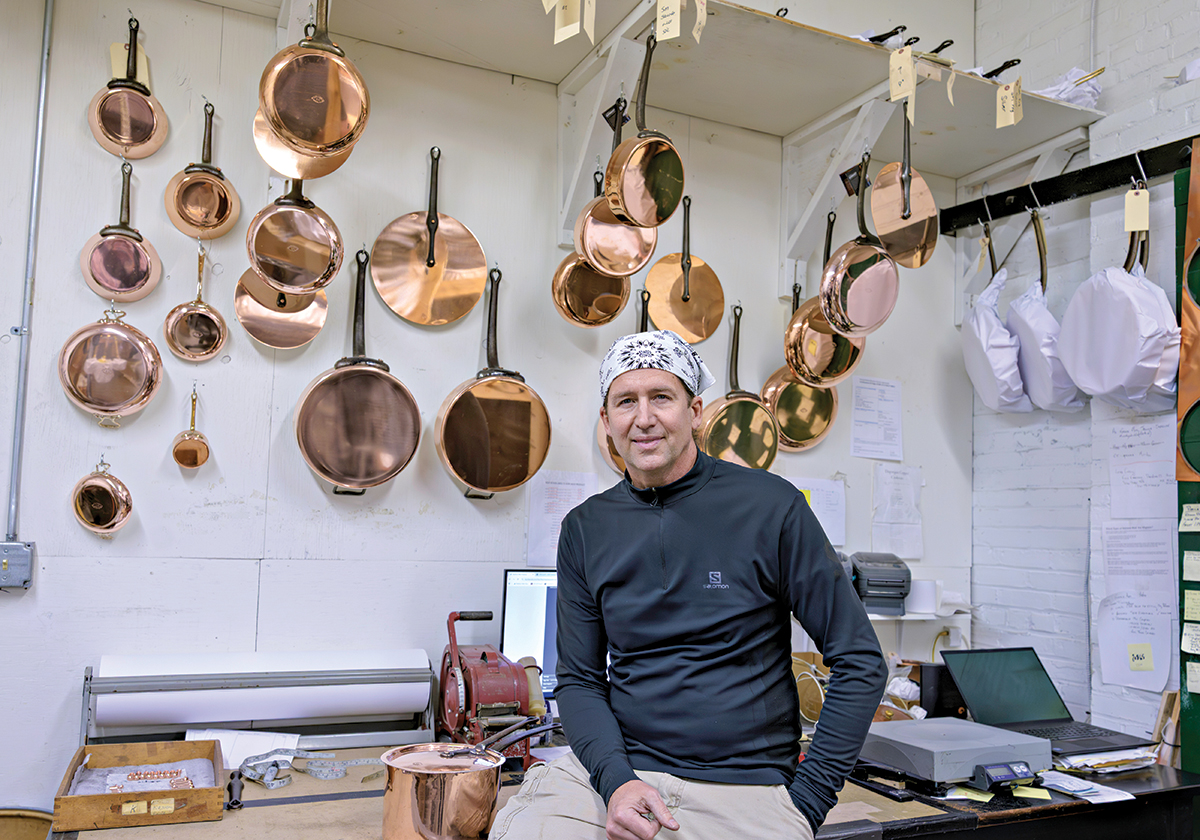
[caption id="attachment_521595" align="alignright" width="321"]

IT’S AN ART: Jim Hamann, owner and operator of Duparquet Copper Cookware in East Greenwich, puts the finishing touches on a pan.
PBN PHOTO/MICHAEL SALERNO[/caption]
Hamann, who is originally from Wisconsin and moved to Rhode Island after college for a job, revived the brand by reregistering the trademark in 2008.
“Once you’re in this world, the brands and names are so familiar,” he said. “I knew about it and understood the brand value in the industry. Anybody who’s in this business is going to run into this brand.”
Today, about a third of the business is dedicated to restoring vintage copper cookware, he said – some dating to the late 1800s – while the rest is split between crafting new pieces and selling refurbished ones sourced from private collections.
One pan sitting on a nearby table, recently restored and ready for use, was originally made in the 19th century.
“It’s 150-plus years old and good to go,” Hamann said. “You could cook in it tonight.”
Each restoration piece tells a story, often marked by stamps indicating where and when it was made – France, Italy, the United States – remnants of a time when copper cookware was a staple in professional kitchens.
That history has found new life in unexpected places.
Duparquet’s restored and newly made pieces have appeared on HBO’s “The Gilded Age” TV show, including in scenes filmed in Newport, as well as a Warwick mansion just miles from the shop.
The production used roughly 100 to 150 restored pieces, along with newly made cookware to outfit period kitchens, Hamann said.
“They wanted things that were authentic to the era,” he said. “So, we had pieces from the 1880s alongside brand-new ones coming out of crates.”
Back in the shop, that same blend of old and new defines the process.
Production begins with flat copper sheets, typically about 3 millimeters thick, considered the “gold standard” for cookware.
Using a computerized cutting system, workers shape the sheets into circular blanks before moving to one of the shop’s centerpiece machines: a spinning lathe dating back to the early 20th century.
The process is as much choreography as it is manufacturing.
Two workers stand on either side of the lathe, guiding the copper as it spins at high speed. One applies pressure, forcing the metal over a mold. The other moves the tool back and forth, shaping the piece in a series of gradual passes.
“It’s a dance,” Hamann said. “You need to know what the other person’s doing, and you need to know what the copper needs.”
With each pass, the flat sheet slowly transforms – 10 degrees, then 45, then 90 – until it takes the shape of a sauté pan or skillet. No two pieces are exactly alike.
“Every pan is different,” he said. “Different ages, different origins, different shapes. That’s where the craftsmanship comes in.”
From there, the cookware is trimmed, polished and lined – either with tin or, in some cases, silver.
[caption id="attachment_521597" align="aligncenter" width="1024"]

GETTING ATTACHED: A worker at Duparquet Copper Cookware prepares to rivet a handle to a piece of cookware.
PBN PHOTO/MICHAEL SALERNO[/caption]
Meanwhile, handles are still attached the old-fashioned way, using rivets – another step rooted in tradition.
“That hasn’t changed much in a thousand years,” Hamann said.
Restorations take about two hours per piece, Hamann said, whereas a full pan from start to finish takes roughly one day to complete.
The team behind the work is small but thoughtfully assembled. One is a trained chef, offering insight into how the cookware will ultimately be used. Another specializes in metal polishing, and a third brings a deep interest in the history behind each piece.
Together, they bridge the gap between function and form.
“I think of this as a food business as much as a metal business,” Hamann said. “It all comes down to how people are using these.”
Customers range from home cooks to high-end restaurants across the country and internationally. Orders have shipped as far as Hong Kong and Norway, while locally, the company has supplied cookware to destinations such as the Ocean House in Westerly.
In New York City, Duparquet pieces have made their way into kitchens at restaurants like Eleven Madison Park and Le Cirque, as well as the Waverly Inn.
Still, the core customer isn’t necessarily a Michelin-starred chef, Hamann said.
“It’s everyday people who love to cook,” he said. “For people who want something they’re going to use every day.”
That everyday use is part of the appeal, and part of what makes the product distinct.
Unlike mass-produced cookware, these pieces are built to last decades, if not generations, Hamann said. Many are purchased as wedding gifts, intended to become heirlooms passed down over time.
“When someone gets one of these, it often becomes their go-to gift,” he said. “It’s something meaningful. And it’s something they’ll use almost every day.”