Tucked in the heart of Pawtucket, once a national powerhouse of American textile production, a third-generation family business continues to spin its legacy in yarn and fabric in a bustling factory built in 1917, as if untouched by time.
Behind the rhythmic hum of 127 knitting machines, North East Knitting Inc. stands as a rare survivor of the state’s once-dominant textile industry: still local, still producing and still finding new ways to grow.
The story begins with Rosalie DaRosa, a Cape Verdean immigrant who arrived in Rhode Island in her early 20s before starting the business in 1987.
“She’s the pioneer,” said her grandson Marcus DaRosa, 26, the third generation now overseeing the family’s manufacturing business. “She grew this to what it is today. This entire place, everything you see – this was her vision.”
Walk through the facility and you’ll hear the steady clatter of needles and the whir of fans, the scent of warm fabric and oil lingering in the air. Spools of vibrantly colored elastic line the walls, and handwritten signs in English and Portuguese guide employees through the maze of machines.
Meanwhile, flags from workers’ homelands – Cape Verde, Italy, Portugal – hang proudly alongside the American flag above the factory floor.
One hundred percent of North East Knitting’s manufacturing is done on-site. That makes the company fully compliant with United States military-grade production standards, enabling North East Knitting to secure specialized contracts across defense and medical industries.
Some of its textiles end up in military and law enforcement uniforms, medical-grade materials, or even everyday undergarments, stretch elastic and knit blends that quietly support the clothes people wear every day.
[caption id="attachment_508178" align="aligncenter" width="1024"]

FAMILY TIES: North East East Knitting Inc. co-founder and President Rosalie DaRosa, middle, is surrounded by, from left, her son Michael DaRosa; her grandson Marcus DaRosa, who now oversees the business; and her sons Alex and Eric DaRosa at the company’s manufacturing facility in Pawtucket.
PBN PHOTO/TRACY JENKINS[/caption]
DaRosa, who graduated from Rhode Island College in 2023 before joining his family’s manufacturing business full time, said the facility produces millions of yards of material per year.
The company even makes items such as straps and belts for the automotive industry, he said.
And it’s all made in a sprawling, 300,000-square-foot manufacturing space in Pawtucket’s industrial downtown area, where 130 employees work to turn 3,000 different raw threads and fabrics into wearable, usable materials.
The facility spans the upper two floors of a four-story building on Conant Street.
On the third floor, one department handles heavy-duty military webbing, including tactical straps and parachute-grade elastic.
Upstairs, knitting machines churn before final inspections are done by hand, and every product is triple-checked before leaving the facility, DaRosa said.
“It’s not just the material that matters,” he said. “It’s how it’s made. If it’s going into a parachute strap or a police vest, it has to meet exact standards – there’s no room for error.”
Most of the machinery is decades old, but some machines still sit alongside newer Italian-built equipment.
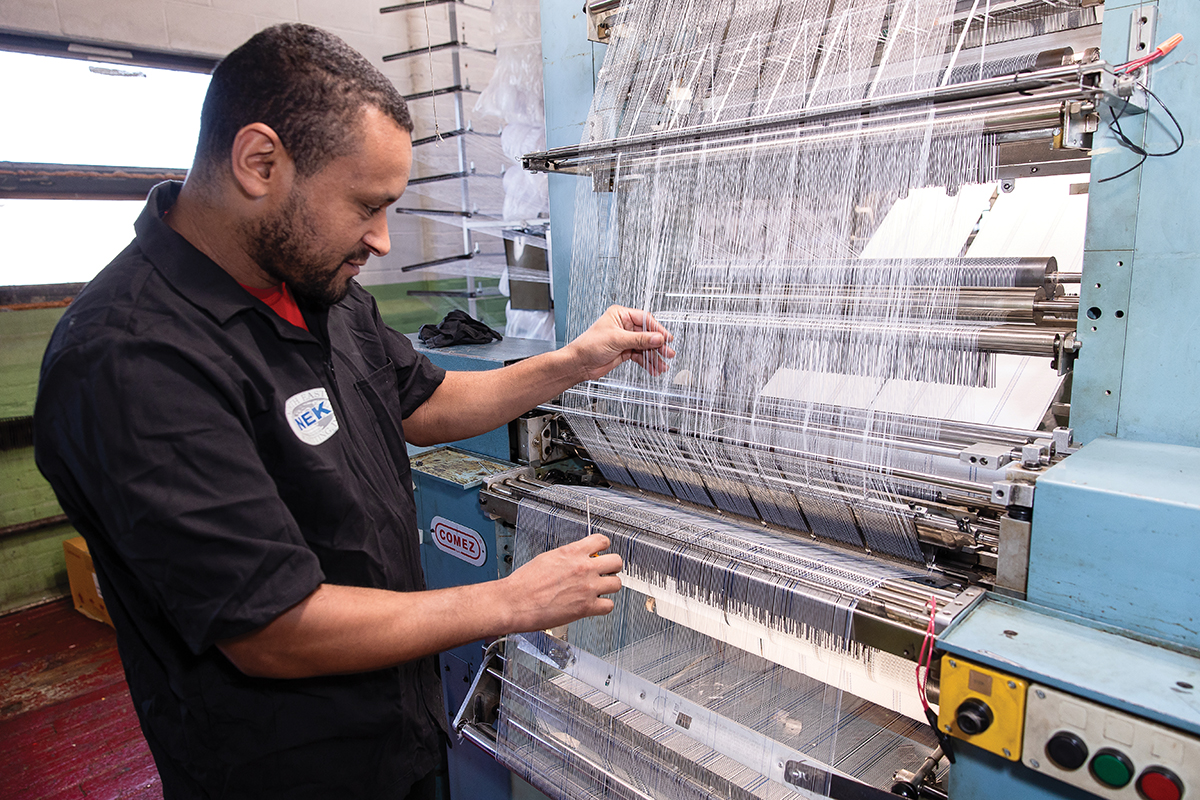
The process is both mechanical and manual: cone by cone, thread by thread, each roll of elastic is carefully tensioned, adjusted and quality-checked at every stage.
After the knitting phase, materials pass through heat canisters reaching more than 350 degrees Fahrenheit, then move into finishing and cutting departments, including festooning, spooling, welding and packaging.
[caption id="attachment_508179" align="alignright" width="380"]

SPINNING: Machines spin fabric into yarn and other materials at North East Knitting Inc.’s manufacturing facility in Pawtucket.
PBN PHOTO/TRACY JENKINS[/caption]
And the people who work at North East Knitting aren’t just employees – they’re part of the building’s story. One longtime employee, lead mechanic Jose dos Reis, or “the Bull” as DaRosa calls him, has worked at North East Knitting since Rosalie DaRosa started the business. He, like many others who work there, lives a few blocks away and still walks to work.
“He’s here every day. Doesn’t want to retire. Says he’ll just come in and check on things because he’s bored,” Marcus DaRosa said. “It’s like a family. People want to work here.”
That sense of community and shared history, he says, helps the company maintain a skilled, loyal workforce despite the industry’s broader challenges.
Another employee started at 16 and will celebrate 10 years on the job this April. And still more – fathers, uncles, cousins – work alongside each other on the same shifts. It’s a kind of continuity that’s disappearing fast in American manufacturing, which in and of itself is rapidly vanishing, DaRosa said.
The U.S. has experienced a decline of 78,000 manufacturing jobs in the past year alone, according to The Washington Post. Artificial intelligence and offshoring have presented very real challenges to stateside manufacturing, prompting companies like North East Knitting to adapt, automate, or shut down entirely.
“Every time some place closes down, we hear it,” DaRosa said. “We have people coming to us, worried: ‘Are we next?’ But we’re not. We’re pushing forward. As long as we’ve got people working these machines, we’re here.”
And while many manufacturers scaled back or shut down, North East Knitting found ways to adapt – and even grow – during one of the most uncertain periods in recent history.
During the COVID-19 pandemic, North East Knitting was responsible for producing fabric ear straps for face masks.
“We were manufacturing a lot of the mask elastics,” DaRosa said. “Before that, it was more of a simple, stagnant formula for our products. But once COVID hit, it was a massive opportunity for us. It has since settled, but it’s introduced us to so many new avenues and opportunities than we could ever imagine. We can absolutely still grow.”
As the industry around the company shifted – factories closing, jobs sent offshore, machines silenced – DaRosa’s grandmother and the family business have remained.
Rosalie DaRosa watched the American textile trade shrink dramatically over the past half-century, but she always kept the machines running in Pawtucket. And she still does to this very day, her grandson said.
“My grandmother is our current president. She’s still here, active after, you know, 60-plus years of doing it,” he said.
Today, the factory’s product ships not just throughout Rhode Island and the U.S. but to Canada, Central America and beyond.
While Rosalie DaRosa’s leadership has sustained the company for decades, the next generation is now focused on ensuring its continued success.
“I feel like I can still make a difference here,” Marcus DaRosa said. “There are 130 families that rely on us. That means something.”