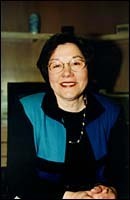
(Al Alexio)
Name: Kathleen C. Hittner MD
Age: 53
Position: President and CEO of The Miriam Hospital
Education: Tufts University School of Medicine, 1973; completed postgraduate
training at Georgetown University Hospital, 1979.
Background: Hittner joined The Miriam staff in 1979. She has been anesthesiologist-in-chief
and chief of the medical staff. She was the first female president of the Rhode
Island Medical Society and Rhode Island Society of Anesthesiologists. She is a
clinical professor of surgery (anesthesiology) at Brown Medical School.
Family: Married
Residence: Providence
PBN: You’ve spent most of your career working at The Miriam. Tell me what you
think its strengths are. What makes it a unique place?
HITTNER: Well I’ve been here 22 years in June. I started as an anesthesiologist and then became very active on the medical staff in general. One of the things that attracted me to this hospital is the medical staff. The quality of the physicians here is extraordinary. When I first applied for jobs around Rhode Island, I was extremely impressed by the consultations that physicians did on patients and how they helped us to take care of the patients. The other very strong thing we have is the nursing staff. And the two go together. I believe that really good physicians need really good nurses, and really good nurses want to work where there are good physicians. That’s why here we have an award-winning nursing staff, which received the Magnet award.
Selling Luxury Real Estate Requires More Than Exposure
By Emilio DiSpirito IV License Partner | Private Office Advisor Engel & Völkers Oceanside www.DiSpiritoteam.com…
Learn More
You became president of The Miriam in April of last year. What’s that transition
been like?
It’s been a wonderful transition. Mr. (George) Vecchione (Lifespan President and CEO) has let me try some things I wanted to try. And I’ve had tremendous support from the staff, both from the people who work here and from the physicians. I often say that I feel like I’ve trained my whole life for this job. I feel like being active in medicine – not just in the practice of medicine, but being active with the medical staff and the Medical Society, has really trained me for this job. And I feel extremely comfortable. Do I get anxious? Do I worry, ‘are we going to make money, how are we going to take care of the patients?’ Of course. But I feel like I know what I’m doing.
Has your vision for The Miriam changed over the past year, now that you’ve
had a chance to see things from that different perspective?
I would say yes, because I’ve been influenced by many things that are going on, by the fine staff we have here, like Sandy Coletta (chief operating officer) and Rebecca Burke (chief nursing officer). But we’ve also gotten ideas from a lot of analysis that has been done by Lifespan on what we need to do to make this a better hospital, what niches of patient care we need to be in. We had a consultant come in to help us with a Lifespan-wide facility plan. And that changed where we think we can build and expand. And so we now have a vision set – we know where we want to be 10 years from now.
What niche would Miriam like to focus on?
Miriam has always been considered a great cardiac hospital, and that’s one of
the niches we plan to expand. And a component of that, actually, is a woman’s
cardiac health program that will be the first of its kind that I know of in the
state of Rhode Island, whereby we will have a female cardiologist who will be
attentive to the special needs of women with cardiac disease. One in two over
the age of 50 will develop cardiac disease. One in 10 women will develop cancer.
And yet much more attention is paid to cancer in this age group of women and not
enough to cardiac – to screening, to treatment of risk factors. We have smoking-cessation
programs, weight-management programs, stress-management programs, diabetes-control
programs, a cardiac rehab program. All the things you need to help women decrease
their cardiac-risk factors. So we think we have all of the pieces here, and now
we’re going to put them together. We hear women talk all the time about how they’ve
had symptoms, and they’ll attribute it to menopaus e until they’ve had so much
heart damage that it was too late to do anything about it. So we think it will
be not only a niche for Miriam, but a true community service.
How much of your time is spent practicing medicine?
One day a week, and usually that day I work in the operating room eight hours.
Do you think there are advantages to the CEO being able to do that?
Yes. Obviously I don’t do as much as the other anesthesiologists. But it helps
me to get a feeling for how the hospital is being run and how the employees are
really acting and thinking. Believe me, they feel free to make any comment they
want to me because they have known me for many years. So I can see, if, for example,
we change something, do they perceive it as a positive thing? It’s like putting
my finger on the pulse of the hospital. And you really understand in great detail
the needs of the physicians and the nurses in order to do their work. So you have
much more empathy and much more of a willingness to push for those things that
you believe are important for them to do their work. I don’t understand as many
of the budgetary situations as well. I’m learning a lot. But that’s why I have
Sandy Coletta. She’s a CPA and has a strong financial background. I feel my job
is to bring physicians in to use this hospital, to make it a hospital that doctors
want to come to.
Miriam has gone from a small independent hospital to part of a large organization
in Lifespan — which would have gotten even larger if the merger with Care New
England had gone through. Is the staff here still adjusting to that structural
change?
This past year, I think people have begun to recognize the importance of Lifespan to The Miriam Hospital. And part of that has actually been my influence, because prior to my seeing all that Lifespan does for us, I don’t think I really understood it. One of the major things is our information system. It wouldn’t be where it is today if we weren’t part of a large organization. Putting our resources together allowed us to hire really good people to develop that system. Today we now have every single patient in the computer; doctors can get access to their own patients, get all their lab work, their cardiograms, their X-rays. Some of the other things Lifespan brings us: research, teaching, residents – because we’re bigger, we’re able to attract better people. We’re able to bring in more residents and rotate them back and forth. So our education, our research – those things that are dear to The Miriam – have been enhanced tremendously.
Was there staff resistance to the idea of another merger?
I don’t know that there was a lot of discussion about that at the medical-staff
level here.
You mentioned having the best doctors is a strength of The Miriam. How are
recruitment issues reconciled between the hospitals, when, for example, Rhode
Island Hospital is also a strong cardiac-care hospital.
We recruit doctors for both sites, like Dr. (Richard A.) Hopkins, who is chief of cardiac surgery at both sites. The medical staffs at The Miriam Hospital and Rhode Island Hospital are very different. The medical staff at Rhode Island Hospital primarily works for foundations, and they work pretty much full time at Rhode Island Hospital. The Miriam Hospital has many private practitioners, so we don’t recruit physicians in the sense that they’re going to come and work for The Miriam Hospital. We recruit physicians to use the hospital. So I’m not competing with Joe Amaral (president and CEO of Rhode Island Hospital) to recruit for a specific position because I’m not hiring doctors for the most part.
Is staffing a big problem at Miriam?
Nursing staffing has particularly been a problem, but there are other areas too. Technician staffing has been difficult to recruit. The way that we’ve hired is a very expensive way and that’s contract labor. It’s worked quite well, but we don’t want to continue that way, because we want our own staff. And so we have put in place many programs to attract people here, nurses here, and to retain them. So that has been, and remains, one of my biggest worries, getting our own staff here at the hospital.
How has Miriam been able to cope financially with the pressures of the last
few years, namely reimbursement decreases and the rising cost of prescription
drugs and medical technology?
We worked very hard last year and this year to keep our patient volume high. We had a positive bottom line last year, significantly positive, and it’s the same this year. We’ve put in a great effort and somehow it’s worked. But we need money. We need to do a lot of work on our infrastructure. We’re spending quite a bit at The Miriam this year doing a lot of construction work. My plan over the next five years is to have a new radiology suite and new operating rooms, so I need to make sure we raise some money to accomplish those goals.
We hear a lot about a national ‘crisis’ in health care. What in your view is
the biggest problem facing hospitals today?
Reimbursement. Specifically in Rhode Island, we’re among the least reimbursed
states in the entire nation. It makes it extremely difficult. And if you add to
that the free care – and Rhode Island Hospital gives much more of that than we
do — and our dedication to research and education, and it becomes a big drain
on the hospital. You have to be careful about your expenses and how you run the
hospital just to break even. And you can’t continue to build up your infrastructure
if you’re only breaking even. I believe a whole new way of supporting medical
education needs to be looked at. Right now it’s on the back of the hospitals and
the government is constantly cutting back. This country wants to have really good
physicians. But somebody’s got to pay for it.