For the last seven years, Joseph Vita has left his Warwick home and driven about an hour – crossing the Connecticut border – to his job as the beverage manager for one of the world’s largest casinos, which just got a little bigger.
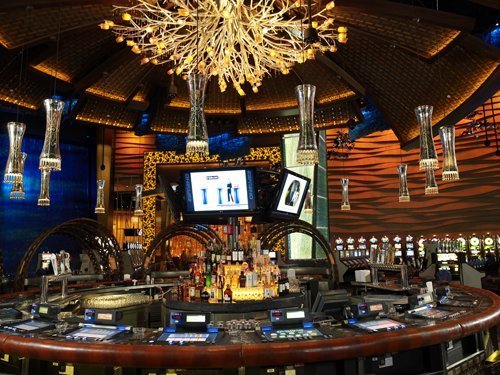
At the Aug. 29 grand opening ceremony of Mohegan Sun’s third casino, the 64,000-square-foot Casino of the Wind, Vita stood behind a circular bar, demonstrating how to make a “Windswept,” the pomegranate-champagne-gin drink he designed for the occasion.
Before taking a job in Rhode Island’s neighboring state, Vita had been with Anton Airfood Inc. at T.F. Green Airport, but couldn’t resist the “opportunity” to work at Mohegan, he said in an interview. “I won’t move to Connecticut, because I like where I am and I like what the state has to offer,” he added, “but Mohegan Sun, it’s basically the No, 1 operation in this business. I love the food and beverage industry.”
And Vita’s business – drawing customers with unique selections and supplying gamblers with complimentary drinks – is part of what’s expected to draw customers into the new casino.
One of the other biggest draws – aside from the Jimmy Buffett’s Margaritaville restaurant opening in September and the new 42-table poker room – is the addition’s interior design.
After the curtain fell at the grand opening – there had been, literally, a curtain that was blocking the new casino’s entrance – a swarm of visitors got the first glimpses inside. There, the centerpiece is arguably a 35-foot-by-50-foot waterfall, on which are projected rotating patterns that are intended to mimic the basket-weaving traditions for which the Mohegan Tribe has historically been known. That’s the work of Rockwell Architecture, Planning and Design Principal David A. Mexico, who’s worked with Mohegan on all of its interior designs, since before the casino’s 1996 debut.
“They wanted to do it in such a way that it was ephemeral, beyond what anyone had seen before – so the third layer [of the waterfall] is the projection and the stone creates a nice background,” said Mexico, whose firm is based in New York. “So you really can’t tell what it is, but as you get closer you understand it.”
The look and feel of the interior is “one of the keys” of the casino’s success, Mohegan Sun President and CEO Mitchell Etess said in an interview. He echoed Mohegan Tribe Chairman Bruce “Two Dogs” Bozum, who in his opening remarks stressed the importance of the tribe’s traditions.
Mexico pointed out the interpretations of the tribe’s “four winds” philosophy in the design: crystal cloud-like hangings represent the north wind, which is the winter; shamira fabric is the east wind that brings inclement weather; silver leaves represent the rain-bringing south wind; and a wooden flock of geese are the west wind, which represents beautiful weather on the horizon.
“Everything has a narrative,” Mexico said, adding that some of the columns – brown pebble-coated ones with interior lights – are representative of the tribe’s “life trail.”
And fitting the new 650 slot machines and 38 gaming tables into that narrative wasn’t much of a challenge, he said. “Slot machines and tables take up only a very small floor space,” Mexico said, “so what we really have to deal with is the walls, the ceilings, the columns, the features.”
The grand opening drew a crowd on a Friday morning. Within 10 minutes of the opening, almost all of the seats at the new 42 poker tables had been filled. Residents of nearby Norwich, Guy and Charlene Brown came. “We’re both retired, so we don’t have anything to do,” Guy said. “So we’re here a lot.”
“Maybe too much,” Charlene added.
Even though it’s less than 30 miles from the Rhode Island border, only about 8 percent of the casino’s business comes from Rhode Islanders, Etess said. And overall revenue has been down this year.
“Our business is down here,” he said. “Our slot revenues are down for about nine months – some people are definitely feeling less positive about the economy and having to make hard decisions about how to spend their money. We’re seeing people coming less or coming and spending less.”
Moody’s Investors Service said last month that it planned to start a review of several bond ratings for the Mohegan Tribal Gaming Authority, “in response to the company’s continued vulnerability to the weak U.S. economy and increased competition in the Northeast.”
Whether Mohegan is operating well could have effects in Rhode Island, too. Waterford Gaming LLC – the company that during 2004 bought Lincoln Park for $435 million and spent $220 million refurbishing it – has revenue that is “substantially” derived from its partnership interest in Trading Cove Associates, which receives a 5 percent revenue-based relinquishment fee from the gross revenue of Mohegan Sun casino, according to Moody’s Investors Service.
Although construction material costs have jumped since the project’s June 2007 groundbreaking, the Casino of the Wind project – the first phase of a $925 million expansion effort for the Uncasville, Conn., casino – was finished under budget, Etess said. He said he could not disclose how far under budget.
When the expansion, dubbed Project Horizon, is completed, it will add another hotel tower – the Earth Tower that will have 919 guest rooms. There will also be 22,000-square-foot spa, 1,500-seat music hall, retail shops and a 300-seat restaurant. It’s expected to be competed by October 2010.
The project is an attempt to update the casino, drawing in new customers Etess said. “The reality is that this creates new opportunities,” Etess said, adding that 340 new employees have been hired for the Casino of the Wind.
But there has also been a growing movement – backed by Gov. Deval L. Patrick –to build three resort casinos in Massachusetts. In March of this year, Patrick told a Massachusetts economic development group that allowing three casinos in the state could create as many as 20,000 permanent jobs and “inject billions of dollars into the Massachusetts economy on a yearly basis.”
Etess, of course, is aware of Patrick’s plans.
“The more competition that there is in the Northeast, the more impact it will have on our business,” he said. “That’s why we’re doing what we’re doing, creating a more dynamic destination – something that people will want to drive to, to see what we have here.”
For some the drive is worth it, said Vita, the beverage manager.
“The fact of the matter is that it’s a little under an hour drive – 50, 55 minutes – so I don’t mind the drive,” he said. “Driving to down here, it’s an easy commute, it’s all farmland. My brother, he drives to Boston everyday. It’s a different kind of commute.” •