
The mortgage industry is bouncing back, but the landscape looks vastly different than before the implosion began more than 18 months ago.
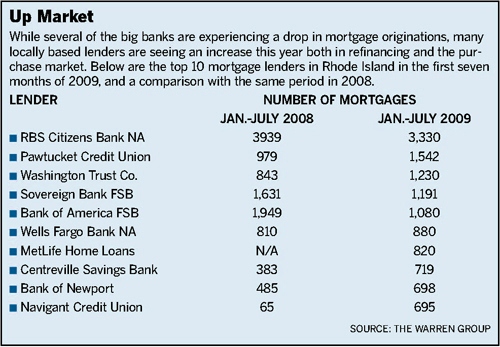
Local brokers and lenders say they have experienced a surge in people seeking mortgages since the beginning of 2009, first in the form of homeowners looking to refinance to take advantage of low interest rates, and now because potential homebuyers want to capitalize on affordable house prices.
Province Mortgage Associates in Providence, for one, recently reported that originations in the first half of 2009 totaled $63.8 million, exceeding the $62.8 million of volume for all of 2008.
“It was very dry over the winter,” Danielle Gervais, senior mortgage adviser at Province, told Providence Business News. “But the purchase market has really picked up recently.”
That experience coincides with the early signs that the local real estate market is at least stabilizing. The number of Rhode Island home sales increased by 6 percent in the second quarter, although the median price of those sales fell 23 percent.
Low home prices and interest rates are boosting the purchase market for the mortgage industry, but some say the federal housing tax credit for first-time home buyers is helping matters as the deadline for the credit looms.
To take advantage of the credit of up to $8,000, borrowers must finalize their home purchases by Dec. 1. But with more stringent government regulations on home loan originations and real estate appraisals, and more thorough credit checks, closings are taking longer, in some cases 45 to 60 days.
“People don’t want to lose out on the free money out there,” Stephen Tetzner, vice president Homestar Mortgage, which has offices in Providence, South Kingstown and Seekonk, said of the recent rush. “We’re very busy.”
In a conference call last month with analysts on The Washington Trust Co.’s second quarter results, CEO John C. Warren called the mortgage activity a “green shoot” in a scorched Rhode Island economy.
Nationally, too, mortgage originations have picked up drastically, with the number of new home loans written in the second quarter jumping 24 percent, according to Inside Mortgage Finance, a Web site for industry news.
But those looking for a home loan are finding it to be a different experience than, say, two years ago.
Gone are countless brokers and originators who became casualties of the subprime meltdown and a weak real estate market that followed. Gone are the lenders that were forced to close when Wall Street grew skittish of buying questionable mortgages that had been packaged into securities.
The Mortgage Lender Implode-O-Meter, a Web-based housing finance tracker, says that by its count, 351 lenders have “imploded” since late 2006.
Also nowhere to be found: Loan products with relaxed income and credit standards, such as Alt-A products that didn’t require borrowers to prove their annual income.
Will they ever return? “Not in my lifetime,” said Mary E. Leach, manager of lending at Bank Rhode Island.
Yet while lenders have tightened their income and credit requirements, Tetzner said potential borrowers with decent credit scores and income can obtain approvals on certain products.
“More people are surprised that they can get financing than those who are surprised that they can’t,” Tetzner said.
Many brokers are steering local applications to government-insured mortgage programs from the Federal Housing Authority (FHA) and the U.S. Department of Veterans Affairs (VA), because those programs typically require a smaller down payment and are less stringent on lending standards than for a conventional loan.
The national Mortgage Bankers Association said the government-insured share of the purchase of mortgage applications in June was 38.6 percent, the highest level since 1990 and up from 27.8 a year ago.
Lenders, brokers and borrowers also face myriad government regulations put into place since the subprime implosion began, which some in the mortgage industry say can delay closings and raise costs.
New rules aimed at preventing home appraisal fraud – called the Home Valuation Code of Conduct – went into effect May 1, prohibiting brokers and lenders from choosing appraisers in mortgage deals that will be sold to government-sponsored Freddie Mac or Fannie Mae. Instead, a third party management company selects an appraiser.
Gervais said that is leading to higher appraisal costs for the borrower and delays in getting a valuation.
There’s the Mortgage Disclosure Improvement Act – in effect as of Aug. 1 – that bars lenders from charging fees upfront in most cases and mandates a seven-day waiting period after the lender has delivered the cost disclosure forms.
In some cases, the tightened scrutiny is overkill, Gervais lamented. Where before lenders were too lax, “we’ve completely gone to the opposite end,” she said. “On one application, you have 15 people checking for the same kind of fraud.”
Nevertheless, those in the industry see a bright future, particularly if the real estate market makes a recovery. With much of the competition weeded out, companies such as broker/lender Homestar Mortgage say they are thriving.
“I’m busier now than I was back [before the subprime problem],” said Tetzner, who declined to give loan volume figures.
Others are looking to take advantage, too.
Providence-based Bank Rhode Island, which has focused on the commercial lending market, has promoted its home loan products since the beginning of the year.
Also preparing for origination growth in a field with fewer players is Westerly-based Washington Trust, which opened a home loan center in Sharon, Mass., last week.
Still, troubles in the industry aren’t over.
Last week, Taylor, Bean and Whitaker Mortgage Corp. in Ocala, Fla., – the nation’s 12th-largest mortgage lender – shuttered its operations after the FHA prohibited it from making government-insured loans through its program.
That development had brokers such as Gervais, who has several loan applications in the pipeline at Taylor, Bean and Whitaker, scrambling to find alternative lenders for their clients.
It’s such problems that have many consumers going to a “local community financial institution” for a home loan, according to Paul Cappello, senior vice president of lending at Pawtucket Credit Union.
Cappello said home loan origination has been steady through the first half of the year – mostly because of refinancing – and there has been an uptick in the purchase market. PCU’s loan volume for the year stands at $250 million, compared with $268 million for all of 2008, according to Cappello.
“I think people want to go where they can have a relationship [with the lender],” he said.
Despite the apparently improving situation in the mortgage industry, brokers and lenders such as Gervais and Tetzner don’t foresee a time when payrolls of mortgage companies will swell again – at least not significantly.
The state requires licensing, background checks and a set amount of hours of continuing education. “There are barriers to entry now,” Tetzner said. “You can’t just jump into it anymore.” •












I think, in the actual uncertain economic situation, it is wise to be very carefully at the moment of dealing with big and small companies all over the world. I’ve recently found an interesting web-site where the enterprises rank each other according to their liability, respect for payment death lines, and so on.
Is: http://www.company-info.biz
The site is pretty new, but I think it would become very useful to be part of it.