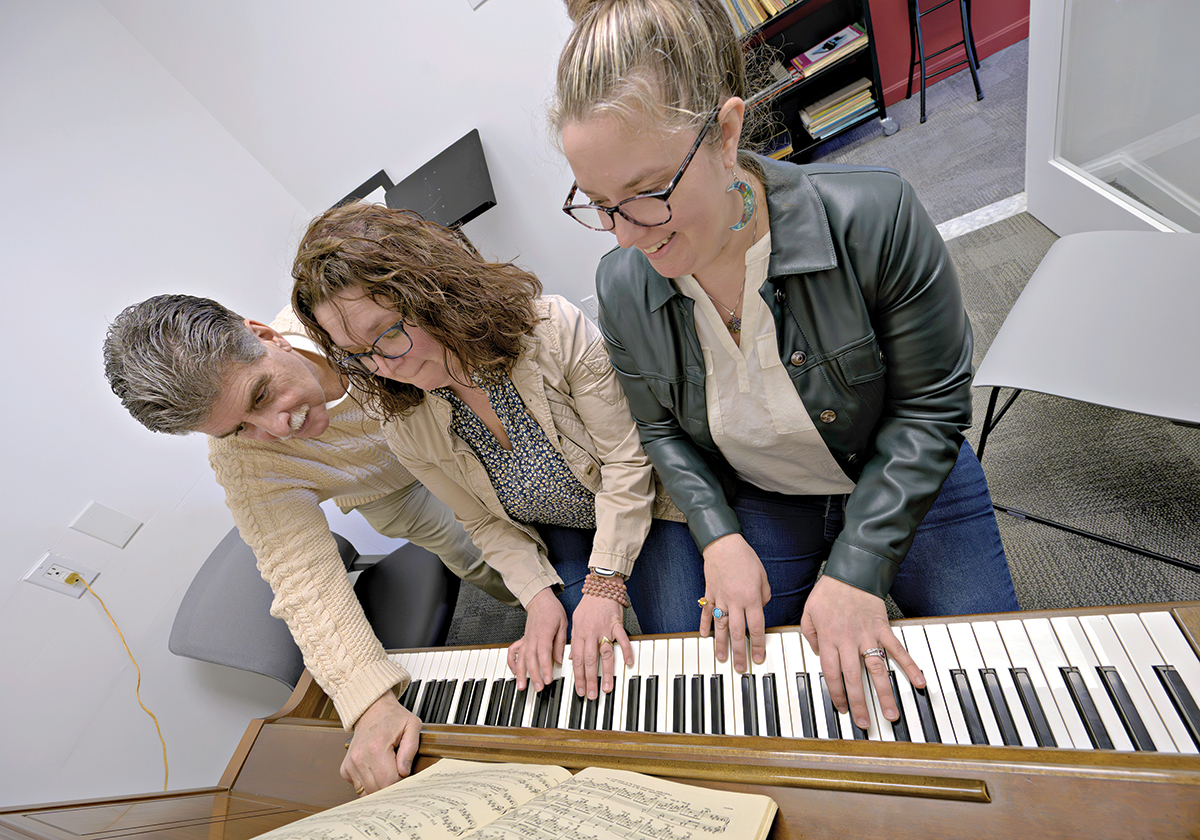
Growing up as the daughters of two music teachers, Rebekah Zabinski and Esther Zabinski had a front-row seat to the value of music education.
“We could ask any question we wanted, and [our parents] set aside time to teach us our lessons,” Rebekah Zabinski said.
In addition to sharpening the cognitive and motor skills associated with learning an instrument, the sisters also understood the ability to teach music as an in-demand skill.
“As we got older, we just know that one could make a living playing music,” Rebekah Zabinski said.
By high school, the sisters were helping their music teachers teach lessons, and in their 20s, both went on to work in musical theater, though primarily on the management side. But in 2010, the sisters became full-time educators with the launch of their own studio, Zabinski Music School.
Sixteen years after the school’s launch in Pawtucket, the sisters and their staff of full- and part-time music teachers work with 230 enrolled students, who attend lessons once or multiple times per week.
Teaching is “a great way to challenge yourself and understand everything you’re talking about,” Rebekah Zabinski said, “because now you have to help someone else understand it, too. So, it helps you be a better musician, too.”
Rebekah Zabinski plays and teaches piano, violin and mandolin, while Esther Zabinski specializes in the performing arts. But the music school’s staff can teach 10 instruments, with the most popular pathways being piano, followed by voice.
Students approach music with a wide range of goals – some may intend to make a career in music, while others view it as a hobby or social opportunity. Many parents also sign their children up for lessons due to the well-researched benefits of music education, such as improvements in academic performance, mental health and coordination skills.
Rebekah Zabinski also suspects that many are drawn to the analog aspects of playing an instrument, seeing it as a way to disconnect from technology and push mental boundaries. Even the sensation of manipulating a surface so different than a touchscreen phone can provide a sense of relief, she noted.
“You get to rely on multiple senses,” Rebekah Zabinski said. “You’re touching [the instrument], you’re hearing it. ... To control the sound the right way is a different way to approach something than what we’re used to, so it’s a fun challenge.”
About 75% to 80% of students are elementary or middle school students, though some attend through high school and even return during or after college.
Esther Zabinksi also works with semi-professional theater performers who want to sharpen their skills before a show.
The school has now reached the point where its earliest students are graduating from college, which Rebekah Zabinksi said has made for particularly rewarding experiences. In one instance earlier this year, former Zabinski student Lauren Boulanger, who currently studies music education at Bridgewater State University, joined the studio as a teacher.
The sisters encourage all students to keep the door open to musicianship after moving on from the school, even if they don’t plan to study or pursue music professionally.
“No matter what they want when they go to college, or when they take a break from music because of their other interests, we encourage them to keep it handy,” Rebekah Zabinski said.
OWNERS: Rebekah Zabinski and Esther Zabinski
TYPE OF BUSINESS: Music school
LOCATION: 139 Benefit St., Pawtucket
EMPLOYEES: 14
YEAR FOUNDED: 2010
ANNUAL REVENUE: WND