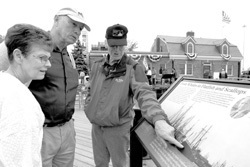
They come for the whaling museum, as always, but also for the historic houses
and gardens, the many art galleries, the Thursday concerts and plays and the
Saturday seafarers’ music and crafts demonstrations.
They stay at places like “haunted” Melville House B&B, sail out on the historic Schooner Ernestina, bike along the water and delight in Portuguese specialties for dinner.
For some, it’s a stopover on the way somewhere else – Martha’s Vineyard, the Cape – but for a growing number, it’s a destination. It’s big with families on the National Park circuit; in the summer, Junior Rangers eagerly study whales to earn their stamps.
ISO 9001:2026: A Practical Opportunity to Build for What’s Next
For Rhode Island manufacturers, ISO 9001 has been much more than a certificate on the…
Learn More
Jennifer Gonsalves, a New Bedford native and director of visitor services at the New Bedford Whaling National Historical Park, loves to see the way tourists from Boston to Europe respond to her hometown.
“People walk in (to the visitors’ center) and say, ‘This is one of the most beautiful places I’ve ever seen. You have such a treasure here. This is a hidden gem,’” Gonsalves said. It heartens her because that’s how she feels about New Bedford, but she’s long been in the minority among city natives. “I’m 39, and I’m one of the few people of my generation who sort of had this vision that I was going to work here in New Bedford,” she said. “All of my peers said, ‘I’m out of here.’”
Once the world capital of the whaling industry, New Bedford has long welcomed tourists to its historic waterfront, where many of the whalers’ descendants still dock their fishing boats. The New Bedford Whaling Museum has taught history and science to generations of children. The 170-year-old Rotch-Jones-Duff House and Garden Museum chronicles a century and a half of economic, social and domestic life in New Bedford.
The Melville House belonged to the “Moby Dick” author’s sister, whom he often visited. And civil rights historians are drawn to the Nathan and Polly Johnson House, where Frederick Douglass lived after escaping slavery in 1838.
Still, the city’s reputation was clearly enhanced when, in 1996, Congress established the New Bedford Whaling National Historical Park, a 13-block area viewed as the best embodiment of America’s 19th-century whaling and maritime history.
“The addition of the national park put what I call the Good Housekeeping Seal of Approval on it,” said Sheila Martines Pina, executive director of the Bristol County Convention and Visitors Bureau. “New Bedford already had a terrific tourism program before the national park designation. They had wonderful attractions. They had great programming. And the national park has just enhanced what was already there.”
Unlike most national parks, New Bedford’s waterfront isn’t a self-contained, government-run site; instead, it’s run as a partnership with the city and with the local nonprofits that run the museums, galleries and other attractions.
The National Park Service provides some extra manpower – six full-time staffers this year – and runs a visitor center and a Web site. It provides promotional materials, and has brought in new federal support, including $400,000 that recently made it possible to replace the waterfront’s aging outdoor interpretive panels and orientation maps.
The federal money also made it possible to create a new permanent exhibit in the Wharfinger Fish Auction Building (Waterfront Visitor Center), “A Working Waterfront,” that is the first long-term acknowledgement of today’s fishermen in the historic district. Local boat owners and fishermen were closely involved in developing the exhibition, Gonsalves said, and while the other historic attractions had never been a big draw for the locals, she sees fishermen at the new exhibit all the time, looking at the photos, pointing out familiar faces and laughing together.
The park’s creation did not turn New Bedford into an overnight success, but it has helped fuel a steady increase in visitors. Gonsalves keeps figures for each individual attraction and for all together, which count as the park’s visitorship. From October through Aug. 31, she said, the whaling museum had 93,558 visitors, and all attractions together, 322,870, up about 4 percent, year-to-date, from 2003.
In all of fiscal 2000, the park had 295,697 visitors, Gonsalves said, meaning tourism has grown by about 20 percent in four years.
Arthur Motta Jr., director of tourism and marketing for the city, said the national park “has had a unifying effect” on the city’s waterfront attractions. All the groups meet quarterly to measure their progress and plan together. “It has made a huge difference, and it’s one that’s building,” he said.
The city’s portfolio of historic attractions is also growing.
The Frederick Douglass house, for example, is about to be restored “to the nines,” Motta said, so it can be a “time capsule” of the pre-Civil War era. The re-establishment of fast-ferry service to Martha’s Vineyard is bringing “more and more people” into the city. And “we’re seeing cruise ships for the first time in 25 years” – coastal day cruises, but still.