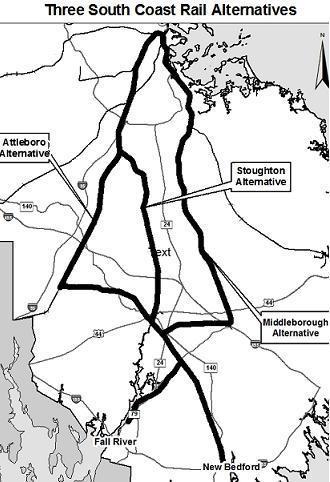
Three months after Massachusetts Gov. Deval Patrick announced plans for a commuter rail line that would extend from Boston to Fall River, New Bedford and Taunton, things are moving forward.
Patrick has hired a project manager, Kristina Egan, for the new South County Rail Project. For three years before taking the job, Egan had been executive director of the Massachusetts Smart Growth Alliance, which has a similar mission as Grow Smart Rhode Island.
Your Business Has Gone Global. Has Your Insurance?
A decade ago, “doing business internationally” was mostly a large-company concern. Today, a manufacturer in…
Learn More
And Massachusetts Lt. Gov. Tim Murray announced two months ago the launch of a $2 million multi-faceted economic development and land use study. Results and recommendations are due by the end of 2008.
“The objective is to figure out how much economic development we can expect from running the rail,” said Egan, who three weeks ago started her new position at the Massachusetts Executive Office of Transportation. “And what are the land use changes that are going to help keep the line with high ridership while making sure we’re preserving open space … and environmental resources.”
Efforts will be made to work with the cities and towns to determine how land use changes can benefit them and the state as well, she said.
In addition, the study will determine ways the state can use money generated from new developments along the commuter rail stops to pay back some of the $1.4 billion the project is expected to cost by the time it’s completed by the end of 2016.
Fall River Mayor Edward Lambert Jr. said he is “much more confident” than he had been in the past regarding the recent efforts to ensure that the commuter rail extension will actually take place under Patrick’s administration. Various governors have presented studies and plans for the extension since the early 1990s.
“There really is an economic justice issue relative to connecting Fall River and New Bedford to the rest of the Commonwealth,” Lambert said, adding that Fall River and New Bedford are two of the few remaining cities without a commuter rail stop – though nearly 40,000 people in the South Coast region commute out of the region to go to work every day.
EOT also will be conducting an alternative route study, Egan said, to determine which of three routes would be the best for the region.
There was a study conducted in 2002 that suggested a route through Stoughton, Mass., would be preferable.
“We’re going to take a fresh look at that,” Egan said. “There are significant environmental and other issues with each route. We’re just trying to make sure … we’re really thoughtful about this.”
Egan said she is confident there is a way to ensure the region grows in a sustainable way that protects the forests, wetlands and farmlands that give the South Coast its character.
“The governor is really committed to … pushing for economic development while enhancing the environment,” she said, adding that the two are not mutually exclusive.
Lambert said he is comforted by the fact that the governor and his cabinet have been visiting Fall River and making a case for the project and communicating that case to the rest of the Commonwealth.
“It’s significant for us in terms of the clarity of the argument and how it will enhance our development here,” he said. “It’s significant when we see what rail extension has meant in other cities.”
Lambert said he expects the commuter rail stop will “keep a lot of our young people here and working, help maintain the middle class and will help our development going forward.” He added that those are three big issues for Fall River, as they are for other urban areas.
“If we want to provide a good quality of life, we need to provide a good tax base,” he said.