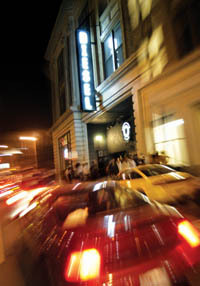
Club Diesel on Washington Street in downtown Providence has been the subject of attention from the Police Department.
Providence invites all sides to seek solution
It’s a concept that most all of the players seem to be able to agree upon – downtown Providence should have a vibrant nightlife, so long as it’s respectful of the area’s other uses. But until recently, discussions on the matter rarely have included all the major stakeholders.
Cybersecurity Awareness Month: What to Do When Your Identity Is Stolen
In recognition of Cybersecurity Awareness Month, it is important to remember that identity theft affects…
Learn More
Now, in an effort spearheaded by the Downtown Improvement District, everyone will get a seat at the table.
According to Frank LaTorre, director of public space for the district, downtown residents, club owners, property owners and safety personnel – including representatives from the Providence Police Department – have begun to meet to address the issue.
The first meeting, in late May, came on the heels of a decision in the show-cause hearing brought by the city Board of Licenses against Diesel, the city’s largest nightclub.
The police had alleged that the presence of the club, in The Strand building on Washington Street, had produced enough incidents of violence and underage drinking that the club’s liquor and entertainment licenses should be revoked.
Ultimately, the Board of Licenses decided not to shut Diesel down. It did, however, impose a month-long penalty on the club, forcing it to close an hour earlier in July than its licenses otherwise allow.
LaTorre said that the idea of starting the meetings among the major stakeholders did not arise specifically from the Diesel situation. Rather, he said, it was time for the meetings because ‘‘everybody had been talking about it on their own.’’
The first meeting brought together four of the elements of the downtown to discuss some of the issues. It was mediated by the Responsible Hospitality Institute, a Massachusetts-based organization that has worked to strike a balance between competing interests across America. Meetings will be held through the end of the summer and early fall, LaTorre said, with definitive action points to be announced afterward.
But in many ways, he said, although the issue is relatively new to Providence, the local situation is a ‘‘microcosm of what’s happening all across America’’ as people begin to migrate from the suburbs back into cities. And in most of those cases, a balance has been struck.
Some people have the misconception that the two sides are mutually exclusive, LaTorre said. ‘‘The two have merged together wonderfully and, in fact, created a great synergy in a lot of cities. It’s a matter of just managing it properly and having all partners at the table to make it work right.’’
Ari Heckman, a development associate at Providence-based Cornish Associates, said his company believes a balance can be struck.
Cornish has developed mixed-use projects in Providence and elsewhere. Over the years, the company has received complaints about clubs downtown, particularly Diesel and places that ‘‘ foster mass underage drinking,’’ Heckman said.
But the company has no desire to rid the downtown of its nightlife, he said. Instead, Cornish, which advocates the principles of new urbanism, views the entertainment scene as part of what attracts people to the city and makes it an interesting place.
The issue, Heckman said, is that Providence is in a state of transition from a neighborhood that contained little more than nightclubs to one where residents are beginning to inhabit lofts and condominiums.
‘‘For so long, there was nothing,’’ he said. ‘‘The nightlife could thrive unchecked. Now, we have a new residential neighborhood that’s only growing as more and more projects come on line. … There’s going to have to be a balance.’’
The Providence Foundation, which has worked since its inception to promote development in the capital city, also supports finding a middle ground, said Daniel Baudoin, its executive director. The foundation has sought the creation of a vibrant, mixed-use downtown with a combination of offices, retail, hotels, universities, residences and entertainment.
‘‘We want all this activity,’’ Baudoin said. ‘‘We just need to recognize that it’s going to take more management of it and more recognition from people that there are different users of downtown. Everyone’s rights need to be respected.’’
As a club owner, Joshua Miller, owner of Trinity Brewhouse and co-owner of The Hot Club, on the waterfront – which also has condominiums nearby – said that as long as residents are taking issue with aspects of nightlife, the problems will remain.
But Miller, who is taking part in the Downtown Improvement District discussions, said he would support reasonable measures to promote a friendlier environment. Among them, he listed initiatives aimed at curbing violence and underage drinking.
‘‘It only makes it a more positive environment for my customers if that happens,’’ Miller said.