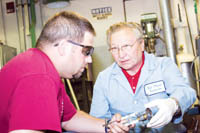
Instructor Robert Plante aids Eric McKeon, left, during his class on basic oil heat technology at New England Tech, which has provided corporate training since 1986.
Rybovich is building and servicing more yachts than its employees can handle. The solution for the West Palm Beach, Fla., firm: hire more skilled tradesmen with knowledge of mechanics, welding, fiberglass, carpentry and electrical work.
The problem is that the region lacks the skilled labor pool to fill Rybovich’s new positions, said Bill Yeargin, executive vice president.
ISO 9001:2026: A Practical Opportunity to Build for What’s Next
For Rhode Island manufacturers, ISO 9001 has been much more than a certificate on the…
Learn More
So, he said, the company plans to tap the existing labor force for people “with the right aptitude, but not necessarily the skills,” then provide training sessions to bring them up to speed. But instead of looking for training programs in its own back yard, the 300-plus employee company is seeking the expertise of instructors from the New England Institute of Technology in Warwick, almost 1,500 miles away.
“I’ve known about them for many years,” Yeargin said. “They’ve got a good reputation in the industry.”
Yeargin knows of New England Tech – as it’s more commonly known – mainly through the American Boat Builders & Repairers Association, which chose the technical college as its “primary training partner” about 10 to 15 years ago, according to Mark Amaral, managing director of the association.
The key to attracting trade associations, large corporations and even government training contracts lies in the expertise of New England Tech’s instructors, said Steve Kitchin, vice president of the school’s corporate training and education program.
The instructors come from their fields of instruction, he said. If they are teaching boat building, then they used to build boats.
In Rybovich’s case, Kitchin said, he’s sending two instructors to Florida in August to lead a 60-day training session for a class of about 20 students.
Though the school has been providing corporate training for New England companies since 1986, its annual outreach to companies and organizations nationwide has doubled in the last 10 years, to about 2,000 students employed by hundreds of companies, said Kitchin.
More than half of New England Tech’s corporate training is now for companies outside Rhode Island. Whippany, N.J.-based Suburban Energy Services, for example, started contracting with New England Tech for training services two years ago.
“I did some research and found that New England Tech had a great reputation,” said Tammy Cronin, director of training at Suburban Energy, which employs 4,000 people nationwide and supplies propane, natural gas and heating oil to about 1 million homes, farms and businesses.
The company uses local training facilities for its needs. After acquiring Agway Energy Products in Vermont, it needed one in the Northeast.
Cronin said New England Tech’s “top-notch” facilities and its ability to customize training to meet Suburban Energy’s specific needs were what initially attracted her to its program.
The school created training boards specifically for Suburban Energy, simulating the breakdown of various parts of an appliance, so a technician trainee must figure out how to fix it. “They knew we need to provide hands-on training for our people,” Cronin said. “Adults learn best by doing.”
Cronin said she was so impressed with one of the instructors, she hired him to teach a class in Syracuse, N.Y.
In addition to sending its instructors to other states, Kitchin said, New England Tech also runs programs in which employees travel to Warwick for training.
The U.S. Army Signal Corps, for example, last month sent 30 members from California, Texas, Louisiana and Georgia to New England Tech for training in information technology, said Maj. Juan Howie, a Signal Corps battalion commander.
“We looked at three institutions of similar regard,” Howie said, adding that each had to meet the military’s standards for safety, logistics and curriculum. “New England Tech had the best facilities.”
The Signal Corps was looking for an additional training facility due to the increasing mobilization of soldiers to Iraq and Afghanistan, he said. “We didn’t have the facilities to handle it.”
Howie said the session at New England Tech was the first time the Signal Corps had ever contracted with a non-government organization for training. “We found it was a lot cheaper to use a civilian training program.”
He added that he is almost certain the corps will use New England Tech for another training session next year. Next time, he predicts, it will send three times as many students.
Kitchin credits positive word-of-mouth with helping the school attract national attention, as its growing number of graduates “reach beyond the geographic border of Rhode Island.” New England Tech’s enrollment has grown three-fold in the past 20 years, and stands at about 3,100 today.
The nationally and regionally accredited technical college began as a proprietary trade school in 1940. Initially, it provided training for people in the rubber and plastics industry – though it started diversifying early on, as the radio, television and electronics industries grew.
In the early 1970s, it became a nonprofit institution offering associate’s degrees. By 1990, New England Tech had four bachelor’s degree programs. Today, it has nine bachelor’s degree programs and more than 20 associate’s degree programs.