
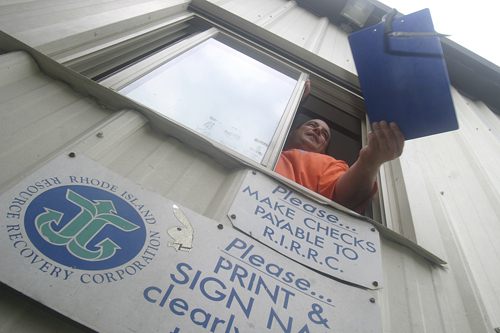
R.I. Resource Recovery Corporation Executive Director Michael O’Connell says dumping at the state Central Landfill has been too good a deal for commercial trash haulers for too long.
With the state-owned dump in Johnston just a few years from reaching capacity at its present size, the quasi-public state agency is hiking its prices to more closely match the average regional fees and to discourage trash companies from heaping on the refuse.
Since July 2007, commercial dumping fees – otherwise known as tipping fees – have jumped more than 26 percent, with the latest increase from $56 to $65 per ton going into effect last month.
It is not clear how much of those increases have been or will be passed on to Rhode Island companies that pay for private garbage pickup. Steven Changaris, regional director of the National Solid Waste Management Association, said some haulers will try to resist charging customers more – at least initially.
But many solid waste companies already are feeling the pinch from higher fuel costs. “So my sense of the marketplace is that customers will see it passed through to them fairly quickly,” Changaris said.
Indeed, a spokesman for Waste Management Inc. – one of the largest trash companies operating in Rhode Island – acknowledged last week that higher fees are resulting in higher prices, but he declined to detail those changes.
Nonetheless, O’Connell said recently that the tipping fee hikes – which leave Central Landfill charges still well below the market rate of $85 to $120 a ton – are having the desired effect at the landfill.
He said the volume of garbage coming into the landfill from commercial sources has dropped by 20 percent in two years. Part of the reason: Price-sensitive solid waste companies are now hauling some trash produced in Rhode Island to less expensive, company-owned transfer stations in other states.
Haulers also are trucking increased amounts of trash to the recycling plant. And O’Connell suspects that the increased fees have made it less worthwhile for some haulers to sneak garbage from other states into the loads dumped at the Central Landfill, an illegal maneuver.
(A trash truck driver was arrested by Johnston police last week for dumping waste from a construction site in Seekonk.)
“I’d love to be giving Rhode Islanders a great deal,” O’Connell said. “But when the fees are too low, there’s no incentive to recycle, and it does encourage waste from other states slipping in here.”
And that means the lifespan of the landfill is shortened.
“Not every town wants a dump in their midst, so this is probably going to be the last one that’s going to be sited in Rhode Island,” O’Connell said. “We have to be careful and protective of it.”
That hasn’t always been the case.
RIRRC used to offer a discount to the haulers that brought in the most garbage, according to officials. The apparent philosophy was that higher volume meant higher revenue for RIRRC.
And that revenue is all important. The $70 million agency relies solely on dumping fees, not on state subsidies, to survive. In fact each year, RIRRC makes money for the state, pouring several million dollars into the general fund.
The agency transferred about $5 million in surplus to the state in fiscal 2008, and this year’s state budget calls for another $7.5 million from RIRRC to be placed in the state coffers.
O’Connell, who has been on the job since last year, wants to operate differently.
His thinking: Revenue, although still critical, should be secondary to prolonging the life of the dump. “We have to get smarter and work differently in order to remain financially self-sufficient,” he said.
RIRRC has seen its share of controversy in recent months, with questions of possible mismanagement by former administrators raised by O’Connell after he was appointed last year. A forensic audit is under way.
Then in July, O’Connell fired five longtime managers as part of an effort to operate more efficiently.
In the meantime, experts estimate that the landfill has three years left before it is filled to capacity at its current size. It is projected that a 100-acre expansion plan that is about halfway through the permitting process with the R.I. Department of Environmental Management will add another 10 years to its life.
By reducing volume, O’Connell’s goal is to extend dumping at the landfill to 25 years or more.
With commercial solid waste making up about 70 percent of the incoming trash at the Central Landfill, according to a 2007 audit, agency administrators figured raising the fees would go a long way to cutting volume.
How have the haulers reacted to the price increases?
O’Connell said most of the 75 haulers that have contracts with RIRRC have not objected, in part because the agency stopped offering discounts to larger haulers that some said enabled them to submit lower bids for jobs.
“I met with all the haulers, and they said all they wanted was for everybody to have the same rate – no special deals,” O’Connell said. “Now they’re happy it’s a level playing field.”
Aside from the environmental issues, there are financial reasons why saving the Central Landfill is so important.
Right now, cities and towns pay a much lower tipping fee – $32 a ton. The price, set annually by state legislators, has remained unchanged for the last 17 years.
But when the landfill runs out of space, Rhode Island communities are going to be at the mercy of privately run dumps outside of state that charge much higher rates.
“At that point, get your checkbook out; Rhode Islanders are going to pay – plus,” O’Connell said.
In addition to the hike in commercial tipping fees, there are other factors reducing the volume of trash coming into the Central Landfill, according to O’Connell.
Some of it is due to the slow economy – people buy less, and likewise throw out less. He also credited growing momentum in the green movement. For five straight years, the recycling rate among the state’s municipalities remained flat, but in fiscal 2008, that rate climbed 6 percentage points. Now 24 percent of the solid waste that is brought to RIRRC is recycled. O’Connell is hoping eventually to get that number to 30 to 40 percent.
As an incentive, RIRRC recently took half the income it generated from selling recyclable materials – about $2.3 million – and split it among the cities and towns.
The increased commercial fees and the growing recycling program are critical for the future, according to O’Connell.
“It’s saving the landfill for the municipalities that continue to bring their trash at that $32 rate,” he said. “When that rate goes away, it’s going to quadruple or quintuple. •




For some reason it is NEVER mentioned that the Landfill and the residents of the Town of Johnston have entered a legal agreement to close the landfill. There is only a couple of years left on that contract so the Director should be converting the dumps old way of burying valuable recyclables into a process that sorts 100% of the trash that enters the facility. Recovering those “commodities” to be sold instead of recovering them with dirt would be one suggestion.