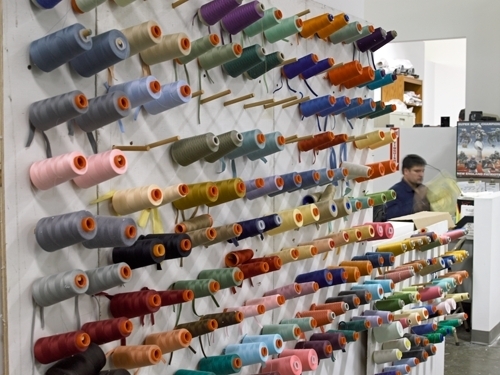
After eight decades of importing, manufacturing and selling fine linens, John Matouk & Co. Inc. will make a big change this year: It will invest in a large-scale, solar energy system that will power about 30 percent of its Fall River facility.
Founded in 1929, the company is one of the country’s largest manufacturers and distributors in the luxury linen market, President and CEO George Matouk said. The 39-year-old Matouk took over from his father, also George, in 2002, and is the third generation of Matouks to serve as president.
“Now we’ve signed a contract to install a 120,000 kilowatt system on our roof,” Matouk said. As of late June, he had applied for a rebate from Massachusetts – which could take about a month for approval. The system, from Borrego Solar Systems Inc., should be up and running about six weeks after that approval is granted. “It’s going to fill the better part of a 9,600-square-foot roof. … The system will include 472 solar panels.”
And Matouk isn’t the only manufacturer in the region that’s attempting to green their energy consumption.
In Portsmouth, Hodges Badge is finalizing plans for a 225-kilowatt wind turbine on its nine-acre property. And, similar to John Matouk & Co., that company is now in the hands of new generation of leadership. Frederick Hodges III, the fourth generation of his family to run the company, has been president for about a decade.
Hodges said recently that the turbine will be about 190-feet tall and cost about $900,000. It will power his entire Portsmouth facility. Hodges is also seeking about $250,000 from the Rhode Island Renewable Energy Fund. Pending approval of that grant and final town zoning, the turbine could go up by the end of 2010. Last year, the company spent $74,900 on electricity.
Matouk’s system, at 120,000 kilowatts, will have an output that’s large enough to power more than a third of the Fall River facility. Along with the cost of the panels, Matouk is spending about $30,000 to resurface the roof because he wants it to last for the estimated 30-year life of the panels.
“It’s a big investment, but there’s a tremendous federal and state financial incentive to do it,” he said. “In fact, the state rebate portion of this project should be in the neighborhood of 40 percent. And the federal government as part of the stimulus plan gives another grant that’s worth about 25 percent.”
Because those grants will greatly cut down the cost of the project, it now makes financial sense and isn’t just an environmentally conscious decision, Matouk said. The company now uses about $100,000 worth of electricity a year and the panels will produce enough electricity to pay for the investment within five years.
Neither of the manufacturers has been drastically affected by the market forces that have caused cuts or closures at many manufacturers in the U.S. In describing their success – or at least staying stabile year over year – both pointed to their ability to quickly produce and deliver highly customized products.
At Hodges Badge, founded in 1920, a good portion of the business comes from event organizers who make last-minute orders. Because Hodges produces its badges – ribbons for equestrian and athletic events or for schools and fairs – in the United States, it can process custom requests quickly. That sets them apart from those companies that have outsourced their production.
“We can turn things over quickly, although we like people to give us three weeks,” Hodges said. “That’s what keeps us in business. The products you can find at the dollar store or iParty that say ‘Happy Father’s Day’ or something else can be made a year in advance. But if you’re going to” an event like a gymnastics meet, you can’t order that far in advance.
And at Matouk, licensing agreements that include Lulu DK, the linen-design company run by Lulu de Kwiatkowski, has added business. There are also custom in-house designs, like the “Bespoke by Matouk” line, that cater to individuals.
“We use it for a real competitive advantage, in that it allows us to create customized products for small but highly demanding and high-margin clients around the United States,” George Matouk said. “That allows us an edge over most of the big players in our industry, who are dealing with import-only models.”
Still, Matouk said he often hears from people that they see his business as an “antiquated model” for production.
“I really look at the company as a luxury-product marketing business, with the distinct competitive advantage built on our production facilities,” he said. So while his products can’t be found at any national retail chains, they can be found at smaller shops in almost every state, including Wendy Brown Fine Linens in Providence’s Wayland Square and The Linen Shop on Newport’s Bellevue Avenue.
And the company’s foray into being a green manufacturer will help Matouk market itself as an American manufacturer that is using new techniques as part of socially and environmentally responsible manufacturing.
“A solar energy system can become a potent symbol for a company’s future,” George Matouk said. “And an old-line manufacturer like myself is constantly fighting the perception that textile manufacturing is either obsolete or perhaps even unsavory in today’s modern environment.” •