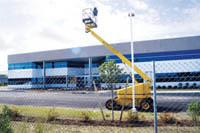
HEXAGON METROLOGY has almost completed its new North American headquarters in Kiefer Park at Quonset Business Park, but there are no more large lots left in the light-industrial district for other major tenants to move in.
Prices at Quonset Point up sharply as the demand for land increases
The building is almost ready: 115,000 square feet for offices, product engineering and manufacturing, labs, and training and demonstration spaces. Within months, Hexagon Metrology will be moving its North America headquarters here.
Selling Luxury Real Estate Requires More Than Exposure
By Emilio DiSpirito IV License Partner | Private Office Advisor Engel & Völkers Oceanside www.DiSpiritoteam.com…
Learn More
Hexagon, which owns the former Brown & Sharpe Mfg. Co., is the biggest and best-known new tenant of the Kiefer Park section of Quonset Business Park, in North Kingstown, but it’s hardly alone. In fact, only “infill” parcels are still available in the 154-acre district, which is geared to light industrial users.
And anyone hoping for a bargain isn’t going to find one. In the last couple of years, as Quonset has been revitalized and CB Richard Ellis/New England has been promoting the park, land prices have jumped dramatically.
“When we started, 18 months ago, they were getting $40,000 to $60,000 an acre,” said Gerald Lavallee, a partner and vice president at the real estate company’s Providence office. “Now we’re getting $175,000 to $200,000 an acre. In West Davisville, we’re up to $160,000.”
Industrial space – good space suited to modern manufacturing– has been at a premium in Rhode Island for several years. Vacancy rates are very low: 4.4 percent, overall, in 2004, and 5.9 percent in 2005, according to a CB Richard Ellis report.
As of last year, there were 47.1 million square feet of leasable space, the company said, and a quarter of the available square footage was in just five buildings. The shortage boosted prices by about 25 percent from 2004 to 2005, with buildings selling for $45 to $70 per square foot.
So is the market responding? Are developers creating new industrial parks and preparing sites so they are “pad-ready” for anyone who wishes to build a new manufacturing plant?
To some extent, but not a lot.
Saul Kaplan, executive director of the R.I. Economic Development Corporation, said he’s pleased to see “multiple locations around the state” where industrial space is being developed and redeveloped, including mill rehabs that involve a mix of uses, with some light industrial and research-and-development space.
There’s also plenty of activity at Quonset, Kaplan said, “which is a good thing for all Rhode Islanders.” Lavallee said the park is particularly good for industrial use: It has good topography (flat and clear), all the infrastructure is in place, and it’s easily accessible.
But the campus-like Kiefer Park has only parcels of less than 15 acres left, Lavallee said. (Quonset’s Web site lists available sites ranging from 1.8 to 7.7 acres, a mix of “mature industrial facilities” and ready-to-build parcels.)
The park also has infill sites available in West Davisville and Commerce Park, Lavallee said. Right now, 15 parcels are under agreement – with preliminary deals signed, but due diligence still being conducted.
The rest of Quonset is being marketed in bigger chunks, either for large tenants – such as Bristol-Myers Squibb, which has since chosen to site its new plant in Massachusetts, instead – or for substantial developments such as the 60-acre gateway project being built by New Boston Development, with a hotel, offices and retail but no manufacturing space.
Elsewhere in the state, the prospects are mixed, as well.
“I think there are pockets,” Lavallee said. There is a substantial piece of land next to the R.I. Resource Recovery Corp., in Johnston, he noted, and the East Providence waterfront, which the city has targeted for redevelopment, is an “excellent site.” CB Richard Ellis already has helped place one new industrial tenant there, Aspen Aerogels.
The relocation of Interstate 195 will create space that will likely be developed for a variety of uses, including light industrial, Lavallee said. But much of Rhode Island’s existing space isn’t suitable for modern industry, he said, because it was built for jewelry manufacturing and has low ceilings and other flaws. Those buildings are better reused as offices and housing, he said, and much of the state doesn’t have sites with the infrastructure to support industrial development.
“We’re not full of a lot of fantastic sites that sit there today, pad-ready,” Lavallee said. “We need to be thinking outside of the box and be creative about it.”
Kaplan said the RIEDC is trying to encourage communities to identify viable sites, and zone and prepare them for development. For biotechnology, in particular, there has been talk of building move-in-ready facilities – but that is “a riskier proposition” for developers, he said, so the state might have to get involved. “You have to make tough choices,” Kaplan said.
In the bigger picture, however, he said he believes “the market is starting to respond,” and the key to promoting development is to “create visible and strong demand for this kind of space.”
Even with growing demand, there are obstacles. Providence-based Gilbane Development Co., for example, is building industrial space elsewhere in the country, but not in Rhode Island.
Asked why, Vice President Edward Broderick said there are several factors. Gilbane has favored sites with even higher demand, major population growth and such advantages as the intersection of major trucking routes, he said. But the biggest factor is cost.
“There’s a higher cost of operation and cost of living [here], and I think taxes are a challenge that needs to be dealt with,” Broderick said. To some extent, the government can help ease the burden for developers, he added, “but it’s also the general environment that Rhode Island is operating in that can make that a challenge.”
The market here is “trying to find an equilibrium,” he said, and smaller developers are doing projects that will help. More places like Kiefer Park, with visible new projects such as Hexagon, are also a plus, Broderick said. “You need more of that type of an environment.”