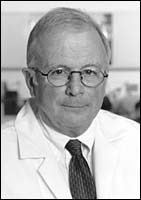
director of research
at Roger Williams
Hospital.
Roger Williams Medical Center this week is launching a new stem cell research center, which scientists say will administer innovative experimental treatments to fight all forms of cancer.
A handful of patients already have received stem cell transplants, after the arrival in January of Dr. Peter J. Quesenberry, an internationally known stem-cell researcher.
A modernized health plan: Supporting cost management and the employee experience.
The Surest health plan came from a group of innovators wondering: What if health care…
Learn More
Quesenberry — former director of the Cancer Center at the University of Massachusetts
Memorial Health Care and now director of research at Roger Williams — brought
with him a team of researchers to spearhead the Center for Stem Cell Biology
at Roger Williams. It is the first facility in Rhode Island dedicated to clinical
stem-cell research.
Doctors plan to enroll patients with all forms of cancers. But the most solid evidence that the treatment works is based on clinical trials with blood-cancer patients in the UMass program.
“We’re already pretty sure it works in patients with leukemia, lymphomas and myelomas,” said Quesenberry, who has secured more than $1 million in grant money from the National Institute of Health.
A number of leukemia and lymphoma patients who underwent clinical trials at
UMass — patients initially expected to die within a few months – have been
living free of disease for two years or more following treatments, Quesenberry
said.
The test platform is a new approach to stem cell transplantation, in which doctors use a tiny fraction of the radiation and chemotherapy used in conventional stem cell transplants.
For patients with blood cancers, stem cell transplants are far less invasive than bone-marrow transplants. The cells are harvested from either the patient’s or a donor’s blood or bone marrow, then infused into the recipient’s blood stream in a procedure similar to a blood transfusion. Within a few weeks, the cells make their way into the bone marrow and begin producing healthy blood cells.
Traditionally, patients are given potent doses of radiation and chemotherapy in advance of the transplant. But in the new protocol at Roger Williams, transplant recipients are given extremely low chemo-radiation doses, or “almost no treatment at all,” Quesenberry said.
The stem cells still spark an infusion of cancer-fighting immune cells, called T cells, but the risk of the toxic effects seen in conventional stem cell transplants is much lower.
“We’ve been able to show that you don’t need high levels of (chemo-radiation) treatment,” Quesenberry said. “The key determinant is T cell engraftment. We’re pretty sure that if we can deliver the T cells in some form, we’re going to get a positive result.”
Still, it’s a delicate balancing act. Those same cancer-fighting T cells can also attack the recipient’s healthy cells, which is a frequent and potentially deadly complication of stem cell transplants called graft-versus-host disease (GVHD).
The lower levels of chemo-radiation therapy help prevent the onset of GVHD. Healthy T cells also can be stored and infused into the patient later to help ward off GVHD while they continue fighting the cancer cells.
Quesenberry says only a small handful of research teams are doing similar clinical treatments. An article in a June issue of the medical journal Blood Weekly highlighted a study by the Fred Hutchinson Cancer Research Center in Seattle that says the new low-therapy approach such as the treatment being done at Roger Williams “appears to offer an easier, better, lower-cost therapy” for patients with leukemia, lymphoma and myeloma.
“The revolutionary part of the whole concept is that the cancer is eliminated through the donor T cells, rather than with high-dose chemo-radiation therapy,” said Dr. Rainer Storb, senior investigator of the study, according to the article.
The experimental treatment, which is done mostly on an outpatient basis, was developed for older transplant recipients or extremely sick patients who aren’t able to tolerate high-dose treatments. But Quesenberry said the technique is so promising that the hospital will use it on younger cancer patients too.
“There’s no age limit,” he said. “We’ll take all comers with resistant cancer,” or patients who have shown no improvement after conventional cancer treatments.
Now eight cancer patients, mostly victims of blood cancers, are receiving experimental stem-cell treatments at Roger Williams, Quesenberry said.
The protocol will be applied to all forms of cancers, including malignant solid tumors. If it works, doctors will hone the approach to target specific diseases such as breast and prostate cancer, Quesenberry said.
Stem cell research has been at the crux of a growing ethical debate because it often involves the use of embryonic stem cells, which are taken from frozen human embryos.
But doctors at Roger Williams’ new Center for Stem Cell Biology say the center will be able to duck that controversy because its research is done with tissue stem cells harvested from adults.
“There’s no ethical problem, because we’re talking about cells from adults, either bone marrow or cadavers,” Quesenberry said. “We know what we’re doing with (adult stem cells) and they may be as good or better than embryonic stem cells.”
Quesenberry says most stem cell research has focused on embryonic stem cells because they were the first cells to show the potential for morphing into new cells such as heart tissue, cartilage, blood cells and even brain cells.
But not until recently have scientists found that stem cells taken from adult bone marrow or blood can be used in the same way.
The research team at Roger Williams began moving into a new, 5,000 square-foot laboratory last week. The hospital spent about $1 million on renovations and equipment for the center, including a $350,000 “cell sorter,” which uses laser technology to isolate and analyze stem cells.
The center also has initiated two other protocols using stem cells, including a treatment of breast cancer and prostate cancer that uses T cells infused with cancer-fighting antibodies.
Quesenberry said such cellular therapies represent the best chances for curing cancer in coming years.
“When you look out over the next 10 years of cancer therapies, there’s justifiable excitement about designer drugs,” he said. “But I think the really big advance is cellular immune therapies. We already know it works. The exploration and fine-tuning of immunotherapy is the next big thing in cancer research.”
(Photo, Roger Williams Hospital.)