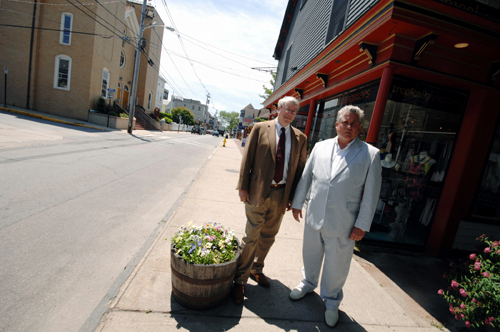
Steven Cundy, the president of the Lower Thames Business Association, is the first to acknowledge this bustling tourist area in Newport needs some tender, loving care. The sidewalks are cracked, flowers that could spruce up the place are lacking and there’s a dearth of public trash cans.
To tidy up the street he wants to form an improvement district with the power to tax local businesses.
To succeed, Cundy needs the support of owners of property comprising 60 percent of the overall property value of the area. With the city valuing the properties along the roughly one-mile long stretch of land at a combined $310 million, Cundy needs property owners comprising at least $186 million in valuation. Two years into the plan, he has $80 million, or 26 percent.
“This is really the hard work now, getting people to sign,” Cundy said.
If formed, the improvement district would become only the second in the state. (Providence hosts the other.) The districts essentially act as mini-governments with the power to tax and run programs. Cundy and his supporters see a Newport district hanging flower pots, cleaning up litter, hiring extra police patrols and undertaking marketing campaigns.
The district would stretch length-wise from the Red Parrot restaurant to the end of Thames Street where it meets Morton Avenue.
Under the current proposal, businesses and residences would pay assessments tied to their property valuations, although primary residences would be exempt. Businesses would pay 0.107 percent of their valuation, and residents about half that. All told, the district would collect about $275,000 annually.
“Small money, but collectively we can make a statement,” Cundy said.
Cundy, who owns Tropical Gangsters on Thames Street, said he started promoting the idea two years ago after meeting with Pieter Roos, the executive director of the Newport Restoration Foundation. The two were brainstorming how to raise money to bury the overhead electric lines along Thames Street. The Dunn Foundation, a Newport nonprofit dedicated to public beautification, suggested forming a downtown improvement district.
Persuading businesses to approve what is essentially a tax during an already downtrodden economy can be a challenge, Roos said. But he and Cundy argue the assessments would total a small amount of money that could yield big business.
“Every city right now across the country at these times has vacant storefronts and you’ve really got to be competitive to make it an attractive place,” Cundy said.
They also note that three years after the district’s formation, state law compels a vote to ensure that 60 percent of the property valuation still supports the district. And property owners can vote to disband the district at any time if 60 percent of the property valuation agrees.
In Providence, property owners voted overwhelming to start and keep the district founded in 2005 with a push from the business-backed Providence Foundation.
“The key is to have the property owners lead this initiative,” foundation Executive Director Dan Baudouin said. “If they have a good business plan and property owners see the value, then it will work.”
Support from local government helps, too. In Newport, the City Council already backed the plan and the mayor is a proponent. Mayor Jeanne-Marie Napolitano said a district would formalize the efforts of ad hoc groups looking to improve the area. A formal organization could also apply directly for government grants without requiring the approval of the city first. And a district could lessen the burden on the city’s coffers as well.
“I’m just really hoping they grab hold [and] see the benefit of it,” Napolitano said. •