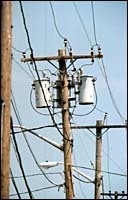
near Manchester St.
in Providence
California’s power woes won’t happen here.
That was the message last spring from the region’s grid operator, ISO New England Inc., which assured residents in April that it had more than enough power to get through the summer without blackouts.
For Leaders Who Don't Have Time to Get Sick
Top performers guard their calendars, delegate relentlessly and optimize every hour of the day. Health,…
Learn More
So far, ISO New England (Independent Service Operator), based in Holyoke, Mass., has made good on its promise. The stifling heat wave that enveloped the region earlier this month sparked a string of four record-setting days of power demand, peaking at 25,158 megawatts on Aug. 9th. Demand found capacity to spare, according to the company.
ISO New England credits foresight for the region’s ability to meet record demands: The region has been ahead of the curve in building power plants over the past decade, while states such as California stood idle.
And more power plants are planned for New England: As many as 14 new power plants are planned in New England over the next five years, with the potential to add 7,000 megawatts of supply, according to ISO New England spokeswoman Ellen Foley.
But new generation is only half the battle. Without ample transmission to move that new power to areas of the grid that need it most, bottlenecks pose a big threat. Boston and southwestern Connecticut are plagued by transmission constraints, Foley said.
“We’re getting new generation on our system, but we’re getting it in areas where there’s not enough demand to use it,” said ISO New England Sr. Vice President and Chief Operating Officer Stephen G. Whitley.
That was the situation during a previous record-setting heat wave in July, when about 800 megawatts of power were bottled up in Maine. Had ISO New England been able to transmit that surplus power to higher-demand areas, it could have saved an estimated $80 million that week, Whitley said.
It’s a problem facing grid operators around the country.
“There’s a lot of generation coming online, but if you can’t move the power around you’re going to have an even bigger problem, ” said Robert Schainker, product line manager for transmission and substation at EPRI (formerly the Electric Power Research Institute), a Palo Alto, Calif.-based nonprofit company that explores new technologies for the energy industry.
But providing that transmission capacity is a problem in itself. The prospect of new transmission lines invariably is met with opposition by nearby residents. And acquiring rights-of-way for new lines and towers is an enormously expensive and time-consuming proposition, Schainker said.
During the coming decade, $56 billion in new transmission lines and system upgrades – equal to half the amount that will be spent on new power plants – will be needed nationally, according to EPRI.
That growing dichotomy – the need for transmission capacity vs. the foreboding capital investment it requires – has pushed the industry in recent years to develop new technologies aimed at boosting the capacity of existing transmission lines. Transmission planners from around New England learned about some of these techniques at a workshop hosted by ISO New England earlier this month.
New conductors coupled with stronger wires have the potential to triple the amount of power that lines can carry, said Schainker, who spoke at the workshop.
Other new technologies measure transmission lines’ thermal limits in real time.
Power flows are limited by the amount of heat generated by currents running through the lines. If cables become overheated from too much current, they can sag and short out.
But those limits vary depending on temperature and wind speeds: Colder weather cools the lines, increasing the amount of power that can be transmitted through the cables.
Utilities typically use an annual average temperature to make sure they don’t exceed a wire’s thermal limit, Schainker said. But this method can limit transmission-line capacity by as much as 40 percent.
New electronic thermal-rating systems measure thermal limits in real time, allowing transmission operators to set power flows closer to the lines’ actual thermal limits.
According to EPRI, a utility in the western United States that used the thermal-monitoring technology was able to defer construction of a new transmission line for five years, saving it $22 million.
“We have a variety of methods to increase power over existing transmission corridors,” said Schainker. “Manufacturers are coming forward with these technologies to satisfy a growing need.”
Since March ISO New England has been outlining a regional transmission-expansion plan and expects to issue it by the end of the year. Whitley said the company hopes to begin implementing some of these new technologies in two years.
“These are some of the most significant new transmission technologies I’ve seen in 30 years,” Whitley said.