In the world of nonprofits, it is a time of retrenchment. According to an online survey conducted in Rhode Island in 2009 by the Acadia Consulting Group, the fiscal health of many nonprofit agencies has declined. In fact, financial shortfalls last year led to layoffs at the United Way of Rhode Island and the Jewish Federation of Rhode Island.
Despite the fiscal challenges, however, the need for services is not declining, with the result that advocates continue to start new nonprofits. Thus, even in today’s challenging environment for attracting donations, corporate sponsors and volunteers, two fledgling nonprofits, Extraordinary Child in Cumberland and U.S. Open Cycling Foundation in Providence, forge on.
Richard Durishin, 49, the head of the U.S. Open Cycling Foundation in Providence, brings great passion to his nonprofit work to promote bicycling as an activity for a healthier, cleaner society.
Understanding the value of networking, he has built collaborations with local organizations, including East Coast Greenway Alliance and the Providence Bicycle Coalition.
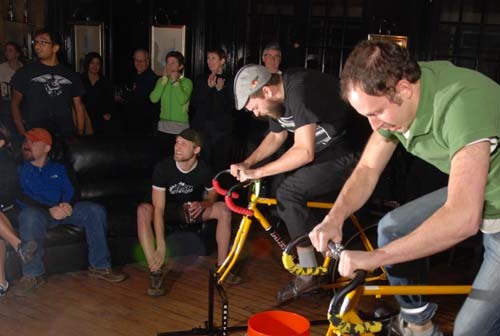
He also has developed an innovative approach for fundraising and building a volunteer base – holding a 10-week series of indoor 500-meter sprint races at McFadden’s Restaurant & Saloon at 52 Pine St. in Providence. The men and women racers pedal on fixed-gear bikes, with a screen in front of them that displays their progress, with the same information projected onto a big screen for patrons. So far, the races have raised about $3,500 to fund the foundation’s educational programs in local schools.
In addition, through the races, he has developed relationships with local businesses, including Marc Allen Clothiers, Ameriprise, Westport Chiro, Providence Bicycle, Legend Bicycle, Dash Bicycles and NBX Bikes in South County. Through the foundation, he has done targeted outreach, conducting Cycle-for-Health programs for more than 6,000 schoolchildren in Rhode Island last year, with plans to reach 15,000 this year, urging them to make cycling part of their daily lives.
What he lacked, however, were corporate sponsors willing to underwrite the costs of the planned event here in Providence. The total sponsorship price tag, which included a two-hour national cable broadcast, a one-hour local broadcast, and a minimum of five international teams, was $500,000, according to Durishin. The lack of corporate sponsorship forced Durishin to cancel the planned race.
“In these tough economic conditions, people don’t seem to want to do innovative marketing and promotions,” he said. “As corporate funding for sponsorships tighten up, new kids on the block like us get dropped.”
Despite the difficult times, Durishin promises he will soldier on, even though he is currently the only employee at his foundation, and he’s working as a volunteer. “It’s the right time to be doing this, regardless of the current economic situation,” he said.
For Jennifer Gingras, the founder and executive director of Cumberland-based Extraordinary Child, her dream to create Rhode Island’s first indoor/outdoor recreational facility for children with special needs and their families has been pared down temporarily to creating an indoor, two-room, multisensory environment in a former mill space in Lincoln. “Because of the proposed size of the original facility, it was going to take too long [to accomplish],” she said.
The nonprofit’s mission is a personal and passionate cause for Gingras, who is a mother with two children with special needs.
Her new nonprofit, which was incorporated in September 2008, recently held its first mall walk March 13 at the Emerald Square Mall in North Attleboro, raising more than $4,000.
She said her group has very much felt the effects of the dismal economy. “I’ve found it difficult in the fundraising arena,” she said. Much of her efforts have been concentrated in “trying to get the word out about what we are trying to do,” Gingras said.
Jill Pfitzenmayer, director of the Initiative for Nonprofit Excellence at The Rhode Island Foundation doesn’t believe that the economy should be used as a reason for lack of success for new nonprofits. “All successful nonprofits really rely on the passion of their leaders at the board level and their volunteers,” she said.
Just as with small businesses, she continued, “If you’ve got a terrific idea, most likely you will succeed, in good times or tough times.”
Her program, she said, is designed “to prepare the next generation of nonprofit leaders, to bring best practices to nonprofit leaders in order to help them be more effective.”
In a survey her program conducted of its participating nonprofits, asking them how they had responded to the financial crisis, the results found that many had tried to reduce expenses (and staffing), and had devoted more staff time to fundraising. “Only 3 percent of the organizations indicated that they had merged,” Pfitzenmayer said. “About 34 percent found new collaborators for space and outreach.”
A project now under way seeks to compile a statewide searchable directory listing all nonprofits in Rhode Island, something Pfitzenmayer said doesn’t exist. That list may become much smaller in the near future, according to long-time nonprofit fundraiser and public-relations professional, Nancy Thomas, who said that financial pressures to merge are growing. Jewish Family Services of Rhode Island and the Jewish Seniors Agency, for example, are now engaged in merger talks.
A full house is expected at the fourth annual Merger and Consolidation Fund Forum on March 30, hosted by United Way of Rhode Island, which plans to award about $100,000 in the next year to assist members of the nonprofit community looking to merge or consolidate. •