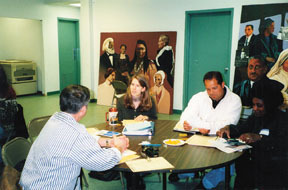
help from the MicroEnterprise Association.
Association helps many
home-based ventures develop, reap business ideas
There are small businesses and then there are “micro” businesses. It is Ann Marie Marshall’s job to help the latter sprout into the mighty small enterprises that form the fabric of Rhode Island’s economy.
Marshall is director of the Rhode Island MicroEnterprise Association, a two-year-old nonprofit whose mission it is to train and support individuals looking to start their own business. Since its May 2000 opening, the association has put more than 600 aspiring entrepreneurs through a training course to give them the business skills – and motivation – to pursue their dreams.
Your Business Has Gone Global. Has Your Insurance?
A decade ago, “doing business internationally” was mostly a large-company concern. Today, a manufacturer in…
Learn More
“We help people do what they love, and change their lives and change their communities at the same time,” said Marshall, who last month was named Home-Based Business Advocate of the Year for New England by the U.S. Small Business Administration.
There are more than 10,000 “micro” businesses in Rhode Island. Most are home-based entities, typically owned and operated by a sole proprietor. A few have as many as five employees. They require relatively modest funds to get off the ground – anywhere from $500 to $35,000 – according to the association’s official definition of “micro.”
The people who come to the MicroEnterprise Association for training run the gamut. Examples include a florist; a mechanical engineer looking to start his own tool-making business; a children’s books author who wants to make some extra money licensing her characters.
There are retirees relishing their freedom to pursue their hobbies; laid-off workers who are not interested in going back to work for The Man; stay-at-home moms; high-energy full-time workers looking for a side gig. And there are many immigrants, who account for more than half of the association’s students. Many were successful proprietors in their homelands but now are confronted with new and foreign barriers to doing business.
Yet all these entrepreneurs face similar hurdles. What legal structure should I use for my new company? How can I creatively market my business without a marketing budget? Where can I find out about zoning regulations?
The four-week MicroBusiness Training Program answers those questions and more: how to write business plans; how to identify customers and locate suppliers; tips on scratching together financing; how to market their company. The program, including all worksheets, planning guides and other supplies, is free to all enrollees.
The sessions are supposed to last two hours (they usually run three) and classes are taught in Providence, Woonsocket, Pawtucket, Bristol, Warwick and Portsmouth.
“My background has nothing to do with business,” said Kathleen Kane Morrison, a 43-year-old mother of three who has started her own English-Spanish translation and training firm out of her Providence home.
A Catholic missionary and youth minister, Kane Morrison learned fluent Spanish while spending six years in Mexico doing relief work. In recent years her part-time business has sprouted to include a growing list of clients. For example, she recently has trained Central Falls firefighters to speak Spanish, so they’re able to communicate with city residents when responding to calls.
Kane Morrison took the MicroEnterprise course last year.
“It’s given me the confidence to approach people, and I feel like I know where to go now when I need help with something,” she said.
About two dozen instructors teach the classes – all professionals who either run their own businesses or who have started successful companies in the past. They are able to provide not only inspiration but also shared misery with the students.
“It’s not all out of a textbook,” Marshall said. “They’re able to share the barriers and challenges and successes, and describe them in a way our participants can understand.”
Graduates go away with a certificate to show potential lenders that they’re serious about building the skills needed to run a successful enterprise. But it is the intangibles that prove most valuable, Marshall said.
The association is tapped into myriad small-business resources throughout the state. If there is a question the association’s instructors can’t answer, they invariably can be sent to someone who can. And there are the connections that entrepreneurs make with one another. Students sometimes become business partners, customers and suppliers, Marshall said.
Participants also have access to the association’s gleaming new office, housed in the Larry Friedman International Center for Entrepreneurship at Johnson & Wales University, which opened last August. The space was designed to spark creativity and motivation: brightly-lit high ceilings, exposed brick and couches where students browse business and trade magazines from the center’s library.
Marshall says the “micro” segment of the business community often is overlooked in Rhode Island’s ubiquitous economic-development discussions.
“There are more and more creative, entrepreneurial minds out there who, if given the opportunity to develop what they do, can be a whole new cluster of economic growth for Rhode Island,” Marshall said.
Indeed, the 41 successful businesses that the association has helped nurture in its first two fiscal years (ended June 30, 2002) have pumped more than $3.1 million into the state’s economy. As testament to the program’s diversity, businesses started by Colombian graduates of the class contributed nearly two-thirds of that amount.
The MicroEnterprise Association, which has an annual budget of roughly $175,000, is funded by Rhode Island Human Resources Investment Council, the Rhode Island Foundation, Johnson & Wales University, U.S. SBA and FleetBoston Financial.
For more information, contact Marshall at (401) 598-2256, or visit www.rimicroenterprise.org.
For the complete current issue, visit our subscription Web site, or call (401) 273-2201, ext. 227 or 234.