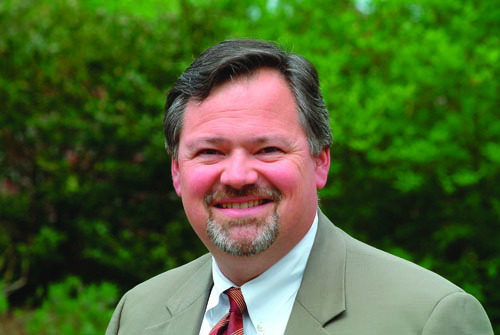
As vice president/administrator of Roger Williams Medical Center Elmhurst Extended Care, Richard Gamache has tried to change the way employees and patients interact in a facility that prides itself on being a community, rather than an institution. With more than 40 birds, five cats and a dog, the nursing home is the only Eden Alternative home in the Ocean State.
Gamache, says that during the last five years Rhode Island has cut spending on nursing homes by almost $10 million, he spoke with Providence Business News about the relationship between elder care and the state’s ailing economy.
PBN: What is the state of nursing homes in Rhode Island?
GAMACHE: We are under incredible financial pressure because of the budget situation. About 75 percent of people who live in nursing homes in this state are covered by Medicaid, which is part of the state welfare system, and Medicaid does not provide the full cost of care … so it’s a discounted rate because these people are on the welfare system. With the proposed cuts to Medicaid – to help balance the state’s budget – nursing homes are looking at the worst financial situation that they’ve ever faced.
ISO 9001:2026: A Practical Opportunity to Build for What’s Next
For Rhode Island manufacturers, ISO 9001 has been much more than a certificate on the…
Learn More
PBN: What will those cuts affect?
GAMACHE: Specifically, there are two cuts that we know of that are being proposed. One is a delay of the cost-of-living allowance. Each year, Medicaid gives a small increase, about 3 percent, to nursing home payments. That happens in October. This year, we’re looking at delaying that until April 2009. The second cut is on the labor cap. There is a system by which nursing homes are reimbursed, where you array the cost of labor for all the nursing homes in the state, then draw a line through the median, then draw a line through the 125th percentile. That’s the top dollar that will be paid to nursing homes. And what the state government is saying now in [Gov. Donald L. Carcieri’s] budget proposal is that that needs to come down to the 110th percentile or even the 100th percentile. That’s going to mean draconian cuts to nursing homes – 27 nursing homes in particular – that spend more on labor than the rest of the nursing homes in the state.
PBN: What type of staff cuts will that lead to?
GAMACHE: Best-case scenario, it will lead to huge layoffs. Worst-case scenario is nursing homes closing. There are nursing homes that will not be able to sustain these cuts and they will have to close. And the state government is not only aware of that, but that’s part of the plan. We’ve seen a draft of the governor’s budget where it talks about inducing nursing homes to sell out, to close, which will lower the total cost of Medicaid in the state …
PBN: Would more in-home care be a positive?
GAMACHE: Personally, I think, yes. … The trouble with the concept is … there is one pie of money that is available and right now the percentage that goes to nursing homes is what they want to cut. I firmly believe – I’ll campaign to the end on this – that when you cut nursing homes, you cut quality. People who are living in nursing homes need quality. It needs to get better, not worse. That’s my mission, and our mission, we want to improve quality.
PBN: How would you improve quality?
GAMACHE: The governor, in his state of the state address said … seniors will no longer be forced into nursing homes because they need help taking medicine or services that can be provided in their own homes. … When I heard him say that I thought it was somewhat reckless and irresponsible because the people who live in nursing homes aren’t here because they need help taking medication. The people who live here need help in the middle of the night, when home care is not available to them. The people who live here have multiple issues – chronic issues and acute issues – with multi-systems in their body that are in need of help.
I think an idea that deserves some consideration would be to provide some incentives to nursing homes to convert to all private rooms, because right now at most nursing homes, when you move in – after you’ve lost your spouse, your home and your health – you move into a room with a complete stranger.
PBN: What kind of financial incentives?
GAMACHE: I think it should be in the form of an add-on to the Medicaid rate. And here’s why: Right now if you have 100 people living in the nursing home, the cost of heating the building, lighting the building, all of your fixed costs, are covered by 100 people, divided by all the people living there. If suddenly you said, “I’m going to convert, making all my rooms private, and now I only have room for 50 people.” How are you going to pay for those fixed costs. Your rate is going to have to go up. That’s the financial incentive I think it would take, but I think it’s the right thing to do. I think when you are old and sick and need to live in a nursing home … you shouldn’t be subjected to living with a complete stranger.
PBN: What is that?
GAMACHE: Elmhurst adopted this Eden philosophy back in 1992. It comes from a Harvard-trained geriatrician, Dr. William Thomas, who is an author and for many years a practicing geriatrician who, during his time working with nursing home elders, found that the bulk of the suffering in nursing homes was actually caused by what he called plagues of loneliness, helplessness and boredom. … These are institutional plagues and so what the Eden Alternative does is it trains staff to recognize these kinds of behaviors and these kinds of symptoms and address them right away. •
interview: RICHARD GAMACHE
POSITION: VP/Administrator at Roger Williams Medical Center Elmhurst Extended Care, Chair of the R.I. Health Care Association.
BACKGROUND: After earning his master’s degree in 1986, he worked for Baltimore-based PersonaCare for 13 years, overseeing nursing homes in Pennsylvania, Connecticut and Rhode Island. He’s been with Roger Williams Medical Center and Elmhurst since 1999. He’s a fellow of the American College of Healthcare Administrators, board member of Ocean State Acute Network and a founding member of R.I. Culture Change Coalition.
EDUCATION: B.A. in History, 1982, University of Massachusetts Dartmouth; M.S. in Health Services Administration, 1986, Salve Regina University.
RESIDENCE:
Barrington
AGE: 48