With sweeping views of Narragansett Bay and located just a few hundred feet from the seashore, Ocean Road in Narragansett is home to some of the most expensive property in Rhode Island.
In June, the town planning board denied an application for a project that included affordable housing on Ocean Road, though not because it didn’t want them in the same neighborhood as pricey homes.
The proposal would have seen a brand new building constructed for ritzy market-rate condos, while the affordable units would have been located at the back of the same lot, in a refurbished apartment house dating from the 1970s. The difference between housing for the rich and the poor would be too obvious, the board said, violating the spirit of the state’s affordable housing law.
“The crux of it is, don’t make affordable housing look cheap,” said architect John O’Hearne, principal of O’Hearne Associates in the Slatersville section of North Smithfield, a four-member firm founded in 1982 that has designed hundreds of structures for residential, commercial, religious and educational use.
The same Narragansett Planning Board that denied the June petition for affordable housing granted full master plan approval last month to O’Hearne’s design for an unrelated housing development on Ocean Road, De La Salle at Black Rock.
Developed by the De La Salle Christian Brothers, this 132-unit project for residents 55 years and older will comprise 42 market-rate condominiums and 90 affordable units. The project has been described in published reports as the largest affordable housing proposal in Narragansett’s history. The De La Salle Brothers operate Ocean Tides School for troubled boys on the same 100-acre site, across from the state Black Rock Conservation Area.
State law requires each community to have at least 10 percent of its housing stock as affordable, a criteria met to date by only five cities, according to the annual HousingWorks RI report released Sept. 25: Central Falls, East Providence, Newport, Providence and Woonsocket. Narragansett is now at 2.9 percent, and the De La Salle development would raise the town’s compliance rate to 4.4 percent, according to O’Hearne. The town has 204 affordable units, out of 7,124 total, and needs another 508 homes to reach 10 percent, HousingWorks said. The 2007 median price for a single-family home in Narragansett was $395,000, requiring an average mortgage payment of $3,093 monthly, the report said.
Price of the affordable units at De La Salle at Black Rock would start at $190,000, O’Hearne said, with market-rate homes going for $600,000 to $1.3 million. None of the affordable homes offers ocean views, but at least six of the market-rate units do, according to O’Hearne. The affordable units are slighter smaller, with 1,200 square feet of living space in a two-bedroom home versus 1,360 square feet for market rate. The affordable units are spread throughout four of the five housing clusters on the site.
The state’s affordable housing law, according to O’Hearne, does not require that affordable units be exactly like market-rate ones. The square footage can differ, interior amenities such as air-conditioning and granite countertops can differ, but the less-expensive units must be “compatible” with their pricey neighbors, particularly when seen from the street, O’Hearne said.
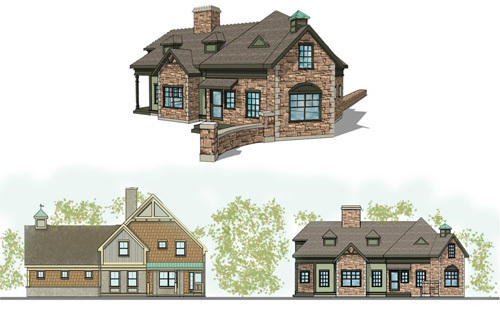
There will be no way to tell from the outside which units are affordable, O’Hearne stressed.
There will be no difference in exterior materials, which will “definitely match right down the line,” he added. “We try to economize where it would not affect durability or make the building look cheap.”
Due to the physical limitations of the Black Rock site, more than half of which is wetlands, O’Hearne found himself with a dilemma – a lot almost too small for a duplex with two affordable units. “We needed smaller units [of 1,100 square feet], so we made them cute,” he said, explaining how he used stone, wood trim and arched windows to give the duplex the look of a quaint gatehouse.
O’Hearne is no fan of public parking lots because he believes they cheapen a housing site and he avoids them in his designs as much as he can. De La Salle at Black Rock, for instance, offers individual driveways at each home, market-rate and affordable. “We’re not spending any more” to have driveways, he said, because money is saved on the paving, curb cuts and drainage that a parking lot requires, “and we’re not taking more land.”
He is also careful in his plans for De La Salle – and for other affordable housing projects he’s done – to separate entryways from one unit to another, so doors and driveways are not directly abutting and homeowners, whether rich or poor, have some privacy coming and going.
O’Hearne prefers duplexes for affordable homes because he has found the cost of building several two-unit houses is no more than constructing a row of six connected units. The connected units require a special “jogged” foundation and expensive firewalls, he noted, while providing less privacy.
The price of affordable units can be contained to some degree by scaling back on such optional features as porches and decks. O’Hearne explained that he may eliminate expensive rails along a porch and, rather than a deck with lots of stairs, he may opt for a step-down patio of concrete or wood.
Maintenance is the key to keeping up the appearance of any home. “The key difference sometimes between luxury homes and a slum is the upkeep,” O’Hearne said. “We try to make it so the home takes care of itself as much as possible.” Vinyl fencing and drought-resistant landscaping are two examples he often employs.
With traditional gabled roofs and lots of windows and wood trim, with pillars and porches where appropriate, O’Hearne’s residential designs have a distinctive country character, reminiscent of old-fashioned farmhouses from the turn of the century. He has designed at least six affordable housing projects in recent years in Rhode Island – in Woonsocket, Warren, North Smithfield, Burrillville, Smithfield and in Providence for the Olneyville Housing Corp. •