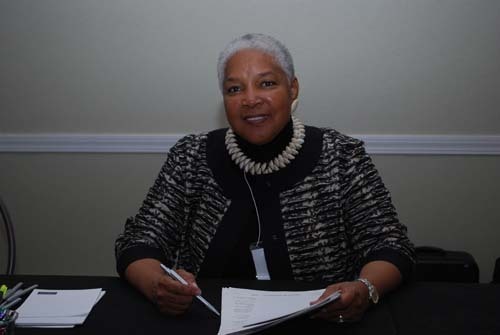
Few people are in a position to change the law, but the national ombudsman who works for the U.S. Small Business Administration (SBA) is in a position to help small businesses overcome what could be unfair enforcement of federal regulations stemming from the law.
“I see this office as being like a liaison between small businesses and federal agencies,” said Esther H. Vassar, who took over the post of SBA national ombudsman Aug. 3. “We represent the interests of small business in terms of regulations that affect their business and their success. We can represent you if you are a small business, small government entity or a small nonprofit organization.”
Vassar’s comments came during a telephone interview from the Hyatt-Regency Newport Hotel on Goat Island where she attended a two-day training conference, Aug. 31 and Sept. 1, for SBA lenders in the Northeast, attended by approximately 400 people. A former small business owner and college English professor, she most recently served as commissioner and chair of the Virginia Alcohol Beverage Control Board.
In general, most comments and complaints from small businesses come to her office through an e-mail link on the SBA’s Web site (www.sba.gov/ombudsman), Vassar said, although some come by letter or telephone. Her office checks out the complaint and, when warranted, will contact the federal agency involved to ask for “a high-level response” within 30 days, she explained.
“However, we’re not magicians,” Vassar said. “We can’t make promises that we will resolve all issues. But at least we can get small business concerns raised to a level that individuals would have great difficulty reaching on their own.” Small businesses usually have limited resources in the form of time and manpower, she added, and can be hard pressed to capture the attention of a federal bureaucracy.
The ombudsman’s office has no legal power over the decisions a federal agency makes, but Vassar noted that she and her staff “can try to get some compromise and/or some reduction if there’s a fine, for example, that the small business feels is unfair.”
She has a relatively small staff, six people including herself, but Vassar added, “we have long arms, and those arms actually have a lot of influence.” She said she works closely with SBA legal counsel and with the new SBA administrator, Karen G. Mills, appointed in April by President Barack Obama. It was Mills who named Vassar ombudsman and, the latter said of her boss, “I think that our office will enjoy a very positive relationship with the administrator. She is committed to small businesses and making sure that they are helped to succeed and grow.”
The office of national SBA ombudsman was established by the Small Business Regulatory Enforcement Fairness Act of 1996. Vassar’s title also includes the position of assistant administrator for regulatory fairness. Besides mediating federal regulatory disputes involving small businesses, nonprofits and small government entities, the office also is charged with rating a federal agency’s response to complaints.
According to former Ombudsman Nicholas N. Owens’ report to Congress for fiscal year 2007, the most recent year available, the average length of time it took a federal agency to respond ranged from two days to 240 days, with most falling between 30 to 40 days. Owens in 2007 said his office increased its workload by 150 cases to a total of 500 that year.
As an example of how the ombudsman can assist a business in a dilemma, Vassar and Martin Gold, deputy national ombudsman for 22 years, spoke of a small business in South Carolina that imports small engines from China.
When the engines arrived at the port, it turned out that the Environmental Protection Agency required all imported engines to be affixed with labels that cannot be peeled off.
After he was rebuffed when he offered to make his own labels and put them on the engines, the business owner went to the SBA ombudsman and the EPA eventually relented, allowing him to do so but assessing a $10,700 penalty at the same time.
Meanwhile, the U.S. Customs and Border Protection announced that the delay of several weeks resulted in a $10,000 bill to cover storage of the engines. In the end, the warehousing fees were waived, the fine was reduced, Gold said, and the business owner, thankful and anxious to help, became a member of the SBA regulatory fairness board, representing South Carolina.
Before implementing regulations that affect small business, Gold explained, a federal agency is required to go through the SBA office of advocacy so the impact can be studied. The advocacy office usually holds a public comment period, so businesses or trade associations can offer input, and then sends its recommendations to the federal agency before the new rules are finalized.
Vassar holds a bachelor’s degree from Howard University in Washington, D.C., and a master’s in English from the University of Virginia in Charlottesville. She was an English professor at a number of universities, including Howard, Virginia and the College of William & Mary in Williamsburg, Va.
For eight years in the 1980s, she owned and operated a business importing art work from Africa and, from 1994 to 2002, she owned a marketing firm whose clients included Dominion Virginia Power and the city of Richmond, Va.
She served as director of the Virginia Department of Minority Business Enterprise under former Gov. L. Douglas Wilder and, from 2002 until her recent appointment to the SBA, served as commissioner and chair of the Virginia alcohol control board, at which she led public service campaigns against alcohol abuse, underage drinking, and drinking and driving. •