Any successful endeavor, whether a personal relationship or new construction, requires three elements that are in short order in today’s culture.
Money, space and time.
This is especially true for the golf industry, where rising prices, a dearth of available land and waning interest in the traditional five-hour round among many newbies have resulted in a growing number of shorter golf courses that can be played without sacrificing the entire day. Golf course developers and industry stakeholders have been putting greater emphasis on making the links more enjoyable, affordable and faster to play.
In Rhode Island, the lack of developable land and the housing shortage has often made the development of a simple nine-hole course difficult.
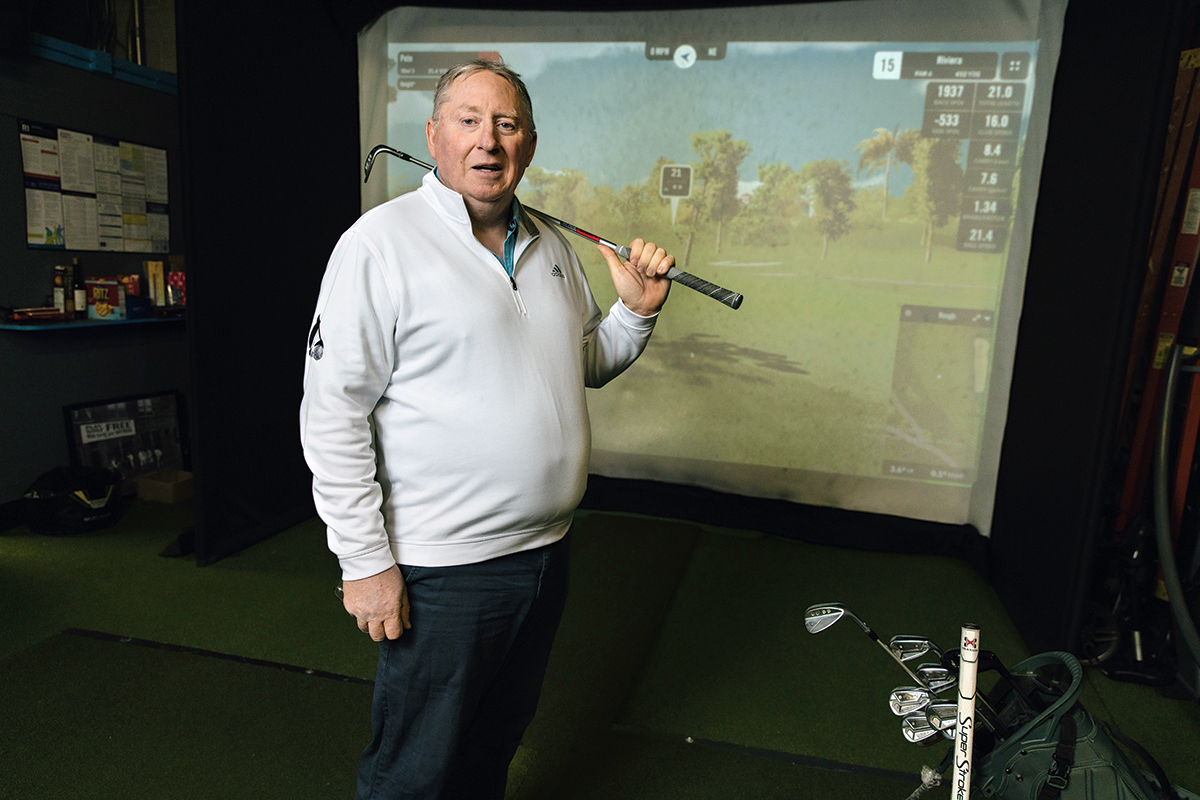
Peter Walsh, owner of Warwick-based indoor golf facility Golf365RI LLC, has seen the industry trend away from the difficult and resource-heavy courses that sprung up during a 1990s building boom.
A PGA golf professional who learned the game on the unforgiving links of Northern Ireland, Walsh is seeing more public interest among people who wouldn’t normally be up for walking the hilly terrain of a traditional 18-hole course. And the proliferation of golf simulators has opened the door to a new crop of players.
“We are definitely a society wanting convenience,” he said. “And this plays into that. It is attracting people that haven’t yet made the investment.”
It’s unclear when the last 18-hole course opened in the Ocean State. The most recent track is the nine-hole South Shore Village Golf Club, a par-35 course in South Kingstown that opened in 2024 and also has a par-3 tee on every hole.
“That’s a pretty tight course with holes right next to each other,” he said.
Golf course architect Doug Smith has been advocating for shorter, more accessible golf courses for years. His calls have often fallen on deaf ears.
“Short golf courses have been discussed for a couple of decades,” he said. “But it had never really taken hold.”
Smith, a graduate of Providence College and the Rhode Island School of Design who was tapped to be the inaugural coach for Providence College’s first women’s golf team set for its opening season in the NCAA Big East conference in September, believes the lack of recreational time in modern life is driving the proliferation of smaller courses.
“Some people don’t have five or six hours to play golf. They want to play nine holes and go home to their family,” said Smith, who has been involved with more than 200 projects and 20 new golf course designs. “If you don’t have the time, it’s a difficult game to master and to truly love. I used to play 100 times a year. Now I play 15 times.”
At the same time, shorter courses aren’t necessarily what the owners want, but they’re working with what they have.
“A lot of places are forced to do an executive or a nine-hole,” he said, “which may not be worth the investment for the people with the money to build these golf courses. But for the game of golf, they are awesome.”
Robert McNeil, founder of The Northeast Golf Co. and McNeil Design Collaborative Inc., manages the nine-hole Metlinks Golf LLC – the site of the former 18-hole private Metacomet Country Club in East Providence – and the short nine-hole, par-3 Bristol Golf Park.
His current portfolio is dominated by course redesigns, including the Fall River Country Club and a renovation of the Bass Rocks Golf Club in Gloucester, Mass.
McNeil says that because of the lack of land in the Northeast, the state of course design in the region has shifted to helping clients be creative within existing footprints “to strategically make the same holes play differently,” a change he earnestly supports.
“What we talk about a lot these days is, how many golf courses are on your golf course? How many variations can you create?” McNeil said. “Our firm is doing so many projects of that type.
“It is really growing the game,” he said. “There are now so many avenues to get into the game and get people interested.”
As more people are introduced to shorter courses, it will become the norm. Metlinks is a prime example, Walsh says.
“Even though it did have some pushback, the end product was a nine-hole that embraced the history of the property while being set up in a way that anyone can play,” he said. “I think there are many opportunities for smaller golf courses within a highly populated market.”
In 2024, the World Handicap System began including courses with a minimum of 750 yards for nine holes and 1,500 yards for 18 holes in its qualifiers for individual handicaps, resulting in more than 600 additional courses becoming eligible for course and slope ratings.
The majority of these were par-3 courses.
This is no surprise to Walsh, who recalls coming across a 140-acre parcel of land in North Kingstown and instantly having the reaction common among golf obsessives.
“I thought that would be a perfect spot for a golf course,” he said. “But they want to sell it to a developer to put up 500 homes. Well, at 1 million bucks [per unit], that’s a $500 million project. Where with a golf course, it would probably be a $10 million project.”