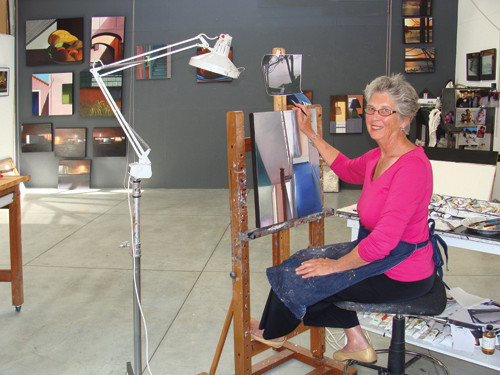
For the artist, the appeal of an open-studio event – during which members of the public are invited to visit an artist’s inner sanctum – is not necessarily the prospect of making a few quick sales or forging professional connections that could lead to lucrative commissions in the future.
Yes, such benefits are important. But most of all, local artists say, they appreciate the opportunity to interact with the public and hear what people have to say about their work.
“I’ve taken part in open studios before, and I enjoy meeting people. I probably get more from them than they do from me,” said Morris Nathanson, one of the most successful designers in Rhode Island.
His studio, Blackstone Studio at 163 Exchange St., Pawtucket, was open to the public at the open-studios event Sept. 24 and Sept. 25 organized by the Pawtucket Arts Collaborative as part of the month-long Pawtucket Arts Festival. About 100 artists at six mills took part in the free event.
Nathanson is well-known for creating the decor at restaurants, such as The Capital Grille, Hemenway’s and, across the Atlantic, restaurants at Euro Disneyland in Paris. He also helped establish the first artist’s district in the state about 28 years ago, converting an old Pawtucket mill into artists’ studios and lofts (where he is still located). He is a painter, but is now creating wood collages most suitable for homes and business offices.
“It’s not necessary to sell [at an open studio], although I love to do that,” Nathanson explained. “What is important is for people to know what we’re doing in the arts community and get their reaction to it. We’re not salespeople, you know, we don’t go out and hustle our work.”
Nancy Gaucher-Thomas of East Greenwich, also a painter, agreed.
“Artists typically are isolated in their studios and don’t often get a chance to interact with the public,” she said. “It’s nice for them to hear what the public has to say firsthand. Even when represented by a gallery, an artist does not always get to know why someone has been so taken by a particular piece of their work.”
A member of Public Art Works, a Rhode Island collaborative through which artists work together on various projects, Gaucher-Thomas is one of four founders and organizers of West Bay Open Studios, scheduled for Oct. 22 to 23 at galleries in Warwick, East Greenwich and North Kingstown. This is the third annual event.
In Fall River, where 35 artists will open their studios to the public Oct. 15, it was a grant from the Fall River Cultural Council – part of the Massachusetts Cultural Council – that is directly responsible for the free event.
Organizer Alison Horvitz, a painter, said she recently received an artist’s stipend from the councils to pursue her artwork and, in return, she offered to open her studio in an old mill on West Street to the public.
“I decided to invite other artists to participate,” she said, and now the event is receiving support from the city Office of Economic Development and the University of Massachusetts Dartmouth. (She declined to specify the amount of the stipend she received.)
In general, open studios see attendees given a list of participants and they can choose which studios to visit. Often, visitors choose sites with the most artists, such as a large studio or a cluster of studios in one building. Transportation is not always provided. Artists are usually charged a nominal fee to take part.
In many cases, artists put on special demonstrations and make certain that pieces of their art are prominently on display. Hundreds of visitors usually attend each event, organizers said. Local artists taking part generally run the gamut from jewelry makers and fiber artists to sculptors, painters and photographers.
Horvitz said she and other organizers have been surprised by the number of local artists interested in taking part. “No one knew anyone else was here, we’re all so hidden away in our own mills,” she said. “We have a lot of mills in Fall River and a lot of artists in them because the rent is relatively inexpensive.”
She, too, enjoys the interaction with the public that open studios provide. “Open studios are always helpful,” Horvitz said. “It helps you to be able to talk about your process and it helps with pricing because you get a feel for what people like and what people are willing to spend.”
She suggested open studios satisfy the public’s curiosity about an artist’s studio. “I know I enjoy seeing how other artists set up their studios,” she said. Her studio is at Riverfront Lofts, 10 Exchange Court, in Pawtucket’s arts district, where the purchase of art made on-site is free from the 7 percent state sales tax.
Hausrath noted that gallery owners often scout open-studio events to find new artwork to display.
Deborah Goldhaft, who designs and makes architectural glass pieces for homes and offices in her studio at the 545 Mill on Pawtucket Avenue, said she has taken part in open studios before and found that visitors often do come back after the event to buy a gift or commission work.
“It’s [also] one of the main ways I get” public relations attention, she added. “It gives people a chance to come and see my studio.”
On the West Bay, Gebhart, who works with kiln-fired glass, plans to add a gallery to her studio on Post Road in East Greenwich that she said should be open in time for the open studio at the end of this month. The value of the event, she said, is to educate the public and “show people what actually goes into the creation of our work.”
Gebhart said she has sold her artwork and made important connections with art galleries at previous open studios.
Ball, a painter from East Greenwich, said open studios help a low-key artist like herself become successful. “I’m a fairly shy person, and I’m not always out there pushing my work,” she said. “For me to feel a piece of my work is successful is when someone says, ‘I see what you mean.’ That means they share my vision and understand it, and it’s nice to hear that.”
“Of course, the ultimate compliment,” she added, “is when someone pulls out a checkbook and buys.” •