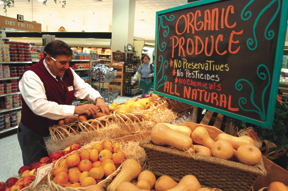
arranges display of organic produce.
The U.S. Department of Agriculture unveiled new regulations last month creating new standards for organic food, in an effort to give consumers a better idea of just what the term “organic” really means.
But what do the new USDA regulations mean for grocery stores and other food dealers?
“Retailers may need to change their systems and procedures to minimize the chances that an organic product could be contaminated,” said Holly Givens, a spokeswoman for the Greenfield, Mass.-based Organic Trade Association.
Selling Luxury Real Estate Requires More Than Exposure
By Emilio DiSpirito IV License Partner | Private Office Advisor Engel & Völkers Oceanside www.DiSpiritoteam.com…
Learn More
Before last month, determining just what constituted “organic” depended on what state you were in, where the product originated and who was selling it. Now the USDA has standardized the criteria through use of a green “organic” label, which certifies that the product was not genetically modified and was grown without the use of conventional pesticides, fertilizers or hormones.
But the new standards also require retailers to “maintain the integrity” of organic foods when receiving, storing, handling and displaying products. One big rule of thumb: avoid contact between organic and non-organic products – either in the back of the house or in the aisle.
Food dealers that sell organic items now will be subject to inspections by the state Department of Environmental Management. DEM last month received accreditation from the USDA to oversee the new federal rules in Rhode Island, said Ken Ayers, chief of DEM’s Division of Agriculture.
The new regulations do not prohibit retailers from displaying organic and conventional foods side-by-side. But those that do might need to reshuffle their procedures to avoid “co-mingling” the two foods, Givens said.
“Retailers either separate or integrate organic foods, depending on what they think their customers are looking for,” Givens said. “Those that integrate simply need to take steps to minimize the chance that organic products come into contact with conventional products.”
Retailers that do integrate organic and conventional food sections can use a few simple techniques to prevent co-mingling, Givens said. For wet produce, for instance, organics should be displayed on the shelves above conventional produce, to prevent water from dripping down and contaminating the organics, she said.
Some retailers use bins, baskets and dividers to buffer organic items from other produce. And packaging can prevent contamination too: organic carrots might be displayed loose next to bagged non-organic carrots, Givens said.
In the back of the house, color-coded bins and trays can be designated for organics only, with separate equipment used for conventional foods.
The association has compiled a training manual, “Good Organic Retailing Practices,” and hosts a half-day seminar (which costs $395 for non-OTA members) to help retailers develop procedures to comply with the new USDA regulations. More information is available at the association’s Web site, www.ota.com.
Shaw’s Supermarkets has always kept its organic and traditional produce on the same shelves, according to Bernard Rogan, a spokesman for the West Bridgewater, Mass.-based grocery chain. He said Shaw’s in some instances uses plastic dividers to separate organic foods on the produce shelves, similar to how kosher foods are displayed.
While the USDA rules provide the first formal oversight of how organic foods at the retail level, many grocery stores that carry organic items say they already have proper policies in place.
“We’ve basically already been doing what the new laws want us to do,” said Ed Pacheco, director of operations at Eastside Marketplace in Providence. “We’ve always had one of the widest selections of organic and health foods in the area.”
Eastside Marketplace keeps its organic produce separate, so Pacheco said the store will not have to implement any significant changes.
One potential upshot of the new regulations for grocery stores is that it could establish a firmer footing for the organic food market.
“We think it’s a wonderful program because it finally validates organic products for the consumer,” Rogan said. “The variety and quantity of organic products on our shelves already had increased tremendously, and I expect that to continue.”