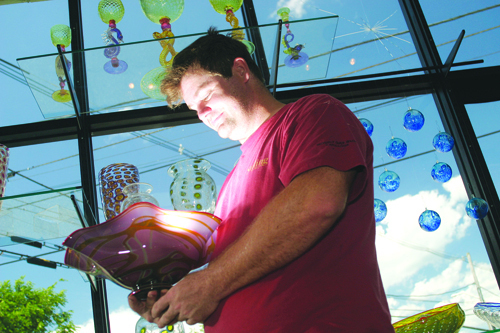
Nineteen years after he started blowing glass during free time while still a high school student, 33-year-old Eben Horton is a survivor in an industry that’s especially challenged during tough economic times.
“I’ve sold my wares from Anchorage, Alaska to Key West, Fla., and right up through eastern Maine,” he said proudly.
Horton opened the Glass Station, in Wakefield, in 2000. Before that he was an apprentice glass blower in Providence and Rochester, N.Y., where he attended the School of American Crafts.
When asked why he chose to work with glass, Horton said his curiosity was first piqued when as a 9-year-old he went with his mother to a glass blowing class in Newport.
“I made a Christmas ornament. I can remember looking at the ornament for months after I made it,” he recalled. “I guess that really had an impact on me – like someone’s first big fish. The hook had been set.”
Horton has one employee and sometimes additional help, depending on production.
“Glass blowing would be very hard to do alone. It’s too physical. There are too many steps,” he said.
The Glass Station is an old gas station right on the corner of Robinson Street and Main Street. His work space is in the old service bays. On any given day you can find Horton with the service doors wide open making bowls and glasses, paperweights, lamp shades, vases, perfume bottles, and even on occasion, lobster pot buoys, striped bass, penguins, and even a glass squid.
When Horton works a crowd often gathers. “People are interested in how the process works,” he said.
Horton doesn’t use anything fancy to shape the molten silica. “My shaping tools I have custom-built by a local carpenter and the basic design has been around since the first century.
“The Mesopotamians and the Egyptians started blowing glass 5,000 years ago,” he said. “All you need is ash, ground up limestone and quartz. You could make a bowl from sand gathered at Scarborough beach. But you’d have to have a fire that would be so hot you wouldn’t be able to work anywhere near it.”
To avoid such intense heat, Horton uses soda lime. The silica in soda lime reaches a melting point at a lower temperature than, say, Pyrex. The soda lime is also very forgiving to work with and is safer. All of Horton’s colors that he melts into his objects are also made of glass. “Many people think I paint the colors in or [use] dye, but everything here is made with glass.”
Inside the Glass Station you’ll see three big, furnace-type devices.
The first is called the furnace and melts the glass and keeps it in a molten form. Horton does not turn the furnace off at night. So when he comes in the morning the glass is liquid. Horton keeps his furnace at 2,000 degrees Fahrenheit.
Then he has a reheating furnace, known in the trade as the ‘glory hole.’ Horton uses this to work on individual objects that need to be reheated or when the glass needs to be softened. The temperature of this device is around 2,300 F.
The last is called an annealer. This he keeps at 900 F. It looks like a kiln. He puts objects into the annealer when he is done blowing them. The annealer keeps the glass from cracking as it cools.
All three of these take prodigious amounts of propane. When asked about his propane bill, he smiled. “It takes a lot of energy to make glass. I go through about 1,000 gallons of propane a month. It’s a huge expense for me,” he said.
Horton also has certain days in the summer when he can’t work due to the heat.
“Even on a cool day the temperature inside the work space, with fans going and the doors wide open, is about 115 degrees,” he said. “It’s much easier to blow in the winter.”
Today’s economy has hit artisans like Horton hard.
“I’m making a nonessential luxury item,” he said. “Plus the cost of oil has driven up other energy costs.”
To stay afloat Horton has increased his marketing outside Rhode Island in search of sales.
“I need other outlets. But there’s a kind of Catch-22 in all of this: I have to make glass to sell glass to make glass. It’s a giant engine that costs a lot money,” he says. “Glass blowers are the first to feel a slow economy and the last to get out of it.”
“Yet I keep working and keep selling. I think that … my objects are becoming recognized,” he said. “So maybe a person at a party sees a glass bowl on the mantle and says, ‘Hey is that an Eben Horton.’ This makes me feel good … [and] it can really launch a career.” •
company profile
The Glass Station
TYPE OF BUSINESS: Commercial glass studio
OWNER: Eben Horton
LOCATION: 318 Main St., Wakefield
EMPLOYEES: 2
YEAR ESTABLISHED: 2000
ANNUAL SALES: WND