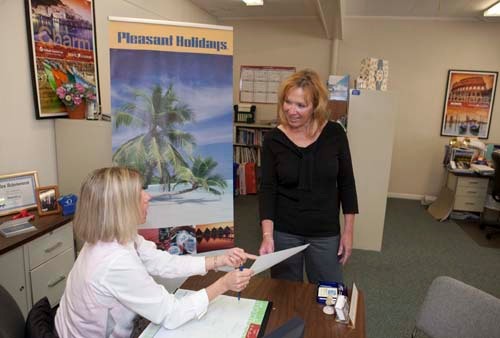
Donovan Travel owner Judy Clappin got what she wanted from the Senate Task Force on Small Business Growth and Development, with its recommendation to give preferences to Rhode Island small businesses in state contracting.
Brent Ryan, co-founder of Coastal Extreme Brewing Co. in Newport, is still waiting, however, for the more streamlined policy for regulatory filings he deals with each year.
Both testified before the Senate task force, which on March 11 released a list recommendations. While most small-business owners will find something to like in the proposals, the challenge now facing lawmakers is to transform them into action – and actual funding by the state to support the effort, says John Cronin, director of the Johnson & Wales University Small Business Development Center.
“Real progress was made,” Cronin said of the report. “The Senate task force has helped to motivate all of the players to help get us a more business-friendly regulatory system.”
The Senate task force’s recommendations include: Preferences to Rhode Island small businesses in state contracting; strengthen the voice of small business on the R.I. Economic Development Corporation; require state regulatory agencies to render regular written status reports on pending applications; fund the Web-based master application for forms needed to do business in the state to eliminate duplicative paperwork and standardize the application for the state fire code.
One of the recommendations in the plan is already under way, according to Chris Barnett, communications director for R.I. Secretary of State A. Ralph Mollis. Barnett said that there is now an online master application for small-business startup forms that enables applicants to enter data just once, no matter how many forms are required. It can be accessed through the Web site, www.sos.ri.gov.
But Greg Pare, a state Senate spokesman, said the Web site, which is focused on new businesses and the various forms that are needed to start a business in Rhode Island, “needs $250,000 in funding” in order for it to become fully operational.
House Speaker Gordon D. Fox said that the House is working collaboratively with the Senate on legislation to fund this proposal.
Fox cited the work of the recently created House Small Business Committee, which has already held hearings on four bills, with several more scheduled to be heard. Among the proposals to be discussed are ways to make more tax credits available to small businesses that create jobs, and ideas on how to make the state’s tax structure more small-business friendly.
While the goal is to cut the red tape that small businesses confront in Rhode Island, some who testified before the Senate panel are still waiting to see results. Ryan, co-founder of Coastal Extreme Brewing Co., told the task force when he testified on Sept. 29, 2009, that he wanted to see the state establish a policy in which all the regulatory filings for a business could be done at the same time, with a single renewal date each year.
“I’m not aware of any major change,” Ryan told PBN. He recently moved into this new manufacturing facility in the North End of Newport, where he brews about 4,000 barrels a year. “I just sent in my application for my $10 retail permit last week,” he explained, for the permit to sell his beer in a small retail store on site. “There is a ridiculous amount of little detail [like the retail permit] that small businesses have to deal with. What I was hoping for was the state to get rid of all these forms and combine them into one process,” he said. “It’s not about the amount of money. It’s about the amount of paperwork.”
Clappin, owner of Donovan Travel in East Greenwich and Newport, also testified at the Sept. 29, 2009, hearing. She told the task force that Rhode Island small businesses should be given preference for business over out-of-state contractors. In her testimony Clappin told how, despite submitting a lower bid for the state’s travel account, a bid from a company in Iowa had been chosen, at a higher price. The contract, worth $3 million, had been handled by her company for 14 years. When Clappin tried to find out what happened, no one from the state purchasing office would talk with her, and letters to the governor and lieutenant governor went unanswered, she said.
The loss of the contract hurt her business, she said, forcing her to put employees on a four-day workweek. “All my employees live, work and pay taxes in Rhode Island.”
Just as frustrating, Clappin continued, was the failure of the state to explain why her bid was rejected. “We couldn’t get anyone to respond.”
Upon learning that the task force had recommended following her advice to give preferences to local small businesses in state contracting, Clappin was thrilled. “That’s fabulous,” she said. “I was glad that I could testify and that somebody would listen to me. It was clear that people on the task force really cared.”
Ray Fogarty, the director of the Chafee Center for International Business at Bryant University, praised the task force for going out and holding field hearings. From his perspective, the state needed to broaden its horizon a bit and provide more help to Rhode Island small businesses to enable them to succeed in the global marketplace.
“For every $100,000 in export sales, a new job is created, at about 20 percent higher than the average wage,” he said. “We need to help small businesses identify opportunities to sell their products internationally.”
The Greater Providence Chamber of Commerce supports all of the task force’s recommendations, according to President Laurie White.
“This is the first time, in my memory, having been associated with the Chamber since 1989, that people are coming together and taking on the tough issues,” she said, praising the collaborative efforts of the Senate task force.
“If we as a community are going to get back into a hyper-growth mode, we can’t be stymied by paperwork and bureaucracy,” White continued. “The whole idea of creating a quick and easy and uniform and predictable process becomes absolutely urgent.” •