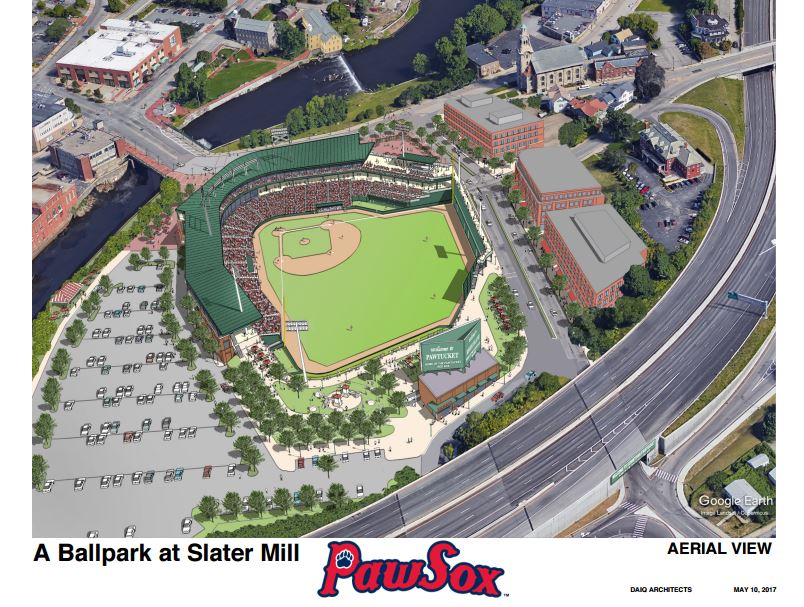
PROVIDENCE – Legislation was introduced to the General Assembly Tuesday by Sen. William J. Conley Jr., D-Pawtucket, that laid out plans for Pawtucket and Rhode Island to enter into a partnership with the Pawtucket Red Sox Baseball Club LLC to build a new stadium in downtown Pawtucket.
The proposal, while similar to Pawtucket Mayor Donald R. Grebien’s previous pitch to the General Assembly, has new protections for Rhode Island taxpayers, stating “none of the Series A, Series B or Series C bonds, nor the lease, nor the payment agreements shall constitute indebtedness of the State or any of its subdivisions.”
Rhode Island's Market Has Changed. Developers, Builders, Investors and Sellers Must Change With It.
By Emilio DiSpirito IV License Partner | Engel & Völkers Oceanside Leader | The DiSpirito…
Learn More
The section summons the memory of 38 Studios, in which the state had no such protections.
Commerce Secretary Stefan Pryor, in a letter to the General Assembly, explained the deal’s mitigation of economic risk for the state, backing the proposed legislation, “The city of Pawtucket and the PawSox organization, working with Commerce, have proposed a structure that’s fair – and even favorable – to the state,” said Pryor. “Here’s how: the state’s expenditure will, in effect, be paid for by those who visit and use this complex.”
Pryor said flatly that, “Not every stadium deal is a good deal for taxpayers, but this one is,” pointing to the PawSox ownership’s commitment to pay for construction cost overruns, effectively capping the state and taxpayers contribution to the project.
The legislation comes toward the end of the General Assembly session, and is not expected to come to a vote until fall, but appears to be timed to get the PawSox organization’s attention.
Grebien earlier this month voiced concerns that without action, the PawSox would leave the state. According to Grebien, the PawSox ownership group was only committed to Pawtucket until July 1.
Said Conley, “The Senate Committee on Finance stands ready to conduct intensive public hearings and receive testimony this fall from anyone wishing to register a position or provide input. We welcome broad participation from our constituents in these discussions to ensure that the voice of the people is heard.”
Breakdown:
Series A
- The proposal said the PawSox would contribute $45 million, with $12 million in up-front equity contributions. The remaining $33 million would be financed with a taxable lease revenue bond issued by the Pawtucket Redevelopment Agency, which the legislation designates as Series A funding. The Series A bond would be repaid with sublease rental payments to be funded from PawSox rents and annual naming rights.
Series B
- The Series B bond will entail $23 million from the state through the PRA, which will be refunded by state taxes, including taxes generated by ballpark users, visitors, the PawSox, ancillary development and a premium ticket surcharge.
Series C
- Series C will be funded by $15 million from Pawtucket through the PRA, which will be paid for by a levy of taxes: the real estate property tax, hotel tax, tangible asset tax, food and beverage tax revenue, and assessments generated in and around the Downtown Redevelopment project, other city revenues and state aid.
- Series C defines this state aid as money that is designated to replace the soon-to-be-repealed car excise tax, as well as funds from the state to restore blighted, poorly lit or ventilated areas, overcrowded areas, or unsafe areas. The legislation proposes that the General Assembly approve the use of such funds to go toward refunding the project.
The deal also includes some charity, as well. According to Pryor, “the Rhode Island-affiliated ownership of the PawSox have taken an unusual step to demonstrate their commitment to Pawtucket and to our state. Owners with Rhode Island ties have pledged no to derive proceeds from this deal for the first five years.” Instead he said, they will donate their profits to the PawSox Foundation, the Pawtucket Foundation or the Rhode Island Foundation.
These terms seemed satisfactory to the governors office. “Under the terms of the proposal, the state ultimately pays nothing for the new ballpark,” said Raimondo. “I support this version of the proposal because without it, Rhode Island could potentially lose hundreds of existing jobs and millions of dollars in existing revenue.”
Grebien, who was credited for working with the team on remastering his original proposal, also supported the financial engagement tweaks provided by the updated legislation. “The PawSox $45 million investment in Pawtucket will be the single largest private investment in our city’s history,” said Grebien. “This project also is entirely self-supporting from ballpark revenues and will not require any new or additional tax burdens to Rhode Island taxpayers. We cannot afford to miss this once-in-a-generation opportunity.”
“Over the last several weeks, Mayor Grebien has heard my concerns about the initial Slater Mill Ballpark proposal, which did not adequately protect state taxpayers. He and the team listened and they addressed those concerns,” said Raimondo.
The governor’s support could go a long way in the survival of the proposal. In May, House Speaker Nicholas A. Mattiello said he wouldn’t consider a bill unless it was introduced by Raimondo.
“I believe Mayor Grebien’s revised PawSox stadium proposal offers an exciting opportunity to create hundreds of new jobs, jump-start downtown development in Pawtucket and keep the PawSox in Rhode Island for new generations,” Raimondo said.
Chris Bergenheim is the PBN web editor.