WASHINGTON – U.S. personal consumption expenditures (PCE) fell 0.2 percent in March to $24.4 billion, after rising 0.3 percent in February, the U.S. Bureau of Economic Analysis reported today. The BEA cited spending on services, which fell 3 percent as home energy bills declined.
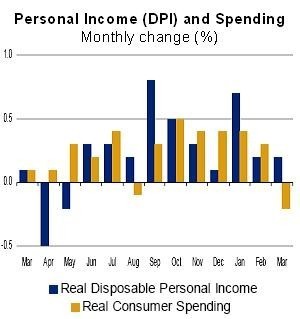
Real consumer spending – adjusted for price changes – increased 0.3 percent in March, after rising 0.2 percent in February, the BEA said. The increase lagged the 0.5-percent median forecast of economists surveyed by Bloomberg News.
The PCE price index rose 0.4 percent to 116.415 points (2000 = 100), matching February’s gain and doubling January’s 0.2-percent increase. The core index excluding food and energy – closely watched by the Federal Reserve Board – was 113.6 points, the same as in February, after rising every month since November.
Personal income from all sources increased 0.7 percent to $79.9 billion in March, matching February’s 0.7-percent increase. The Bloomberg survey had predicted a rise of 0.6 percent. Wages and salaries increased 0.7 percent after rising 0.5 percent in February.
Real personal disposable income – the after-tax income available for spending or saving, adjusted for price changes – rose 0.2 percent, the same as in February, to $65.5 billion.
Your Business Has Gone Global. Has Your Insurance?
A decade ago, “doing business internationally” was mostly a large-company concern. Today, a manufacturer in…
Learn More
The U.S. personal savings rate improved to negative 0.8 percent (-$79.3 billion) in March – from February’s negative 1.2 percent (-$118.8 billion) and the 12-month average of negative 1.3 percent – as consumers continued to borrow or draw down assets to spend more than they made.
There is “a bit more caution on the part of consumers,” Nigel Gault, chief U.S. economist at Global Insight Inc. in Lexington, Mass., told Bloomberg. “We’re coming off two very strong quarters of consumer spending, so you have to anticipate some slowdown.”
But federal policymakers have been counting on consumers to keep the economy going in the face of a troubled housing market and a manufacturing slump, Bloomberg said. Since the end of February, “generally positive” retail sales have helped balance “slow” manufacturing growth in most regions, the Fed said last week in its Beige Book report.
Additional information, including the 12-page Personal Income and Outlays news release, is available from the U.S. Department of Commerce’s Bureau of Economic Analysis at www.bea.gov.