Eric Hertfelder doesn’t have any delusions that everything at historic Fort Adams can be fixed in one massive multimillion-dollar restoration project.
The job would be just too big.
After all, the parade grounds inside the Newport fort’s thick stone walls are a sprawling 6 acres. Its structures, if laid out end to end, would stretch for a mile, and much of that mile desperately needs attention. The fort – built in the 19th century to guard Narragansett Bay’s East Passage and Newport Harbor from an invading navy – has been ravaged by time and Mother Nature.
“We know that to restore the entire fort would cost tens and tens and tens of millions of dollars, if not $100 million, because of its size and complexity,” said Hertfelder, executive director of the nonprofit Fort Adams Trust.
Instead, the trust is using a $125,000 federal grant, plus a matching $125,000 from an already approved state bond issue, to assemble a new master plan to determine which preservation projects should be attempted and in what order.
In the spring, Hertfelder’s group will issue a request for bids for a structural engineer to study the fort’s buildings. The trust is also looking to hire a landscape architect and a marketing and museum consultant.
“Then we will have excellent information on the condition of the fort, and the rough cost of different paths that we might take,” Hertfelder said.
Public charrettes are planned for the summer, and by the fall Hertfelder hopes to have a strategic master plan in hand, with some clear direction and estimated costs.
Stopping further deterioration will be a top priority of a new master plan, as well as making Fort Adams safer for visitors, Hertfelder said.
“We want to save as much of the fort as possible,” he said. “We want to open up as much of it as possible.”
Although Fort Adams has been owned and managed by the state since the Navy relinquished ownership in 1965, much of the property has been closed to the public, except for guided tours and special events, since then. The trust, formed in 1994, operates all educational and cultural activities and raises restoration money.
Many of the deteriorating areas of the fort are not stable enough to be opened to the public, but Hertfelder said he hopes that eventually visitors will be able to walk around on their own.
“Because most of it has been closed to the public since 1965, this is like a found park,” Hertfelder said recently. “It’s something that a lot of people have never seen before.”
Construction work on Fort Adams started in 1824 when the United States was a relatively young country still vulnerable to attack from the sea. The pentagonal fort, made of granite and shale, is the largest coast fortification in the nation and once housed 440 canons. Its guns were never tested in battle. In more recent times, Fort Adams has been the site for the Newport jazz and folk festivals.
“There are certain parts of the fort I would really like to see restored first because the are interesting and unique,” Hertfelder said recently. “But we have to have an open mind and allow the consultants to do their work, and find out what other people think.”
The trust has been through the process of assembling a master plan before, using one to undertake several large projects in recent years.
In 2003 and 2004, the trust renovated several casemates that once housed canons that poked out of openings in the walls. Some of those rooms are filled with exhibits from the Naval War College now.
In 2007, The Newport Collaborative Architects completed a $1.1 million restoration of another five casemates that served as officers’ quarters, making it possible for youth groups such as the Boy Scouts to stay overnight.
Another casemate was converted into a dining hall, where groups could cook food, and have classroom sessions.
Two years ago, Newport Collaborative also repaired the fort’s 8-foot-deep earthen roof that, despite a sublayer of lead flashing, had always leaked. Workers skimmed off 6 feet of the soil, installed a plastic membrane and replaced the soil and planted field grass.
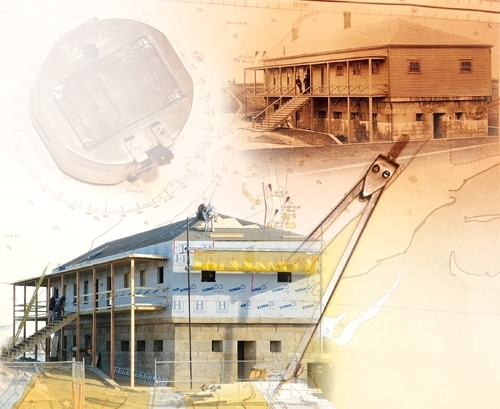
In the most recent project, workers are installing a second floor to the fort’s redoubt, a building that was intended to protect the complex’s main entrance.
Hertfelder said the original second story of the building, which doubled as a jail, blew off in a hurricane in the 1930s.
The work needed to stabilize the fort is daunting.
Masonry work through the complex is crumbling. Because of the fort’s location by the water, moisture is a constant problem. And vegetation has taken root on some rooftops, adding to the deterioration.
“It’s amazing that the fort is in as good a shape as it is, but it is deteriorating at a fairly rapid rate,” Hertfelder said.
The trust – which has an annual budget of $300,000 – has raised about $6 million for restoration work since 1994, and has spent most of it on various projects.
Earlier this month, the trust announced that it has established the Fort Adams Preservation Fund, a permanent endowment at the Rhode Island Foundation to help cover the cost of operating and maintaining the fort and surrounding property.
“With renovations come increased operating and maintenance costs,” said Larry Mouradjian, associate director of Natural Resources Management for the R.I. Department of Environmental Management (DEM). “This endowment will generate funds that in the long-term will support those increasing costs.”
Hertfelder acknowledged that fundraising will be difficult during the economic downturn. But, he added, that makes it a good time to focus on developing a master plan.
“It’s impossible to raise any money if you don’t know what you want to do with it,” Hertfelder said. •