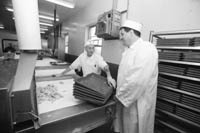
Willow Tree Poultry Farm’s history can be traced as far back as the turn of the 20th century when it was a small farm producing fresh poultry and eggs for the family and local trade. The name came from the willow trees that at one time dominated the property. The Attleboro company now employs about 100 people.
PBN: Tell us about the origins of the business.
CEKALA: My dad started with the business in 1954. At that time, it was pretty much a chicken-raising operation. He was fresh out of URI and he was raising chickens on his property. He needed a place to slaughter them. So he went to Frank Moses, the original owner, and asked if he could rent out space in the slaughterhouse so he could kill his chickens. And Frank realized my father was killing off more chickens than he was … so he said, ‘Why don’t you come work with me?’
ISO 9001:2026: A Practical Opportunity to Build for What’s Next
For Rhode Island manufacturers, ISO 9001 has been much more than a certificate on the…
Learn More
PBN: So it was a traditional chicken farm?
CEKALA We were a traditional broiler farm. There were chicken coops not only here, but down Oak Hill Avenue. I think he had 3,000 to 5,000 hens in rotation at a time. It was a busy place. And Frank Moses, before he passed away in the late 1950s, wanted to transfer ownership over to my dad. My dad took over the business. And in the 1960s, things changed in the area. Feed became very expensive.
PBN: The economy forced changes?
CEKALA: It really did. We were producing chicken pies for our retail store as a way to get rid of the overage of broilers you couldn’t sell. My father would cook them off and there was the little retail store up front. He would produce the chicken pies, chicken cacciatore, anything chicken-related. Joe Fernandes’ wife used to shop in here quite a bit. She was buying the chicken pies and one day, she said, ‘My husband should sell these in the supermarket.’ She told her husband and he eventually brought the pies into Fernandes Supermarkets. They had about 50 stores throughout this area.
PBN: So the chicken pies, in essence, became the business?
CEKALA: They did. The last chickens we would have raised here on-site would have been about 1974. And that was for retail-store use only. But after that, the chicken coops started coming down and the big brick buildings started going up for production and warehousing. The chicken pie business was our lifeblood until the mid-1980s. When I was a kid, we would only run a four-day operation here in the summertime. In the summer, no one wanted to heat up their ovens to cook a chicken pie. My father came up with the idea to work longer hours, four days a week and give everyone a three-day weekend. Well, that was great … but just coming out of college, I said: ‘Boy, we’re not producing anything on Mondays. We really should do something.’ We were selling chicken salad in the store – my father’s recipe. And people really liked it. I thought that maybe it would go well wholesale.
PBN: So in the beginning, your plans for chicken salad were more modest.
CEKALA: My intention was just to have the chicken salad to supplement the business during the summer months. For the first three or four years, I had a cooler in the back of my AMC Gremlin and used to deliver to the three stops that I had. But all of a sudden, in the late 1980s, it started catching on. RoJacks Supermarket picked us up. Almacs picked us up in some of its markets and by the early 1990s, in all of their markets.
PBN: What told you back then that it was going to work?
CEKALA: I was in the retail store one day, busy waiting on customers. A customer came in and asked me for a pound of Willow Tree. And I thought: ‘She’s not even asking for chicken salad. She’s asking for Willow Tree.’ That was pretty good brand identification. At that point, we probably had about 110 stops. Now, we have 1,000 independent stops.
PBN: And where are they?
CEKALA: Our primary market is Rhode Island. It has a lot of population, but it’s not Boston. We’re not fighting traffic going into Boston and we’re much closer to the Rhode Island border. So that’s really where the 1,000 independent accounts are.
PBN: Is there a point where you don’t want to reach out any farther?
CEKALA: No, actually we’re pushing. We’re pushing this year in the Cape Cod market. We’re there, in the Shaw’s and Stop & Shops, but not a lot of the independents.
PBN: You mention Shaw’s and Stop & Shop. Do your trucks deliver to those locations?
CEKALA: No, the only way we could deliver to them is through warehouse distribution. They want it to go through their warehouses. One of the big ones took us first, but when they heard our product was a no-preservative product and it only had at that time an eight-day shelf life, they backed off. They didn’t want the product. But their customers were asking for it. And in the Rhode Island market, they realized they had to get it because people were going down the street to the mom and pop deli instead of the supermarket. So they knew they had to find a way to bring it in. So they ended up putting our product through their perishable foods warehouse and it is treated almost as produce is treated.