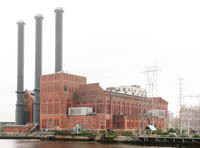
New Englanders have strongly resisted any attempts to build new power plants especially anything that is not gas-powered, according to local energy experts. Above, the Manchester Street Station in Providence.
The view from ISO New England Inc. was optimistic: “Despite high fuel prices and record-setting electricity use, the region’s competitive wholesale electricity markets performed well in 2005,” read a news release on the 2005 Annual Markets Report.
There were no blackouts or brownouts, and only three instances of “unusual power system conditions or contingencies” that required special measures. Plus, supply management became more elastic, allowing the region to save more than 66,000 megawatt-hours.
Selling Luxury Real Estate Requires More Than Exposure
By Emilio DiSpirito IV License Partner | Private Office Advisor Engel & Völkers Oceanside www.DiSpiritoteam.com…
Learn More
“Efficient markets should produce competitive prices that reflect underlying supply and demand conditions, support reliable operations and encourage appropriate long-term investment,” said Gordon van Welie, president and CEO of ISO, which operates the region’s bulk power system and wholesale electricity markets.
“Based on these and other factors,” he said, the markets “met the challenge.”
Well – not quite, Rhode Island’s energy czar and two consumer advocates said last week.
Yes, the lights stayed on, they noted, but the report also mentions, for example, that wholesale prices went up “by about $25 per megawatt-hour” last year due to the high cost of fossil fuels.
For context, that’s 2.5 cents per kilowatt-hour, or one-quarter of National Grid’s current Rhode Island “standard offer” rate. Two years ago, that rate was 5.9 cents; nine years ago, it was 2.8.
In Massachusetts, which abolished the price-controlled standard offer last year, National Grid customers who in April 2005 paid 6.3 cents/kWh saw the rate rise to 12.8 cents by January (it’s since dropped to 9.3). Some communities, such as Fitchburg, have seen even bigger jumps.
The ISO report puts “the best face on what’s proven to be a very difficult market for consumers,” said John Farley, executive director of The Energy Council-Rhode Island, an alliance of four dozen of the state’s largest commercial and institutional energy users.
“We don’t think the wholesale market is working,” said Andrew C. Dzykewicz, chief energy adviser to Gov. Donald L. Carcieri. “We’ve got pricing that’s gone absolutely berserk.”
Part of the problem, both Farley and Dzykewicz noted, is that New England relies far too heavily on natural gas to generate electricity – it’s used to produce 38 percent of the power, about twice the national average. The ISO itself raised concern about this issue.
“New England’s continued dependence on natural gas- and oil-fired resources makes the region’s wholesale electricity costs vulnerable to volatility in the prices of these fuels, as illustrated by the effects of tightening global energy markets and hurricane damage to fossil-fuel production facilities in the Gulf of Mexico.”
The problem, Farley and Dzykewicz said, is that New Englanders have strongly resisted any attempts to build new power plants, especially anything that’s not gas-powered.
Carcieri has set a goal of having 15 percent of Rhode Island’s electricity come from wind power, and it’s developing a site selection plan to try to avoid conflicts such as Cape Cod’s, but wind “is not a panacea,” Dzykewicz acknowledged.
Public resistance to new power plants isn’t the only problem, however, Farley and Dzykewicz said. In the decade that the market has been in place, smaller new entrants have been forced out of business or acquired by bigger players, they noted – to the point that to encourage new power plant construction, the ISO is now talking about a competitive grant offering.
“It’s an indication that the free market really isn’t working,” Farley said.
Then there are cost-of-service “reliability agreements,” which the ISO report says “increased significantly” in 2005. Under such agreements, plants that are deemed to be essential to keeping the lights on in a particular area are guaranteed they’ll be paid whatever it costs them to generate power – even if it’s substantially more than it costs their competitors.
Historically, Farley said, such agreements have been used in densely developed places such as Boston, but now they’re spreading, so now even a power plant in Cape Cod is subsidized. The higher-cost plants, in turn, raise the base line rate for everyone, Dzykewicz said, so not only are inefficient plants getting business, but less-costly plants rake in big profits.
“The problem with that is that the whole market is premised on competition,” Farley said, “but some risks that generators should be assuming, they’re being shielded from. To a large extent, the customer is not being adequately represented in how this market works.”
Matt Auten, an advocate with the R.I. Public Interest Research Group, is equally critical – both for consumers’ sake, and for the environment.
“The ISO should be at least as committed to conservation and efficiency as they are to building new capacity and spending resources on transmission capabilities,” he said, “but in reality the ISO seems much more committed to creating new markets that reward energy generators and increase transmission investments that are funded by rate-payers.”
(In fact, the ISO news release blames consumers, to some extent, for making it necessary to keep expanding peak capacity. It says that “few New England consumers have access to retail electric rates that reflect the dynamic nature of wholesale electricity prices,” so they don’t get “price signals to reduce energy consumption” when wholesale prices are higher.)
To be fair, Farley said, “it’s not entirely clear where [the ISO’s] job ends and what should be the responsibility of the states.” The ISO’s own take is that some areas of concern are “not likely to be addressed by wholesale market design alone.”
Dzykewicz said the states most certainly need to mobilize. “We’re trying to muster support from the rest of the New England states to actually take this on,” he said, “but unfortunately, all of the states have different goals” – Maine is talking about dropping out of the ISO, for example, while Massachusetts doesn’t seem to view the situation as a crisis.
In the meantime, the energy legislation approved by the Rhode Island Senate and now being considered by the House will make at least a small difference, Dzykewicz said, by extending the standard offer system, among other things. “That gives us some stability.”