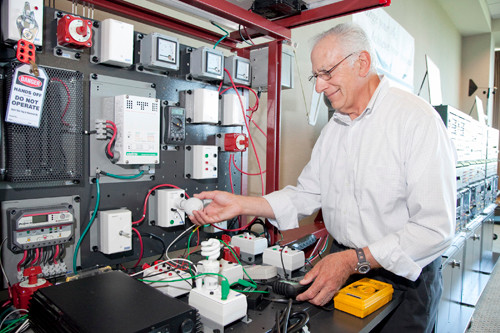
The average National Grid line worker is age 53, and he may have started his career when meter-reading tools were a pencil and notebook, computers were Paleolithic, and wind was for kites.
Adding to the time pressure of replacing this graying work force, National Grid puts new hires through a four-year apprenticeship before turning them loose in skilled jobs on utility lines and substations and electric grids.
The aging-out of these workers and the need to replace them with newcomers with very specific technical skills are two of the factors that drove a cooperative effort between National Grid and the Community College of Rhode Island to create a new, two-semester certificate program in energy utility technology.
In addition, National Grid continues to need more skilled electrical technicians because energy needs continue to grow, company officials say.
“If there are any job opportunities in the near future for people studying technology, this is it,” said Jerry Bernardini, chairman of the Engineering and Technology Department at CCRI.
At a cost of $3,800 in tuition for 27 credit hours over two semesters, students in the new program can ramp up their theoretical and technical knowledge to land them a job with National Grid or other utilities in positions like utility line technician, utility substation technician, and meter services specialist. Course work covers energy industry technology and operations, technical math, AC and DC circuits and controls, and computer applications.
Hourly pay in National Grid’s jobs can range from $18 for starting apprentices to $38 for a first-class lineman, said a National Grid spokesman.
Creation of the new certificate program, including teacher training, curriculum development, and sophisticated equipment, was funded with a $750,000 grant from the U.S. Department of Energy. The money was part of the nearly $100 million in grants to 54 smart-grid work force training programs across the United States that the federal energy department awarded in April.
For the past four years, National Grid has partnered with three community colleges in Massachusetts to present training similar to the new certification program at CCRI. Kevin Peltier, a manager in National Grid’s training program, said his company has hired about one-third of the people who finished the programs in the Massachusetts colleges.
People in work force training these days are cheering for industry-to-college partnerships that allow collaborators to assemble public money, buy equipment, train and pay teachers, and provide on-the-job experience. Lots of commentators have sounded alarms about the aging of the Ocean State population; the growing obsolescence of work force skills; and a disturbing disconnection between graduates’ skills and employers’ needs.
The program is “an excellent example of the public and private sectors collaborating to skill up workers,” said Laura Hart, an administrator with the state Department of Labor and Training.
At a mid-August open house at CCRI to promote the program, prospective students ranged from a youthful bartender to a grizzled manufacturing professional who was nearing the classic – if no longer relevant – retirement age.
Josh Pomplun, 26, a native of Minnesota who moved to Rhode Island and worked as a bartender before he was laid off, said he has a math background and a strong interest in renewable energy. With an undergraduate degree in physics and a basic understanding of how electricity works, Pomplun said, “I want to work in wind energy and wind farm projects.” He mentioned a number of places where wind energy is or will be harvested – like Minnesota’s “huge wind farms,” Long Island, New York and Cape Cod.
Another guest peering at large circuit boards and chatting up CCRI officials at the open house was Richard Bassett, 58. Bassett said he is now employed in manufacturing engineering technology, but he preferred not to name his present employer. He said at his workplace, “engineers come to me with questions about ways to do things.”
The problem is, he added, that his pay doesn’t match his skills. “I am looking to get paid for my abilities,” Bassett said. “You are in a company and you can prove yourself, but without that [degree or certificate], advancement is not possible.”
Rhode Island has a long way to go to upgrade its work force training, according to the April 2010 report of the CCRI 21st Century Workforce Commission. The report says, “Post-secondary occupational degree programs often lack strong mechanisms for building ongoing relationships with employers.”
Richard Coren, director of marketing for CCRI, said the new certificate program is “a perfect example of how business and higher education can partner to get students into courses with employment opportunities at the other end. If there were more of that, we would be doing a better job for students coming out of college. And there would less brain drain in Rhode Island. That would be huge.” •