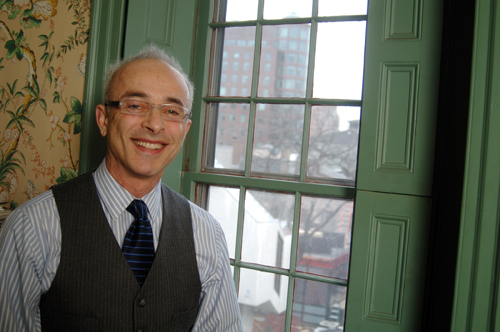
Before announcing his resignation in late November, Jack Gold for three years served as director of the Providence Preservation Society. Under his guidance, the society started a business-membership program, pushed for the revival of historic school buildings, furthered its positive public image – showing up at more community and public events than in the past – and streamlined its financial operations.
In January, Gold starts as executive director of San Francisco Architectural Heritage. Before his move to California, Providence Business News asked Gold for his thoughts about the past, present and future of architecture, design and heritage in the Ocean State’s capital.
PBN: What originally attracted you to Providence?
GOLD: I had done a couple of freelance projects in the 1980s, and I was struck by the Arcade and the quality of the downtown. I came up on the train and left the same day in 1989 and it just struck me as a cool, historic city. I’d really never spent any time in Rhode Island, other than at the shore, at Misquamicut in the summertime. So, I saw a posting in the Chronicle of Philanthropy and a few friends of mine said, “Jack, they’re looking for a convener, they’re looking for somebody to fund raise. You have all those skills.”
Selling Luxury Real Estate Requires More Than Exposure
By Emilio DiSpirito IV License Partner | Private Office Advisor Engel & Völkers Oceanside www.DiSpiritoteam.com…
Learn More
PBN: How have PPS operations changed since you arrived?
GOLD: It’s been a great stint. It’s been wonderful to see the organization grow … We now have a very large and committed board of trustees and I have just an incredible staff. One of the things we did was trim a full-time position and we’ve been operating with a half-time office manager. In doing that, we’ve been able to become solvent. PPS had been running deficits for several years and in addition had a very large credit line drawn. All those things have been eliminated. We’ve also added about almost $500,000 to our endowment – we’ve basically doubled it, so it’s over $1.1 million now.
PBN: How about community interaction?
GOLD: I think PPS had kind of drifted, lost the support of its base on Benefit Street and the East Side in general. … We organized a committee and convened a group, including RISD and neighbors, to fix up the Meeting Street steps. We got involved with the College Hill neighborhood graffiti problem, although that problem has not yet been solved. We’ve gotten involved with neighborhood groups on city schools and we’ve significantly increased our community presence by attending planning and zoning meetings.
PBN: What areas downtown have changed for the better during the past three years?
GOLD: When I came for the interviews in 2004, I was struck by those grassy canyons around the capital center, thinking, ‘Oh my God,’ these spaces are so desolate. I learned later that they were planned for development. I think – while not everyone is happy with the design of the GTECH building and the Intercontinental project – the infill of new construction, getting more density downtown, is important. Since I came in 2004, we have created a much more vital downtown, you can’t argue with that. Getting people to live downtown, creating a more livable downtown. We were supportive of the 110 Westminster project, because getting a high-rise condominium tower would increase the amount of people living downtown. Now, I understand it’s proposed as a hotel, but I hope that it’s built.
PBN: Are there any specific projects that are well-aligned with PPS goals?
GOLD: I think there’s been a lot of activity with new construction that’s really helped the vitality of downtown – the shops have opened up on Westminster Street. The role of nonprofits, especially AS220, not only with its original facility on Empire Street, but taking on the Dreyfus is really exciting, and I think it has national significance to see how an arts-based nonprofit can take on a development project like that. For not only a great restaurant, but live-work spaces for artists, it’s a wonderful project. And I think we’re probably going to see more from AS220 in that department.
PBN: What about the future?
GOLD: The waterfront is a big challenge. … I am supportive of the idea of a working waterfront and also the concept of public access to the waterfront. One of the things we had been very interested in is having a so-called “ribbon of connectivity” from Fox Point all the way across to Allens Avenue once the new highway is completed. I hope that happens. I think that Brown’s purchase of property in the Jewelry District was a great move. Ultimately that will spur investment from the private sector.
PBN: What other downtown locations are important for Providence’s revival?
GOLD: I’d like to see the Arcade revitalized. … They’ve always struggled to find what works there and I hope it can become a real vital space again. I’d like to see the train station fixed up.
PBN: What big changes does Providence need to make?
GOLD: I think that the idea of reconnecting Westminster Street to the West Side is really, really important and key to downtown. The city should spend more time in way-finding, so people can get from the West Side to the East Side easily. I live in the Armory District and the idea of taking a bus to the East Side, where I work, is out of the question because I’d have to get off at Kennedy Plaza and then walk – why wouldn’t I just walk from the Armory. •
interview
Interview: Jack Gold
POSITION: Executive Director, Providence Preservation Society, until Dec. 20. Soon to become executive director, San Francisco Architectural Heritage.
BACKGROUND: A Brattleboro, Vt., Gold was a program director for Connecticut Trust for Historic Preservation in New Haven during the early 1980s. He then worked as a publicist for architects Cesar Pelli & Associates. And, before coming to Providence, he worked in the fund-raising departments of Habitat for Humanity and Yale School of Forestry & Environmental Studies.
EDUCATION: B.A. in sociology, 1973, University of New Hampshire; M.A. in architectural history and preservation planning, 1978, Cornell University; courses at the Yale School of Management.
RESIDENCE: Armory District, Providence
AGE: 56