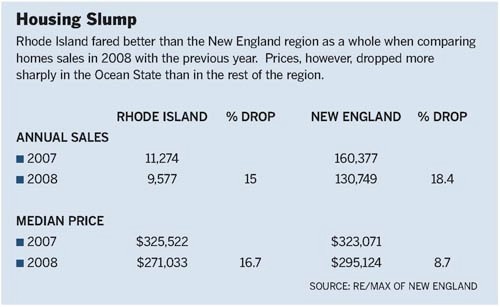
While single-family home sales in Rhode Island last year fell by 15 percent, New England sales fell even more, by 18.4 percent year-over-year, according to a report compiled by RE/MAX of New England and released early this month.
The 9,577 single-family homes sold in the Ocean State in 2008 accounted for an almost 1,700 drop from the 11,274 sold the year before.
Of the New England states, only Massachusetts’ annual sales fell a lesser percentage than Rhode Island. There, sales fell 13 percent last year. In Massachusetts, home sales near Boston and on rail lines have been the least impacted, Massachusetts Association of Realtors President Gary Rogers said in the report.
Connecticut led the region, with a 25.3 percent drop in annual sales.
And although the drop in home sales wasn’t as steep in Rhode Island as much of the rest of New England, the year-end median sale price in Rhode Island fell by a greater percentage than New England’s median price.
While Rhode Island started out the year with a higher median price than New England as a whole, the price here fell 16.7 percent – compared to New England’s 8.7 percent drop – and the Ocean State closed the year with a median price below the average for the region.
Rhode Island median prices fell $54,489 – from $325,522 in 2007 to $271,033 last year – prices throughout the region only fell $27,947, to $295,124.
RE/MAX of New England Regional Director Jay Hummer, who oversees 275 offices, attributed the higher percentage drop in Rhode Island to the state’s population density and urban foreclosure rates.
In Rhode Island, about 27 percent of single-family home sales were foreclosures or short sales. During the first half of the year, 1.2 percent of Rhode Island homes entered foreclosure, slightly higher than the 1.1 percent national average.
But, Hummer said, there are towns in Rhode Island this year that were not hit as hard by the crisis.
“You also have cities that didn’t really see a great drop in home prices – Exeter, Charlestown, Narragansett, Barrington, Warren and the East Side of Providence,” he said. “That’s a result of – they probably didn’t have many foreclosures.”
Looking forward, Hummer anticipates that some aspects of the market will improve in 2009.
“We’re expecting modest gains, in terms of units sold,” he said. “But we really don’t expect any pricing gains at all and that’s a result of that foreclosure action still taking place.”
Toward the end of 2008, Hummer saw an increase in real estate investment.
“We saw a great return of investors,” he said. “I think you can probably say that happened from two reasons: the stock market became more difficult … and, probably most important, they saw great value in the pricing that had occurred as a result of those foreclosure activities.”
He expects more investors to buy this year.
In the Jan. 8 report, Rhode Island Association of Realtors immediate past President Rob Scaralia said once those distressed properties are sold “we’ll come back to a healthier market.”
Hummer also has high hopes for first-time homebuyers pushing sales up early this year.
One of the main reasons, he said, is the federal first-time homebuyer $7,500 tax credit, good for anyone who has not purchased a home in the last three years. That’s due to expire in June, but the National Association of Realtors has been pushing for the U.S. Congress to extend the program and increase it to all buyers.
“With so many reasons, including the near-historic lows of interest rates and values of the properties that are out there, we expect the market to maybe have some modest gains in 2009,” he said. “We expect that in all of New England, with the majority of activity likely taking place in the second half of the year.”
A new presidential administration might also give a boost to homebuyer confidence, he said. •