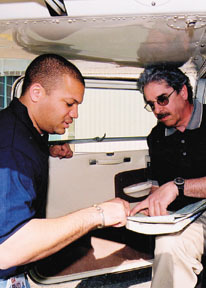
plans with flight instructor Scott McCoy.
Travel headaches prompt executives to become pilots
Alfred J. Mello Jr. can see it now. He’ll drive to T.F. Green Airport for one of his usual business trips to Pennsylvania or New York. There will be no line snaking through the terminal, inching towards bag-check. Jumbo jets won’t be backed up on the runway like cattle in a chute. Mello will simply walk up to his airplane, get in and take off.
Mello, 52, routinely travels up to 400 miles to visit his customers for his consulting and sales business in the heavy construction industry. Like all business travelers, he’s intimately familiar with the headaches associated with commercial flying, the waits, particularly since Sept. 11.
For Leaders Who Don't Have Time to Get Sick
Top performers guard their calendars, delegate relentlessly and optimize every hour of the day. Health,…
Learn More
Now, Mello, who lives and works in Barrington, believes he’s found a way to eliminate the headaches. He earned a private pilot’s license in March, and plans to get his instrument rating. Once that’s done, Mello plans to rent a private jet and fly himself to his construction and oil company clients throughout the Northeast, whenever the occasion arises.
The number of business people learning to fly has been increasing steadily, as people grow increasingly frustrated with commercial air travel and all the hassle and delays that go with it, and become more aware that earning their own private pilot’s license is an affordable, realistic option.
The Federal Aviation Administration projects the number of private pilots to increase to 264,000 next year. Among those becoming new pilots will be business people who see an airplane as a business tool, as an airline system in dire straits, unprecedented delays at the gate, a post-Sept. 11 commercial flight climate of new restrictions, cutting frequency to save money.
Between February 2001 and April 2002, the National Business Aviation Association reported that members flying themselves for business increased 6 percent from 1,456 to 1,550.
“Since Sept. 11, we’ve seen an increased interest in learning to fly, much of that from people who want to use an aircraft for business travel. We’ve also heard from many members who say they are using their personal aircraft more now for business travel to avoid increased delays and restrictions encountered when flying the airlines,” said Warren Morningstar, vice president of communications for the Aircraft Owners and Pilots Association.
Mello, who trains at Rhode Island State Flying School at T.F. Green Airport, said he can’t wait to turn daylong business trips into two-hour excursions. And because his business flights and possibly even his training costs will be tax deductible, earning a private pilot’s license for business travel is also a way for Mello to finance a personal dream.
“I do a lot of flying and quite a bit of driving. That was a main consideration. But also I’ve wanted to fly since I was about 5 years old. Then I finished paying for the kids’ college tuition, and I took a look into getting my pilot’s license. And because I can use it for business, it helps justify the expense. In fact it turns out I could write it off. So it’s also fulfilling a more personal dream,” said Mello.
In fact, earning a private pilot’s license and renting a two-person airplane for business trips is not as expensive as one might expect, and middle-class Americans constitute the vast majority of private pilots.
On average, it costs between $3,000 and $7,000 to earn a private pilot license, depending on the student’s frequency of training and local costs. The average student can fly solo after just 12 to 14 hours of training, costing as little as $1,000, according to Be A Pilot, a non-profit organization supported by more than 60 aviation companies and organizations dedicated to educating the public about the benefits of learning how to fly.
Thirty-three percent of all private pilots reported household income of less than $50,000, 23 percent earn $50,000 to $75,000, and 16 percent earn $75,000 to $100,000, according to Be A Pilot.
Mello said he pays approximately $80 an hour to rent a plane, but the prices can vary dramatically.
Phil Lizotte, a partner and vice president of sales for the glazing contractor Fenestration Architectural Products in East Providence, prefers flying himself to job sites that aren’t served by commercial airlines.
Lizotte earned a license in 1995, and later earned multi-engine and instrument ratings. Now he owns a Piper Twin Comanche and commutes between his office and home in South Hadley, Mass., flying out of Northampton Airport. He also flies himself to visit manufacturers all over New England, as well as Pittsburgh and Toronto.
He said he prefers flying to driving for the convenience, time benefit and for the therapeutic effect flying delivers.
Mike Brouillard, 49, owner and president of Interior Creations Inc., a commercial floor covering company in Woonsocket, earned his private license in January, 2002 after taking the Be A Pilot introduction flight lesson at Skylanes Aviation in Lincoln.
Brouillard, who lives in Woonsocket, said he wants to get his instrument rating
and anticipates occasionally flying to job sites in Block Island and southern
New Hampshire. He said he has been interested in flying since he was a kid,
and was inspired to take lessons after seeing a commercial for Be A Pilot.
For the complete current issue, visit our subscription Web site, or call (401) 273-2201, ext. 227 or 234.