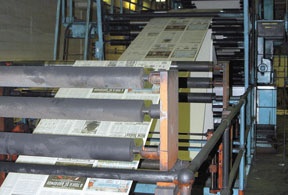
the newspaper's plant in Fairhaven.
A higher percentage of people read newspapers on a daily basis in the Providence-New Bedford area than anywhere else in America, according to a survey conducted last fall, making this region the No. 1 newspaper market in the nation.
More than 67 percent of all adults in the Providence-New Bedford area read a newspaper every weekday – more than in any other newspaper market, according to Scarborough Research, a prominent research firm for the newspaper industry. Each Sunday, 76.4 percent of adults in the Providence-New Bedford area read a Sunday newspaper – again, tops among all markets in the nation.
In fact, the Providence-New Bedford market has been among the top newspaper markets in the nation for many years – in an identical survey published earlier this year, the Providence-New Bedford market tied for first place with Hartford-New Haven for daily newspaper readership and ranked third for Sunday readership.
Cybersecurity Awareness Month: What to Do When Your Identity Is Stolen
In recognition of Cybersecurity Awareness Month, it is important to remember that identity theft affects…
Learn More
But in the past year, Providence and New Bedford rose in the rankings to hit number one in all newspaper readership categories – dwarfing bigger urban markets that are centers of the media landscape in the United States, including New York City, Los Angeles, Boston and Chicago.
That may surprise some people not familiar with the workings of the newspaper industry. But in fact, Providence and New Bedford are tops in the newspaper world precisely because they are smaller, more parochial cities that aren’t national hubs for TV news and other media, according to John Murray, vice president of circulation markets for the Newspaper Association of America.
Providence and New Bedford have all three key ingredients that create a regional “newspaper readership habit,” in which a majority of adults read newspapers every day, said Murray: 1) A population dominated by people who have grown up in the area and plan to stay; 2) A population with a higher than average level of education; 3) An availability of good hometown newspapers with a long history of covering local news and providing local advertising.
“This marketplace … has an abundance of long-term householders deeply interested in local news and local advertising,” said Bill Kennedy, publisher of The Standard-Times in New Bedford, that city’s only daily newspaper. “And New Bedford is served by broadcast TV in Providence, but the coverage is not concentrated in New Bedford, so here again, newspapers have a particular advantage. Another factor is there’s a correlation between newspaper readers and age, and Providence and New Bedford are on the high side in terms of average age.”
This daily appetite for newspapers tells advertisers that newspapers are delivering the readers they crave, particularly in a bad economic climate. In fact, the down economy has made newspaper advertising more appealing than advertising on TV or radio, which cost more money and don’t reach as broad a base of consumers on a daily basis. In the past year, anecdotal evidence shows newspaper advertising growing in the region while TV and radio advertising has stayed flat or dipped, said three local industry experts.
“Even during these serious economic times – clearly folks are nervous, there have been a lot of bumps in the road – our media placement service (for advertisers) continues to grow. Especially in the areas of southeast Mpassachusetts and metropolitan Rhode Island – that’s been a very desirous area in terms of advertising,” said Brenda Reed, executive director of the New England Press Association.
Aware that advertisers jump on board when a newspaper’s circulation number goes up, newspapers here and across the nation are finding new ways to gain and retain subscribers. In particular, online circulation programs are becoming one of the fastest-growing sources of new subscriptions, according to the NAA.
And don’t think the local newspapers don’t crunch their circulation and market penetration numbers to make themselves as attractive as possible to potential advertisers. For example, the The Providence Journal regularly updates a 22-page report on its Web site that analyzes the newspaper’s market reach, based on the Scarborough Research industry reports.
“In terms of the competitive media scope, advertisers want to know, ‘Where am I going to get the biggest bang for my buck?’ The first question any advertiser asks us is, ‘What’s your reach, how many people am I going to reach.’ So yes, these circulation numbers are important,” said Barbara Nauman, director of promotions for The Providence Journal. “We show them the numbers and tell them, a single advertisement in the Providence Journal reaches more people than an advertisement on nine morning or evening news spots.”
Even in New Bedford, where the local economy has been harder hit and slower to recover in the past couple of years, advertising in the Standard-Times has held its own, said Kennedy.
Kennedy would not discuss the newspaper’s ad business in detail. But, he said, “It’s hard to measure that and I think it’s fair to say New Bedford isn’t a robust economic market.
But in terms of market share, this newspaper outperforms other newspapers in our ownership group in our ability to capture advertising dollars spent in the marketplace.”
For the complete current issue, visit our subscription Web site, or call (401) 273-2201, ext. 227 or 234.