Fall River and New Bedford are working on plans to expand waterfront development in anticipation of the South Coast Rail project, which would bring commuter rail from Boston to both communities and spur economic development in an often-overlooked area of Massachusetts.
Gov. Deval L. Patrick revealed at a recent legislative luncheon that he intends to see if federal funding could be obtained sooner than originally planned, a move that could see the Massachusetts Bay Transit Authority (MBTA) lines in place before 2016, the earliest completion date now identified for the $1.4 billion to $2 billion project.
Patrick was the keynote speaker at the 2009 South Coast Legislative Luncheon April 16, sponsored by the Fall River Chamber of Commerce and the New Bedford Chamber of Commerce. Approximately 300 lawmakers and business leaders attended the event at White’s of Westport.
Patrick told the audience that, unlike some other governors who have preceded him, he cares about the South Coast. “I still have my eye on the South Coast,” he said. “I know that in the past you’ve felt that state government stops at [Interstate] 495. But this administration pays attention to you, and I hope you know that.”
Indeed, Patrick’s appearance at the luncheon marked the second time in as many days that he was in the area. The day before in New Bedford he announced $25 million to $35 million in increased funding from the federal recovery act for cleanup of the New Bedford Harbor Superfund site.
Regarding the South Coast Rail project, Patrick departed from his prepared speech to reveal that he trying to see if he can obtain federal funding for it “sooner than thought. There will be more news on that when we have it,” he said.
Later, during an impromptu news conference, the governor was asked to elaborate on the push for faster funding. He at first declined, but then said he intends to meet with U.S. Reps. Barney Frank, D-Fall River, and James McGovern, D-Worcester, to see “whether there is a strategy and what that strategy is to try to get federal support” to make the rail project “a reality sooner rather than later.” There are funds for rail projects in the federal stimulus package, but he said they are competitive and he expects Amtrak to get most of them.
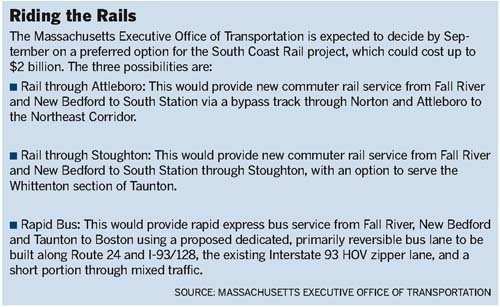
The Attleboro alternative would run track through Mansfield, Norton and Taunton at a cost of more than $2 billion and a projected startup date of 2020, state officials have said. Although the Massachusetts Executive Office of Transportation (EOT) had rejected this route several years ago, a later study of projected ridership for this option was higher than expected and the state Executive Office of Environmental Affairs selected it for further study.
The Stoughton alternative would extend service through the Stoughton line through Easton, Raynham and Taunton. Cost is expected to be $1.4 billion with a startup date of 2016. Both diesel and electric power will be considered for the rail routes.
A third option involves no rail at all. The rapid bus alternative would use dedicated lanes along Routes 24, 128 and 93, and would be the least expensive at $500 million, with a starting date projected sometime before the Stoughton alternative’s 2016 target. It would offer the shortest commuting time at 62 minutes from Boston to Fall River and 68 minutes to New Bedford.
A preferred route will be announced around Labor Day, officials have said, when the draft environmental impact report will be completed. Final selection is scheduled for spring of 2010 when the final environmental review is finished.
Train stations to serve commuters, as well as tourist drop-off stations that would not have a lot of parking, would be established in Fall River and New Bedford. The drop-off stations would be at Battleship Cove in Fall River and at the state pier near the whaling museum in New Bedford.
Fall River Mayor Robert Correia told Providence Business News that his city is working on plans with federal and state officials to open up the waterfront for development. A key component would be the lowering of Route 79 to waterfront level and its conversion into a boulevard “to reconnect the city and the rail to the waterfront,” he said. About 10 acres would be opened for development. Correia said he definitely wants to see commercial development there, but does not favor industrial use.
“It would help reshape the South Coast, and that’s why we so badly want to see the rail built,” said Robert A. Mellion, president of the Fall River Chamber. “It makes no sense that it doesn’t already exist in the 21st century.”
His counterpart, Roy Nascimento, who is president of the New Bedford Chamber, said a rail stop has been proposed downtown near the visitor center and waterfront. “Traditionally, whenever you have commuter rail, there tends to be development around it, and that’s why the business community is so supportive of it,” he said.
Expanded waterfront development is now being studied as part of the city’s master planning process and would be tied into the city’s ongoing plans for harbor improvements, Nascimento said. The renovation of nearby mill buildings and construction of a hotel along the waterfront are key elements of the plan, although Nascimento said the hotel will be built with or without expanded rail service. •